
Why Your Dachshund Yelps When You Pick Them Up (and What to Do Right Now)

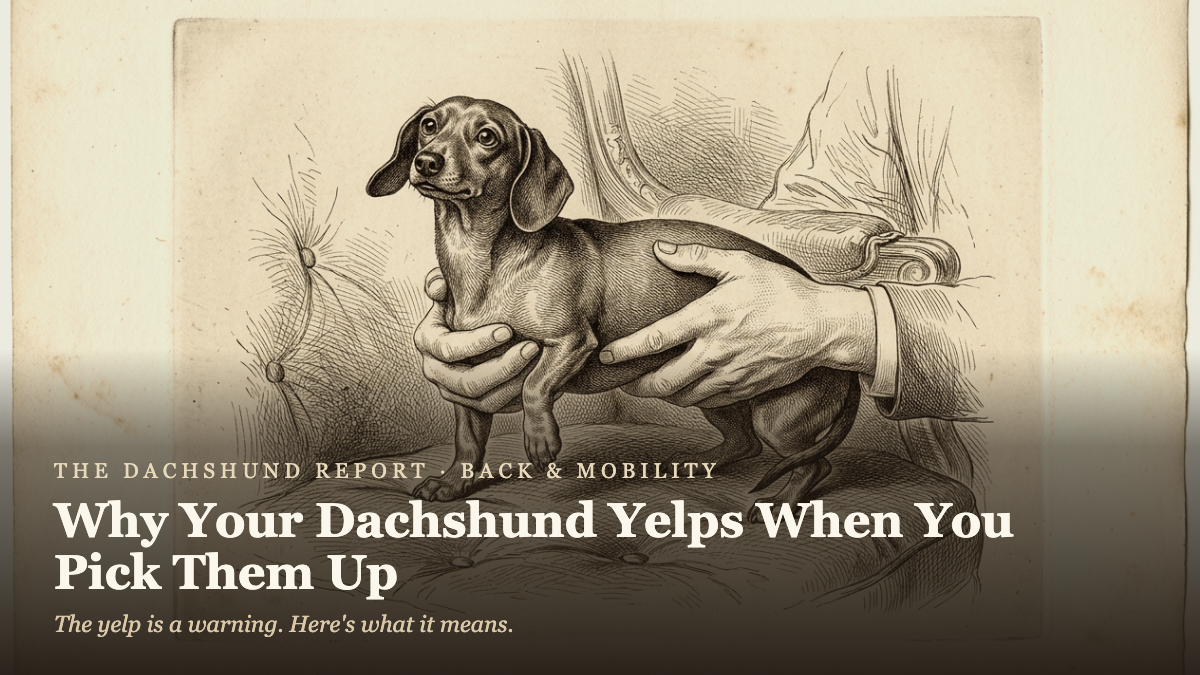
A dachshund that yelps when picked up is usually telling you something hurts — and in a breed where 1 in 4 will face disc disease, that yelp deserves a same-day vet call. Most yelping dachshunds can still walk and are at the earliest, most treatable stage — but IVDD can progress from pain to paralysis within hours, so waiting to "see if it goes away" is a gamble you don't want to take.
You know the moment.
You reach down to pick up your doxie the same way you've done a thousand times — one hand under the chest, lift — and they scream.
Not a whine. Not a grumble. A yelp. The kind that stops your heart for a second.
And then they look at you like you just betrayed them.
So you put them down. They walk around. They seem... fine? Maybe a little stiff. Maybe a little quiet. And you stand there Googling "dachshund yelps when picked up" at 11 pm while they stare at you from their blanket like nothing happened.
I know that moment. Every dachshund person does.
Here's what you need to know — tonight.
Why does my dachshund yelp when I pick them up?
The most common reason is pain. And in a dachshund, the most likely source of that pain is the spine.
Dachshunds account for 40 to 75% of all intervertebral disc disease (IVDD) cases in dogs, according to the American College of Veterinary Surgeons. Their relative risk is 10-12 times higher than other breeds. The disc degeneration that causes it can start as early as 4 months of age.
When you pick up a dachshund without properly supporting their rear end, the spine flexes. If there's an inflamed, bulging, or ruptured disc in there, even that small movement shifts disc material against the spinal cord.
The yelp is involuntary. They're not being dramatic. Something genuinely hurt.
About 80% of IVDD cases in dachshunds happen between ages 3 and 7 — so if your doxie is in that window, your radar should be on.
But here's the thing people miss: it isn't always the back.
Is it always IVDD?
No. And this is where it gets tricky.
About 65% of disc problems are in the thoracolumbar region — the mid-to-lower back. But roughly 15-18% occur in the neck. A dachshund with a cervical disc problem might yelp when picked up, hold their head low, resist turning their neck, or develop muscle spasms across the head, neck, and shoulders.
And then there's the diagnostic trap nobody talks about.
Back pain in dachshunds often causes referred pain to the abdomen — a rock-hard, painful belly that looks exactly like a stomach problem. Dr. Andrew Spanner (BVSc(Hons) MVetStud) puts it plainly: "The clue is that dogs with spinal pain usually eat normally, as miserable and lethargic as they are. Dogs with abdominal pain are usually off their food."
That one sentence could save you a misdiagnosis.
Other things that can cause yelping when picked up: muscle strain, pancreatitis (dachshunds are predisposed), ear infections, anxiety, or even surprise — especially in senior dogs whose hearing or vision has faded.
But in a dachshund? You assume it's the back until proven otherwise. That's not being paranoid. That's being a doxie parent.
The grading scale every dachshund owner should know
When vets assess IVDD, they use a 5-grade scale developed by Dr. Marianne Dorn (BVM&S PGCert SART MRCVS):
Grade 1: Walking normally but painful. Yelps, hunches, resists movement. This is probably where your dachshund is right now.
Grade 2: Walking but weak and wobbly. Might knuckle over on back paws.
Grade 3: Can't walk or stand unassisted. Still has some sensation.
Grade 4: No voluntary limb movement. May lose bladder control.
Grade 5: Loss of deep pain sensation. Paralysis.
Here's why this matters: a Grade 1 dachshund — walking fine, just yelping — has a 70-100% chance of recovery with conservative treatment. Grade 5? About 30% without surgery.
And Grade 1 can become Grade 5 within hours.
That yelp you just heard? It's not the emergency. It's the warning before the emergency. And the warning is a gift — because catching it at Grade 1 means catching it when the odds are on your side.
How do I know if it's an emergency?
Here's the decision tree. Print this.
Drop everything and go NOW (emergency vet, tonight):
- Your dachshund can't walk or stand
- They're dragging their hind legs
- They've lost bladder or bowel control
- They're suddenly paralyzed
- You pinch their back toes and get zero response — no flinch, no turn, nothing
See your vet same-day (not tonight, but first thing tomorrow):
- They yelped when picked up but are walking fine
- They have a hunched back or tense belly
- They're reluctant to jump, move, or climb stairs
- They're shaking or trembling with no obvious cause
- They've yelped more than once in the past few days
Monitor closely (vet if it continues 24-48 hours):
- A single yelp during an awkward pickup, acting completely normal after
- No change in appetite, movement, or energy
- No stiffness, hunching, or reluctance
One yelp with totally normal behavior after? Could be nothing. But if you're reading this article at midnight, it probably wasn't nothing. Trust that instinct.
The misdiagnosis problem
Here's a fact that should make every dachshund owner uncomfortable.
In a survey of dachshund owners conducted by Dachshund Health UK, only half of IVDD cases were correctly diagnosed by the general practice vet on first presentation. A quarter of vets incorrectly diagnosed the problem as muscle pain, arthritis, or a stomach issue.
That matters because early treatment matters. The difference between Grade 1 and Grade 3 is the difference between crate rest and potential surgery. And you don't get that time back.
If your vet says "muscle strain" and your dachshund is between 3 and 7 years old, ask the question: "Could this be a disc problem?" Push for a proper neurological exam. Ask about X-rays — and know that X-rays can't definitively diagnose IVDD because they don't show the spinal cord. MRI is the gold standard.
You're not being difficult. You're being a responsible doxie parent who knows the breed statistics.
What to do tonight
While you wait for the vet appointment:
1. Restrict movement immediately.
No jumping. No stairs. No couch launching. If you have a crate, use it — not as punishment, but as spinal rest. A 36-inch crate is the standard recommendation. If you don't have one, confine them to one small room.
2. Pick them up the right way — every time.
One hand under the chest, the other under the rump. Lift slowly, keeping the body level like a tray. Never let the spine bend or twist. Lower them the same way — slow, level, gentle.
DISA (Dachshund IVDD Support Australia) warns directly: "Don't ignore any signs of distress from the dog, particularly if it yelps when picking up. This is often a sign of an impending IVDD episode."
3. Don't give human painkillers.
Ibuprofen and acetaminophen are toxic to dogs. If you have leftover Rimadyl or gabapentin from a previous vet visit, call your vet before giving anything.
4. Watch for escalation.
The 8 early signs of back pain in dachshunds are subtle — a skipped jump, a hunch, trembling, a tense belly. If the yelping was the first sign, there will often be others. Know what to watch for tonight.
Why the right pickup matters more than you think
I wrote a whole article about how to pick up a dachshund because most people do it wrong. The "under the armpits" lift that works fine for other breeds is a spinal risk for dachshunds — it lets the back half dangle and the spine flex under its own weight.
The level lift — chest and rump, spine straight — isn't just good practice. For a doxie with an angry disc, it might be the difference between a yelp and a trip to the emergency vet.
Teach every person who handles your dachshund. Your partner. Your kids. Your dog sitter. The friend who visits and scoops your doxie up like a football because they don't know any better.
This is a two-hands dog. Always.
Can I prevent this from happening?
I'm going to be honest with you, because that's what this site does.
You can't prevent IVDD. The gene mutation (CDDY) that causes premature disc degeneration is what makes a dachshund a dachshund — the long body, the short legs, the 400 years of badger-hunting engineering. You can't breed it out without breeding out the breed.
But the research does show that lifestyle choices affect the odds. The DachsLife 2015 study — 2,031 dachshunds — found that active dogs who exercised more than 30 minutes a day had roughly half the IVDD risk of couch-only dogs. Overweight dachshunds are at higher risk. Ramps instead of jumps, a proper harness instead of a collar, weight management, and regular exercise don't guarantee anything — but they shift the odds.
The single biggest thing you can do? Know the signs. Catch it at Grade 1. Get to the vet fast.
You're already doing that. You're reading this.
Free: The Dachshund Back Handbook
I put everything we know about keeping these long little backs strong into one free guide — the 8 early warning signs, the furniture setup, the weight math, how to pick up a doxie the right way, and the exact checklist I'd bring to a vet visit.
It's free, it's short, and it might be the most useful thing you ever read about your wiener dog.
Grab the free Back Handbook here
(Educational only — not veterinary advice. When in doubt, call your vet. Always call your vet.)
FAQ
Should I take my dachshund to the vet for one yelp?
If the yelp happened during pickup and your dog is acting completely normal afterward — eating, walking, jumping, no stiffness — a single yelp may have been an awkward position or a momentary twinge. Monitor closely for 24-48 hours. But if there's any stiffness, hunching, reluctance to move, or a second yelp, call your vet same-day. In a breed with 1-in-4 lifetime IVDD risk, it's always better to be the owner who overreacted than the one who waited too long.
How fast can IVDD progress in dachshunds?
A dachshund can go from pain only (Grade 1) to weakness and wobbling (Grade 2-3) to paralysis (Grade 4-5) within hours. This is why veterinary neurologists emphasize early intervention — catching IVDD at Grade 1, when the dog is still walking normally, gives 70-100% recovery odds with conservative treatment. The window is real.
Can a dachshund yelp from something other than IVDD?
Yes. Muscle strain, pancreatitis (dachshunds are predisposed), cervical disc problems in the neck, ear infections, abdominal pain, anxiety, or surprise can all cause yelping. But in a breed with the highest disc disease rate of any dog, back problems should be the first thing you rule out — not the last.
What will the vet do if my dachshund yelps when picked up?
Your vet will likely perform a neurological exam: palpating along the spine for pain response, testing range of motion in the neck, checking proprioception (whether your dog can feel and correct the position of their paws), and assessing gait. X-rays may be taken but cannot definitively diagnose IVDD — MRI is the gold standard for confirming spinal cord compression.
Is shaking a sign of back pain in dachshunds?
It can be. Trembling or shaking is a common pain response in dachshunds with disc problems, alongside hunching, yelping, and a tense abdomen. If your dachshund is shaking and also yelping, that combination warrants a same-day vet call. Cold, excitement, and anxiety can also cause shaking — but in a dachshund, you want to rule out the back first.



