Dachshund IVDD Crate Rest: The Non-Surgical Recovery Guide

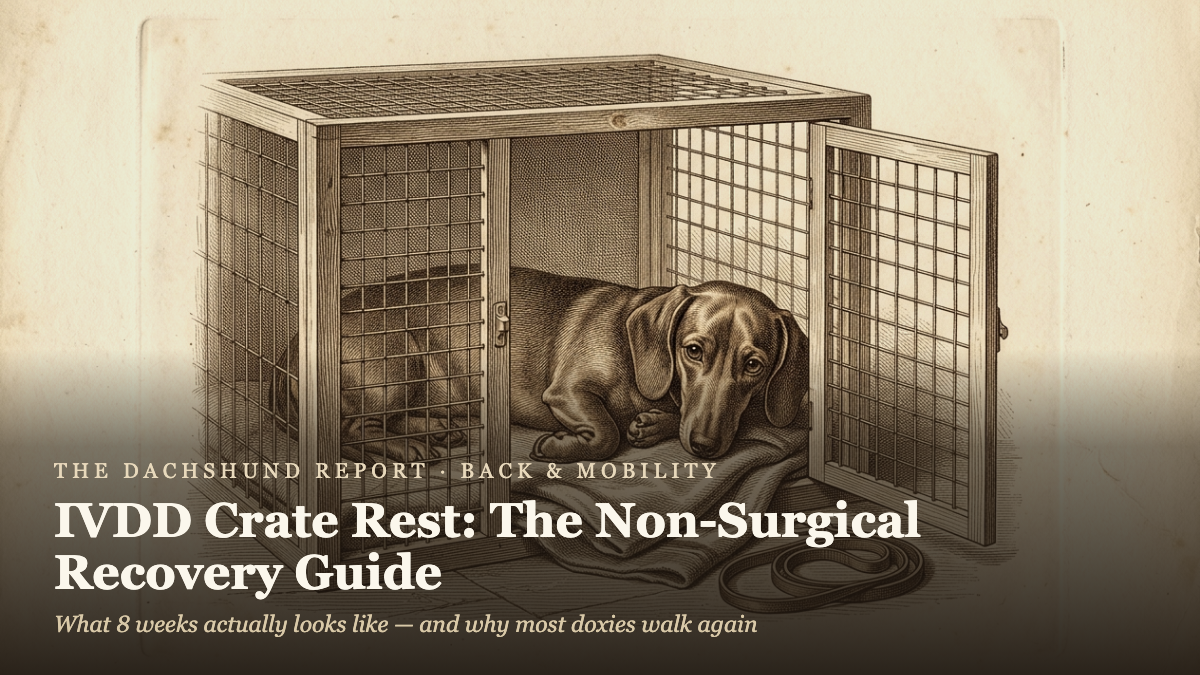
Most dachshunds with IVDD recover without surgery — up to 85% achieve functional recovery with conservative treatment when it's done right. "Done right" means strict crate rest for 6-8 weeks, the correct medications, and the hardest part: watching your wiener dog stare at you from inside a crate while you try not to cry into your coffee.
Nobody Googles "dachshund crate rest" on a good day.
If you're reading this, something happened. Maybe your doxie yelped getting off the couch. Maybe the back legs went wobbly overnight. Maybe you just left the vet with a piece of paper that says "IVDD" and "strict cage rest" and a dog who has no idea their life is about to get very small for the next two months.
I wrote the IVDD surgery cost breakdown for the owners facing that decision. But here's the thing most people don't realize:
The majority of IVDD dachshunds never go under the knife.
Conservative treatment — which is the clinical way of saying "crate rest, medication, and patience" — is the first-line approach for most cases. And the numbers behind it are better than most panicking doxie parents expect.
This is the guide I wish existed in one place.
How Successful Is Conservative Treatment for Dachshund IVDD?
It depends entirely on how bad the episode is.
Vets grade IVDD on a 1-to-5 scale, and Dr. Marianne Dorn (BVM&S) breaks it down like this:
- Grade 1 (back pain, walks normally): 70-100% conservative success rate
- Grade 2 (wobbly walk, may scuff paws): 55-100%
- Grade 3 (can't walk, can still move legs): 55-80%
- Grade 4 (paralyzed hind legs, can feel toes): 40-80%
- Grade 5 (paralyzed, no deep pain sensation): essentially 0% without surgery
A 2022 study in Frontiers in Veterinary Science followed 40 dachshunds treated with nonsurgical rehabilitation. 85% achieved "functional pet status" by 12 weeks. Every single dog that could still move its legs at presentation recovered.
That's not nothing.
But here's the honest caveat: about 1 in 3 dogs treated conservatively will have another disc episode in the future. Conservative treatment heals the current crisis. It doesn't make the other discs in that long spine any less vulnerable.
Your doxie still has the same CDDY gene and 19-24% lifetime IVDD prevalence they were born with. The crate rest buys you recovery. The lifestyle changes afterward buy you time.
How Long Does IVDD Crate Rest Actually Last?
The standard answer is 6-8 weeks of strict confinement.
Here's why that number isn't negotiable: a tear in the disc's outer ring (the annulus) takes a minimum of two weeks to seal. That's the biological clock. If your dog moves too much before that seal forms, more disc material can squeeze out and compress the spinal cord again.
Dr. Theresa Pancotto (DVM, MS, DACVIM Neurology) structures it in two phases:
Weeks 1-2: "Prison." Her word, not mine. The dog is in the crate 24/7. Carried outside for bathroom breaks. If they don't go, they go back in and try again later. No sniffing around. No "just five minutes." Prison.
Weeks 3-4+: If the dog has improved, Dr. Pancotto introduces controlled rehabilitation — 3-to-5-minute leash walks, sit-to-stand exercises, passive range of motion. Still mostly crate. Still carried.
Dodgerslist (reviewed by Dr. Andrew Isaacs, DVM, ACVIM Neurology) recommends a full 8 weeks for conservative treatment before any active physical therapy begins.
DISA (Dachshund IVDD Support Australia) recommends 4-6 weeks minimum if there's no neurological involvement, longer if there is.
The variation depends on severity. Your vet sets the timeline. The one thing every source agrees on: cutting it short is how relapses happen.
What Does Crate Rest Actually Look Like Day to Day?
This is the part nobody prepares you for. Not the medical protocol — the emotional grind of watching your doxie live in a box for two months.
Here's the practical setup, compiled from DISA, Dodgerslist, and Dachshund IVDD UK:
The crate: A 36-inch metal crate with a roof. Big enough to turn around, eat, and use a pee pad at one end. Small enough that they can't build up any speed. Place it where your family hangs out — isolation makes it worse for both of you.
The surface: Flat, firm bedding. Vet bed or a folded blanket. Not a bean bag, not a pillow mountain — their spine needs consistent support.
Bathroom breaks: Carry them out. Two hands — one under the chest, one supporting the rear. Keep the spine level, never let the back end hang down. Attach a leash before you set them down. Even IVDD dachshunds think they're invincible when the doorbell rings.
Toys: Nothing that encourages tugging, pulling, or twisting. Excessive neck and back movement disrupts the healing disc. Kong with peanut butter. Lick mats. Quiet chews. That's about it.
The hardest part: Your dog will feel better before they are better. The meds work. The pain fades. And then you've got a dachshund who believes they are, in DISA's words, "Super Dog" — convinced nothing is impossible, testing the crate walls, giving you the eyes.
Hold the line. The disc isn't healed just because the pain is managed. Letting them loose too early trains unhealthy movement patterns that become very difficult to fix later.
What Medications Do Vets Prescribe for IVDD Conservative Treatment?
Your vet tailors this to the grade, but the typical toolkit includes:
- NSAIDs (non-steroidal anti-inflammatories like Previcox or carprofen) — the frontline for pain and inflammation
- Gabapentin — for nerve pain; Dr. Pancotto adds this for Grade 2 and above and notes it can be useful long-term for dogs prone to chronic pain
- Opioids (for acute episodes in the hospital — not your standard home meds)
- Methocarbamol — a muscle relaxant, but only helps dogs with visible muscle spasms
One important note: the use of steroids is not currently recommended in the UK for IVDD, either conservatively or pre-surgery. If your vet prescribes steroids, that's a conversation worth having.
These medications manage pain so the disc can heal while the dog stays still. They are not fixing the disc — the crate rest is doing that. The meds just make the crate rest survivable.
Never adjust doses or stop medications on your own. If you think the meds aren't working, call your vet. If you think they're working so well that your dog doesn't need the crate anymore — that's the meds talking, not the spine.
When Does Conservative Treatment Fail?
Not every IVDD episode resolves in a crate.
Dodgerslist (Dr. Isaacs, ACVIM Neurology) lists the red flags that mean surgery should be on the table:
- The dog can't walk and is getting worse during strict crate rest — losing leg movement or bladder control
- Pain returns every time you try to wean off the anti-inflammatory after several attempts
- Pain can't be controlled even after adjusting the medication dose, frequency, and combination
- This is the 3rd or 4th episode — which may mean the same disc keeps herniating
The Rehab Vet adds reassurance: unless the dog is actively getting worse, there's no need to rush into surgical referral. Most studies show that delaying surgery doesn't affect the outcome — as long as you're managing pain and monitoring closely.
But if your doxie is deteriorating — especially if they're losing sensation in the toes — quick referral before they lose deep pain perception gives the best surgical outcome. That's the line you don't want to be on the wrong side of.
When in doubt, call your vet. Always call your vet.
What Happens After Crate Rest Is Over?
The crate opens. Your doxie bolts out like they've been released from prison.
You do not let this happen.
After 8 weeks of rest, the key is to slowly reintroduce activity. Dr. Isaacs (ACVIM Neurology) is specific: if at any point during the return to activity you notice pain or worsening coordination, you go back to crate rest and consider imaging (MRI or CT).
The Sedlacek et al. study that achieved 85% recovery used a full rehabilitation program — underwater treadmill, therapeutic exercise, passive range of motion, acupuncture. If you have access to a canine rehab specialist, use them. 64% of board-certified surgeons and 46% of board-certified neurologists recommend rehabilitation after IVDD treatment.
The long-term reality for a dachshund who's been through IVDD:
- Ramps, not jumps. No couch launching. No stair climbing without supervision. Ramps everywhere the couch height used to be a problem.
- Harness, not collar. Every walk, forever.
- Weight management. An overweight dachshund puts more load on the discs that are already compromised.
- Keep them moving. Controlled daily exercise builds the muscle that protects the spine. The crate was the treatment. Movement is the maintenance.
And watch. You'll know the early signs of a back problem now. You'll never not notice a flinch again.
FAQ
Can dachshunds fully recover from IVDD without surgery?
Yes — most do. A 2022 study found 85% of dachshunds achieved functional recovery with nonsurgical rehabilitation by 12 weeks. Success rates are highest for Grade 1-2 cases (70-100%) and drop significantly at Grade 5, where surgery is essentially the only path to walking again.
How strict does IVDD crate rest really need to be?
Extremely strict. The dog is in the crate 24/7, carried out only for bathroom breaks. No walking around the house, no "supervised" couch time, no "just a few minutes." The annulus tear needs a minimum of two weeks to seal. Movement before that risks re-extrusion.
Will my dachshund get IVDD again after crate rest?
It's possible. About 1 in 3 dogs treated conservatively will have another disc episode. The Sedlacek study found a more encouraging 5% recurrence at 1 year and 11% at 2 years in dogs who completed full rehabilitation. Lifestyle changes — ramps, weight management, controlled exercise — are your best tools for reducing risk.
How do I know if crate rest isn't working and my dachshund needs surgery?
If there's no improvement after 4 weeks, or if your dog is getting worse at any point — losing leg movement, losing bladder control, or pain that can't be managed with medication adjustments — talk to your vet about surgical referral. Any deterioration during strict crate rest is a signal, not something to wait out.
Is it safe to let my dachshund move around once crate rest ends?
Slowly. Reintroduce activity gradually over weeks, not days. If you notice pain or coordination problems returning at any point, stop and contact your vet. Long-term, avoid jumping on and off furniture, use a harness instead of a collar, and keep your doxie at a healthy weight.
Free: The Dachshund Back Handbook
I put everything we know about keeping these long little backs strong into one free guide — the 8 early warning signs, the furniture setup, the weight math, how to pick up a doxie the right way, and the exact checklist I'd bring to a vet visit.
It's free, it's short, and it might be the most useful thing you ever read about your wiener dog.
Grab the free Back Handbook here
(Educational only — not veterinary advice. When in doubt, call your vet. Always call your vet.)