Should Dachshunds Climb Stairs? What the Research Actually Says

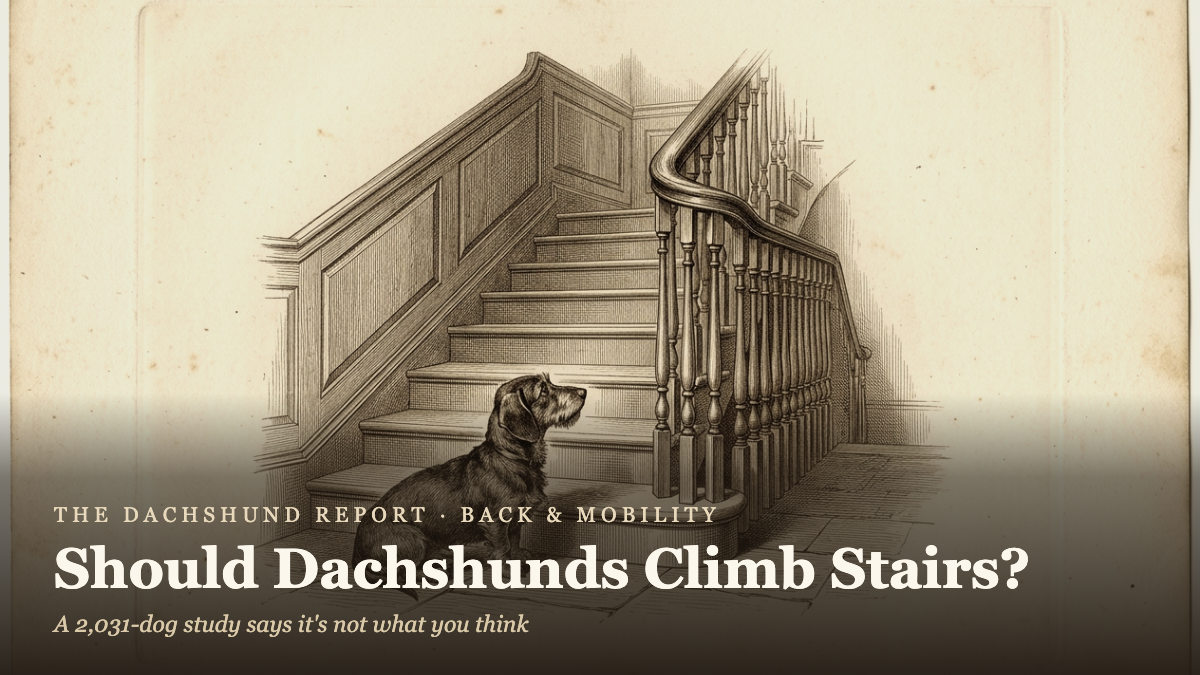
Healthy dachshunds can generally use stairs — and the research may surprise you: in the largest dachshund lifestyle study ever done, dogs who climbed a flight of stairs daily had lower odds of back disease than dogs who avoided stairs entirely. The real risks are hard downward impacts, excess weight, and too little exercise. Dogs with diagnosed back problems are a different story — for them, follow your vet's instructions exactly.
If you've spent more than nine minutes in a dachshund Facebook group, you've seen The Stairs Fight.
Someone posts a video of their doxie trotting upstairs. Within the hour: forty comments, six crying emojis, and at least one person typing "NO STAIRS EVER" in all caps like the dog committed a crime.
I get it. We all know what these backs are up against — I've written the full handbook on dachshund back problems, and the numbers are real.
But here's the thing about the all-caps advice:
The biggest study ever done on dachshund lifestyles looked at this exact question.
And it did not say what everyone thinks it said.
What does the research say about dachshunds and stairs?
Buckle up, because this is one of my favorite plot twists in all of doxie science.
In 2015, researchers surveyed the owners of 2,031 dachshunds in a study called DachsLife 2015, published in Canine Genetics and Epidemiology. They compared dogs who'd had back disease (IVDD) against dogs who hadn't, across dozens of lifestyle factors — including, yes, stairs.
The finding: dachshunds that did NOT use stairs each day had about 1.46 times higher odds of IVDD than dogs that went up and down a flight of stairs every day.
Read that again slowly.
The no-stairs dogs did worse.
And it wasn't a one-off. The researchers noted an earlier study had already found that moderate stair climbing was associated with reduced IVDD risk in standard wire-haired dachshunds — the variety at lowest risk in their own data.
Even weirder? The same study found dogs who were not allowed to jump on and off furniture had higher odds of IVDD than dogs who were allowed.
I know. I KNOW. Put down the pitchfork and stay with me, because the "why" actually makes beautiful sense.
Why would avoiding stairs make things worse?
One word, really:
Muscle.
A dachshund spine is a long suspension bridge, and muscle is the cabling that holds it up. Dogs that move — walk, climb, trot up the stairs behind you like a furry Slinky in reverse — build the exact musculature that supports those discs. The DachsLife researchers made this very point: dogs that regularly navigate stairs and furniture may develop more supportive spinal musculature than dogs that don't.
The same study found exercise pointing the same direction: doxies getting less than 30 minutes a day had higher odds of IVDD, while dogs getting over an hour a day had lower odds.
The bubble-wrapped couch potato isn't the protected doxie.
He's the deconditioned one.
Now — honesty time, because I promised you what the research actually says, not a pep talk:
These are surveys, not lab experiments. The researchers themselves flag that some of this could run backwards — maybe owners of dogs who already had back trouble banned stairs afterwards, which would make "no stairs" look risky when it's really "already hurt." Science calls it reverse causality; I call it "the chicken-and-egg problem with extra steps."
But even with that caveat, here's what you cannot get from this data: any evidence that normal stair use hurts healthy dachshunds. It just isn't there. The UK's dachshund health community — the people who literally run the breed's IVDD programs — put it perfectly: you won't be able to wrap yours in cotton wool, so be sensible instead.
So what's actually dangerous for a dachshund's back?
Let's aim the worry at the right targets. The genuinely risky stuff:
Hard downward impacts. There's a difference between climbing stairs (controlled, muscle-building) and launching off the back of the couch six times an hour (repeated shock through a long spine). Going UP is exercise. Bombing DOWN a full staircase at zoomie speed, or leaping off high furniture onto hardwood — that's the physics you want to manage. Ramps at the couch and bed, runners on slick floors.
Excess weight. The load every disc carries, every second. The single biggest thing you control — I covered the weight math in the handbook.
Being a couch potato. Under 30 minutes of exercise a day was the elevated-risk category in the research. Daily walks aren't a treat; they're spine maintenance.
Falls. The breed community's honest caveat about stairs isn't the climbing — it's the falling. Puppies still figuring out their comically mismatched chassis, seniors with fading eyesight, steep open-backed staircases, dogs racing you to the bottom: use a baby gate and common sense.
Ignoring the whispers. A doxie who suddenly hesitates at stairs they've climbed for years isn't "being stubborn." That hesitation is a message — here are the 8 early signs a doxie's back is bothering them, and sudden stair-reluctance is on it.
When should a dachshund NOT use stairs?
Because this matters more than everything above:
If your dachshund has diagnosed back disease, has had an episode, or is recovering — your vet's instructions override this entire article, the study, and me. Restricted activity after a disc episode exists for a reason, and "the research says stairs are fine" applies to healthy dogs building muscle, not injured dogs healing. The UK dachshund health folks also note stairs remain a real risk for dogs with heavily calcified discs.
Same for puppies (carry them down big staircases while they're tiny — their proportions are still in beta testing) and wobbly seniors.
For everyone else — the healthy, ribs-feelable, daily-walked doxie?
Let the little athlete climb.
Anyways...
Somewhere right now a dachshund is reading this over their owner's shoulder, absolutely vindicated.
You may tell them I said so.
FAQ
Can dachshunds go up and down stairs?
Healthy adult dachshunds generally can. In the DachsLife 2015 study of 2,031 dachshunds, dogs using a flight of stairs daily had lower odds of back disease than dogs avoiding stairs — likely because regular movement builds the muscle that supports a long spine. Manage the real risks: falls, racing downhill at speed, and high jumps onto hard floors.
Do stairs cause IVDD in dachshunds?
The research doesn't support stairs as a cause. The largest dachshund lifestyle study found the opposite association — daily stair users had lower odds of IVDD — though researchers note some of that could reflect owners restricting already-affected dogs. Known risk factors are genetics, excess weight, and too little exercise.
Should dachshund puppies use stairs?
Be conservative with puppies: their coordination and proportions are still developing, and a tumble down a staircase is a real injury risk. Many owners carry puppies down full staircases and let them practice on a few low steps, then expand as they grow. Ask your vet what's sensible for your pup's age.
Should a dachshund with IVDD avoid stairs?
Yes — follow your vet's activity restrictions exactly. Dogs with diagnosed disc disease, a past episode, or heavily calcified discs are the group for whom stairs are a genuine hazard, and recovery protocols typically restrict stairs and jumping. This article's "stairs are okay" findings apply to healthy dogs.
Is jumping on the couch bad for dachshunds?
Jumping up is far less concerning than hard landings coming down — repeated downward impacts from furniture height are the kind of shock a dachshund disc handles worst. A ramp or pet stairs plus a few days of treat-training removes the issue entirely. Interestingly, the DachsLife study found furniture-jumping dogs had lower IVDD odds, again pointing at muscle and fitness.
Free: The Dachshund Back Handbook
The stairs question is one page of a bigger playbook — the 8 early warning signs, the furniture setup, the weight math, how to pick up a doxie the right way, and the exact checklist I'd bring to a vet visit. I put all of it in one free, printable guide.
It's short, it's free, and it might be the most useful thing you ever read about your wiener dog.
Grab the free Back Handbook here
(Educational only — not veterinary advice. When in doubt, call your vet. Always call your vet.)