Dachshund Back Problems: The Owner's Handbook

Dachshund back problems are common — studies show 15–24% of doxies develop intervertebral disc disease (IVDD) in their lifetime, more than any other breed. The good news: the biggest risk factors owners can influence are weight, muscle, and how your dog moves through the house, and the early warning signs are learnable. This handbook covers all of it.
Let me tell you something nobody tells you when you bring home that impossibly long, impossibly smug little sausage:
You just adopted a back.
The ears, the drama, the burrowing under every blanket you own — that's all bonus material.
The back is the whole ballgame.
I've loved these dogs most of my life. I've run a doxie community for years. And if there's ONE thing I wish someone had sat me down and explained on day one, it's everything on this page.
So here it is. The handbook I never got.
Grab a coffee. Your wiener can sit in your lap while you read — that's what they're for.
Why do dachshunds have back problems in the first place?
Because we built them that way.
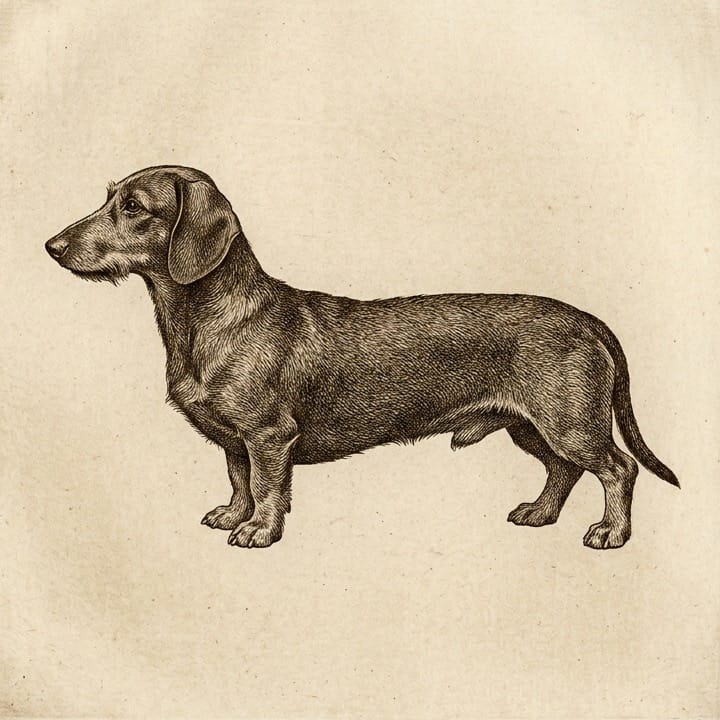
Dachshunds were bred to chase badgers down tunnels — long body, short legs, big attitude. That shape comes from a gene for dwarfism (the fancy word is chondrodystrophy), and it does something sneaky to the discs between the bones of the spine.
In most dogs, those discs stay squishy and jelly-like for years — little shock absorbers doing their quiet job.
In dachshunds, the discs can harden and calcify early. Some start changing in the first couple years of life.
A hardened disc doesn't absorb shock. It cracks. And when it cracks, the material inside can bulge or burst upward into the spinal cord.
That's IVDD — intervertebral disc disease. The thing every doxie owner has heard whispered about at the dog park.
Now, before you scoop up your dog and refuse to ever put them down again (I see you)...
Take a breath. Most dachshunds live long, happy, zoomie-filled lives. But you should know the real numbers, because they're the reason this site exists.
How common is IVDD in dachshunds, actually?
More common than in any other breed on Earth.
A 2025 study in the Journal of the American Veterinary Medical Association looked at lifetime prevalence across breeds and found 15.3% of dachshunds were affected by IVDD — the highest of any breed in the study.
And the biggest dachshund-specific study ever done — DachsLife 2015, which surveyed 2,031 dachshunds — found an overall vet-diagnosed IVDD prevalence of 15.7%, climbing to nearly 1 in 4 (24.4%) in the standard smooth-haired variety.
Read that again.
Roughly 1 in 6 overall. Up to 1 in 4, depending on the variety.
That's not a rare, exotic thing that happens to somebody else's dog on a Facebook group. That's a coin flip you're playing every year of your dog's life — which is exactly why the rest of this handbook matters.
Anyways...
Deep breath. Because here's the part that should make you feel better:
The same research that measured the problem also measured what's associated with it. And a surprising amount of it lives in YOUR hands, not fate's.
Are some dachshunds more at risk than others?
Short answer: yes, a bit — but no doxie gets a free pass.
DachsLife's numbers weren't one number because the risk varied across the six varieties — coat type mattered. In their data, the standard wire-haired was the lowest-risk variety at 7.1%, while the standard smooth-haired topped the chart at 24.4% — nearly one in four.
(My theory? The wire-haireds are simply too busy plotting to get injured. But the researchers point at genetics, and I suppose they've done more math than I have.)
Here's what I want you to take from this, though:
Even the luckiest variety carries a back risk most breeds never have to think about. Nobody gets to skip this handbook.
So whether you've got a standard wire with the eyebrows of a Victorian professor or a smooth mini the size of a burrito — you play the same defensive game. Same weight rules, same muscle rules, same warning signs.
The chassis came with the risk. The owner's manual is identical.
What raises a dachshund's risk of back problems?
Let's go through the big ones the research and the vets keep pointing at.
1. Weight. Weight. Weight.
An overweight doxie is a long bridge carrying a load it wasn't engineered for, every minute of every day.
Every vet source on the planet lists excess weight as the #1 factor owners control. It strains the spine, it weakens the support muscles, and it turns every couch jump into a bigger impact.
You should be able to feel your doxie's ribs with light pressure and see a visible waist tuck from above. If your dog is a smooth little torpedo with no waist... it's time. (Long-time readers of mine know the story of Obie — the Oregon rescue doxie who made it all the way to the Today Show after hitting 77 pounds, more than double what any dachshund should weigh. He lost 42 pounds with a foster mom who simply fed and walked him right. Dachshunds are small dogs; the fix is boring and it works.)
2. Too little exercise — yes, too LITTLE.
Here's where the research surprises people.
In the DachsLife study, dachshunds that exercised less than 30 minutes a day had higher odds of IVDD, while dogs exercising more than an hour a day had lower odds.
The bubble-wrapped doxie who never walks isn't the safe doxie. Muscle is what holds a long spine together, and muscle comes from moving.
(There's a whole conversation about stairs that surprises people even more — I wrote it up here: Should dachshunds climb stairs? What the research actually says.)
3. High-impact landings.
Off the back of the couch. Off the bed. Out of your arms because somebody spotted a squirrel.
It's not that a doxie can never hop — it's that repeated hard, twisting landings from heights are exactly the kind of shock a calcified disc handles worst. Ramps and pet stairs next to the "big furniture" are the cheapest insurance you'll ever buy.
4. How they get picked up.
Most people pick up a dachshund like a loaf of bread — one hand behind the front legs, rear end dangling, spine folded like a taco.
Don't do the taco.
One hand under the chest, one hand under the hips, keep the whole dog level, hold them against your body. Teach the kids. Teach the guests. Be annoying about it — I am.
What are the warning signs of a dachshund back problem?
The early signs are quiet. That's the dangerous part.
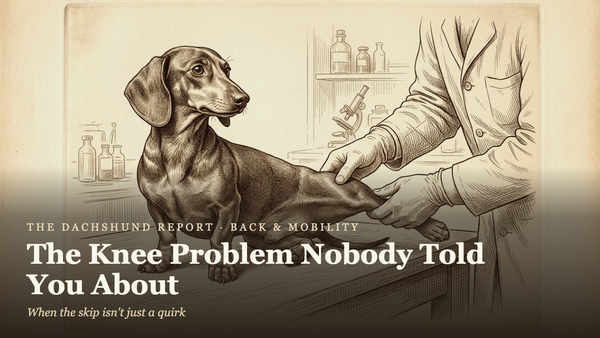
Veterinary sources describe the classic early picture: reluctance to jump, a hunched or arched back, yelping when touched or picked up, and trembling, along with wobbliness in the back legs and sensitivity along the spine.
Not screaming. Not dragging legs. Usually it starts as... hesitation. A doxie who suddenly thinks about the couch jump instead of doing it.
I wrote a full guide to the subtle stuff — 8 early signs your doxie's back is bothering them — and I'd honestly call it required reading for anyone with one of these dogs.
The one-line version: any sudden reluctance, hunching, yelping, or wobbliness = call your vet that day. Emergency vets note that back-leg weakness or loss of coordination is a drop-everything emergency, because with disc disease, hours matter.
I'm not a vet and I never play one on the internet. When in doubt: call. No vet in history has ever been mad about a cautious dachshund owner. We're their favorite genre.
What does treatment for IVDD cost?
Let's talk about the number nobody wants to say out loud.
Mild episodes are often managed with strict crate rest and medication — that's a vet-supervised plan, and relatively affordable.
Surgery is another universe. Estimates from MetLife Pet Insurance put IVDD surgery at roughly $1,500–$4,000 for the procedure alone, and $3,000–$8,000 once imaging, hospitalization, and rehab are included. Specialty neurology centers put the all-in figure at $10,000–$15,000. In the IVDD support communities, owners regularly report five figures.
I'm not telling you this to scare you.
I'm telling you because "1 in 4" plus "five figures" is why pet insurance (or a real emergency fund) belongs in the plan while your doxie is young and healthy — not after the first yelp.
The Doxie-Proof House: a 10-minute checklist
None of this is expensive. All of it compounds.
- Ramp or pet stairs at the couch and the bed — then actually train the dog to use them (treats on every step; doxies are food mercenaries, this takes a weekend).
- Rugs or runners on slippery floors. Hardwood + zoomies + long spine is a bad physics experiment.
- Feed to a waistline, not a food bag chart. Ribs feelable, waist visible. Ask your vet to show you body condition scoring once — it takes two minutes.
- Daily real walks. Remember: under 30 minutes a day was the risk category in the research. Sniffy, steady, every day.
- The two-hand carry, always. Chest and hips, level dog, no exceptions, even for "just a second."
- A "no launching" rule — blocked-off backs of couches, furniture pushed away from window perches, whatever your particular gremlin requires.
- Know your emergency vet's address before you need it. Write it down now. Seriously, I'll wait.
That's it. That's the whole defensive game plan: strong muscles, healthy weight, soft landings, smart handling, fast reaction to warning signs.
Not cotton wool. Not fear.
Just stacking the odds for the little weirdo asleep in your lap right now.
FAQ
What percentage of dachshunds get back problems?
Studies put lifetime IVDD prevalence in dachshunds at roughly 15–24%. A 2025 JAVMA study found 15.3% — the highest of any breed — and the DachsLife 2015 survey of 2,031 dachshunds found up to about 1 in 4 affected in some varieties. It is the signature health issue of the breed.
At what age do dachshunds get back problems?
Disc disease most commonly shows up between ages 3 and 7, because dachshund discs can calcify early in life. That's why habits like weight control, daily exercise, and ramp training pay off from puppyhood — the foundation is laid years before the risk window peaks.
Can dachshund back problems be cured?
Many dogs recover well — milder episodes are often managed with vet-supervised crate rest and medication, and surgery helps many severe cases. Outcomes are best when treatment starts fast, which is why knowing the early warning signs matters so much. Your vet is the only one who can tell you which category your dog is in.
How do I know if my dachshund has a back problem?
Early signs are subtle: reluctance to jump, a hunched back, yelping when picked up, trembling, or wobbly back legs. Any of these deserves a same-day vet call; back-leg weakness or dragging is an emergency. See our full guide to the 8 early signs for the complete list.
Should I get pet insurance for my dachshund?
That's a personal call, but know the math: published estimates for IVDD surgery run $3,000–$8,000 comprehensive and up to $10,000–$15,000 at specialty centers, and 15–24% of dachshunds develop the disease. Insure them (or save deliberately) while they're young and healthy — coverage bought after symptoms won't cover them.
Free: The Dachshund Back Handbook
Everything on this page — the warning signs, the furniture setup, the weight math, the right way to pick up a doxie, and the exact checklist I'd bring to a vet visit — is going into one free, printable guide.
It's short, it's free, and it might be the most useful thing you ever read about your wiener dog.
Grab the free Back Handbook here
(Educational only — not veterinary advice. When in doubt, call your vet. Always call your vet.)