Dachshund Luxating Patella: The Knee Problem Nobody Told You About

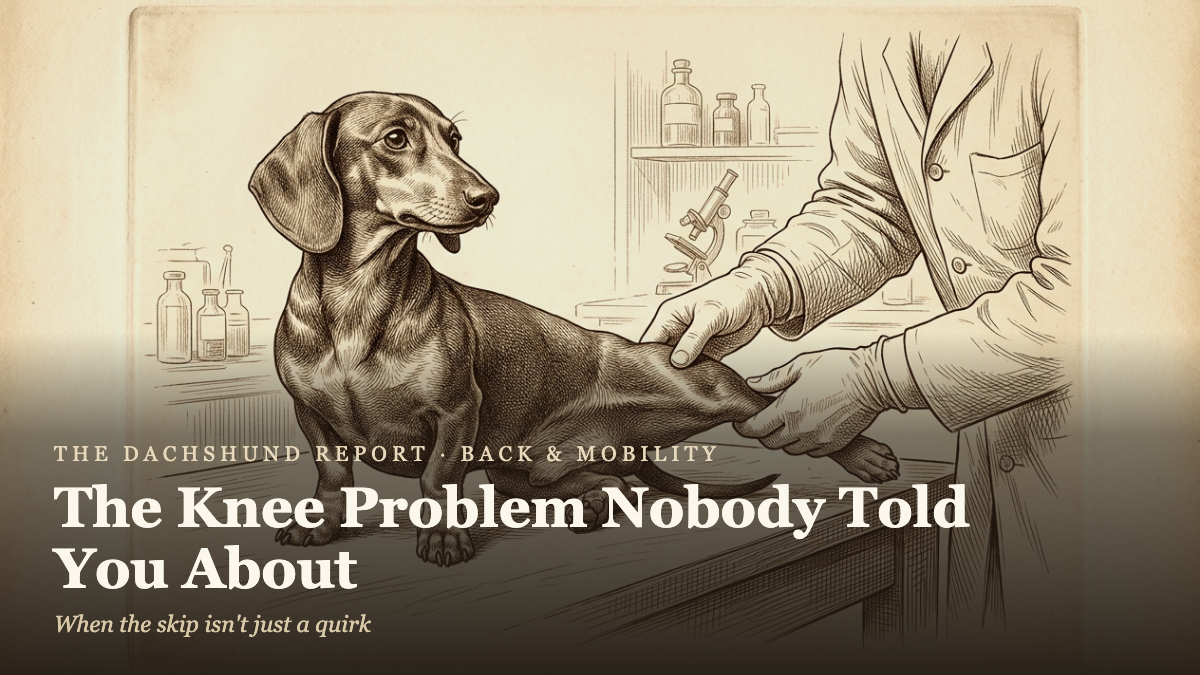
Luxating patella in dachshunds is a condition where the kneecap slides out of its normal groove, causing an intermittent "skip" in your dog's walk. It's especially common in chondrodystrophic breeds like dachshunds, affects both knees in up to half of cases, and ranges from a barely noticeable hitch to a permanent dislocation that needs surgery. The good news: over 90% of surgical repairs lead to normal function.
You know that thing your doxie does sometimes?
That little skip.
Mid-walk, one back leg pops up for a step or two, maybe a quick shake, and then they're trotting along like nothing happened.
You probably thought it was cute. Or weird. Or just... a dachshund thing.
I get it. When you own a breed that does half the stuff dachshunds do — the burrowing, the barking at nothing, the full-body drama when you leave the room for thirty seconds — a little skip barely registers.
But here's the thing.
That skip might not be a quirk. It might be a kneecap that just slid sideways.
What Is Luxating Patella in Dachshunds?
Your dog's patella is their kneecap. It sits in a groove at the front of the knee joint — the trochlear groove — and it's supposed to stay there, gliding smoothly up and down as the leg bends and straightens.
In a luxating patella, that kneecap slips out of the groove. "Luxate" literally just means "to dislocate."
In small breeds like dachshunds, the kneecap almost always slips to the inside of the knee — that's called medial patellar luxation, and it accounts for roughly 75% of all cases. Lateral luxation (to the outside) is rarer and more common in large breeds.
Here's the part that matters for dachshund owners specifically: patellar luxation is particularly common in chondrodystrophic breeds — dogs with shortened legs and elongated spines. That's your doxie. The same body type that makes them predisposed to IVDD also puts extra stress on their knee joints.
The ACVS reports it's diagnosed in 7% of puppies, and in about half of cases, both knees are affected.
And tiny dogs? Twelve times more likely to have it than large breeds.
Wait — Is This IVDD or a Knee Problem?
This is the question I really want you to hear.
Because if you're a dachshund owner, you've probably spent more time worrying about your dog's back than any other part of their body. And rightfully so — 1 in 4 dachshunds will deal with IVDD in their lifetime.
But when your doxie starts limping or skipping on a back leg, your brain immediately goes to: oh no, is it the back?
Sometimes it's not.
Here's how to tell the difference:
Luxating patella looks like an intermittent, sudden skip. One back leg lifts for a few strides. Your dog might shake the leg, and then they're fine. Between episodes, they walk normally. No pain expression, no hunching, no behavioral change. The Merck Veterinary Manual describes it as "intermittent non-weight-bearing lameness that resolves within a few steps."
IVDD is different. It's progressive. Your dog might hunch their back, refuse stairs, walk like a drunk sailor, or drag their hind legs. The symptoms don't just pop in and out — they build. And the pain is in the spine, not the knee.
One is a kneecap sliding out of place. The other is a disc pressing on the spinal cord.
Both are common in dachshunds. Both affect the hind legs. But they're completely different problems with completely different treatments.
If you're not sure which one you're looking at, call your vet. They can tell the difference with a physical exam.
What Are the 4 Grades of Luxating Patella?
Not all luxating patellas are created equal. Vets grade the condition on a scale from 1 to 4, and the grade changes everything about how it's managed.
Grade 1: The kneecap can be manually pushed out of the groove, but it pops right back on its own. Your dog might show occasional mild signs — or none at all. Most owners with Grade 1 dogs don't even know there's a problem until a vet finds it during a routine exam.
Grade 2: The kneecap luxates on its own sometimes — spontaneously — and may stay dislocated until the dog extends and rotates the leg to pop it back. This is where you start seeing that classic skip. Intermittent lameness. Your dog seems fine, then suddenly isn't, then is again.
Grade 3: The kneecap is out of the groove most of the time. A vet can manually push it back in, but it immediately slips out again. The dog walks with a noticeable limp and a semi-flexed stance. Consistent lameness.
Grade 4: The kneecap is permanently dislocated and can't be put back manually. The leg may be carried entirely or the dog crouches while moving. Significant deformity.
Here's what's important: a study following Grade 2 dogs for four years found that 50% of them eventually developed chronic lameness or needed surgery. Grade 2 is not "no big deal." It's a watch-carefully-and-be-ready situation.
What Does It Look Like? (The Signs You'll Actually Notice)
Cornell's veterinary school describes the primary sign as "intermittent skipping lameness when one hindlimb is suddenly lifted for a few skips."
In plain English: your doxie is walking normally, one back leg suddenly goes up, they take a few hops, maybe shake the leg, and then they're back to normal.
Other things you might notice:
- Bunny hopping when running — both hind legs moving together to minimize the discomfort of the loose kneecap
- A bowlegged stance in the back legs, especially in puppies
- A popping or cracking sound when the knee bends
- Your dog occasionally yelping during a luxation episode — though many don't seem bothered at all
Symptoms usually show up before age one. If your dachshund puppy is doing the skip, don't wait to have it looked at.
How Is It Diagnosed?
The good news: your vet can usually diagnose luxating patella with a physical exam alone. They feel for the kneecap while extending and flexing the leg, checking whether it slides out of the groove and how easily it goes back.
X-rays come next if the vet wants to see the bone structure underneath — things like a shallow trochlear groove, tibial rotation, or femoral deformity. In more complex cases, a CT scan gives a three-dimensional picture.
The OFA offers patellar evaluations for breeding dogs — done awake, at 12 months or older. If you got your dachshund from a breeder, ask whether the parents had OFA patellar clearance. If they didn't... well, now you know why this article exists.
Treatment: What Actually Happens at Each Grade
Grades 1 and mild Grade 2 are usually managed conservatively. Cornell Vet Med lists the playbook: weight management, controlled exercise, anti-inflammatory medication when needed, and joint supplements to support cartilage health.
Sound familiar? It's basically the same lifestyle management you'd do for a dachshund with arthritis or weight issues. Keep them lean. Keep them moving appropriately. Don't let them jump off furniture. (You're already doing that last one, right? ...Right?)
Grades 2 with worsening symptoms, Grade 3, and Grade 4 typically need surgery. The Merck Veterinary Manual recommends surgical intervention for dogs with "moderate to severe patellar luxation" or "progressive worsening of clinical signs."
The main surgical procedures, per the ACVS:
- Trochleoplasty — deepening the groove so the kneecap has somewhere to sit
- Tibial tuberosity transposition — realigning the bony attachment where the patellar tendon connects to the shin bone
- Soft tissue procedures — tightening or releasing the structures around the knee to rebalance the pull on the kneecap
Cost? PetMD puts it at $1,000 to $3,000 per knee. Real-world totals — once you add pre-op testing, anesthesia, imaging, and follow-ups — run $1,500 to $5,500 per knee. And remember: in half of cases, both knees are affected.
The success rate is genuinely encouraging. The ACVS reports that over 90% of owners are satisfied with their dog's outcome after surgery.
Recovery: What to Expect After Surgery
PetMD recommends strict crate rest for 6 to 8 weeks post-surgery. If your dachshund has already been through IVDD crate rest, you know the drill. If they haven't — well, it's exactly as fun as it sounds.
The general recovery timeline:
- Weeks 1-2: Strict rest. Leash-only bathroom breaks. Your doxie will hate you.
- Weeks 3-4: Gentle walking starts. Physical therapy exercises begin.
- Weeks 5-6: Gradual increase in activity. Short walks get a little longer.
- Weeks 7-8: Most dogs regain good function. Your vet may clear them for normal activities.
- Weeks 12-16: Full return to normal. The skip is gone.
The Arthritis Connection (This Is the Part Most People Miss)
Here's why even a Grade 1 or 2 luxating patella isn't something to ignore forever.
Every time that kneecap slides out of the groove, the cartilage on its surface takes damage. It's not articulating with the groove cartilage like it's supposed to — it's grinding against bone it was never meant to touch.
Over time, that's osteoarthritis. And the PDSA states it plainly: "Even with treatment, most dogs with patella luxation develop arthritis in their knees later in life."
Worse: 13% to 25% of dogs with medial patellar luxation may also develop a cranial cruciate ligament injury — a knee ligament tear — because the joint instability puts stress on surrounding structures.
This is why weight management and joint support matter even for mild cases. You're not just managing the kneecap. You're trying to slow down the arthritis clock.
Can You Prevent It?
Honestly? If it's genetic — and the ACVS says it primarily is — you can't fully prevent it.
But you can manage the risk factors that make it worse:
- Keep your dachshund lean. Obesity doesn't cause luxating patella, but it increases severity and surgical complications. You already know the weight math.
- Limit high-impact activity. Jumping off furniture, rough play on slippery floors — same precautions you'd take for their back.
- Regular moderate exercise. Strong muscles around the knee help stabilize the joint. Short, consistent walks beat weekend warrior bursts.
- Ask your breeder about OFA patellar clearance. The ACVS recommends against breeding dogs with patellar luxation. If the parents weren't evaluated, that's data you don't have.
FAQ
Is luxating patella common in dachshunds?
Yes. Dachshunds are a chondrodystrophic breed — their shortened legs and long bodies put extra stress on their knee joints. Miniature varieties are especially predisposed. Small and toy breeds overall are 12 times more likely to develop patellar luxation than large breeds.
How much does luxating patella surgery cost for a dachshund?
Expect $1,000 to $3,000 per knee for the surgery itself, or $1,500 to $5,500 with pre-op testing, imaging, and follow-ups. Since about half of cases are bilateral, budget for the possibility of both knees needing attention.
Can a luxating patella heal on its own?
No. The underlying structural problem — a shallow groove, misaligned tendons, or genetic conformation — doesn't self-correct. Grade 1 dogs can live comfortably with conservative management, but the kneecap won't stop luxating without intervention. Left untreated, arthritis develops over time as the cartilage wears down.
How can I tell if my dachshund's limp is luxating patella or IVDD?
Luxating patella typically causes an intermittent skip — your dog lifts one hind leg for a few steps, then walks normally again. IVDD symptoms are progressive: hunching, back pain, reluctance to move, and in severe cases, dragging the hind legs. If you're not sure, your vet can tell the difference with a physical exam. When in doubt, call your vet.
What grade of luxating patella needs surgery?
Grades 3 and 4 almost always require surgery. Grade 2 is a judgment call — conservative management works for some dogs, but 50% of Grade 2 cases develop chronic lameness or need surgery within four years. Grade 1 is typically managed without surgery. Your vet will help you decide based on your dog's symptoms and progression.
Free: The Dachshund Back Handbook
I put everything we know about keeping these long little backs strong into one free guide — the 8 early warning signs, the furniture setup, the weight math, how to pick up a doxie the right way, and the exact checklist I'd bring to a vet visit.
It's free, it's short, and it might be the most useful thing you ever read about your wiener dog.
Grab the free Back Handbook here
(Educational only — not veterinary advice. When in doubt, call your vet. Always call your vet.)