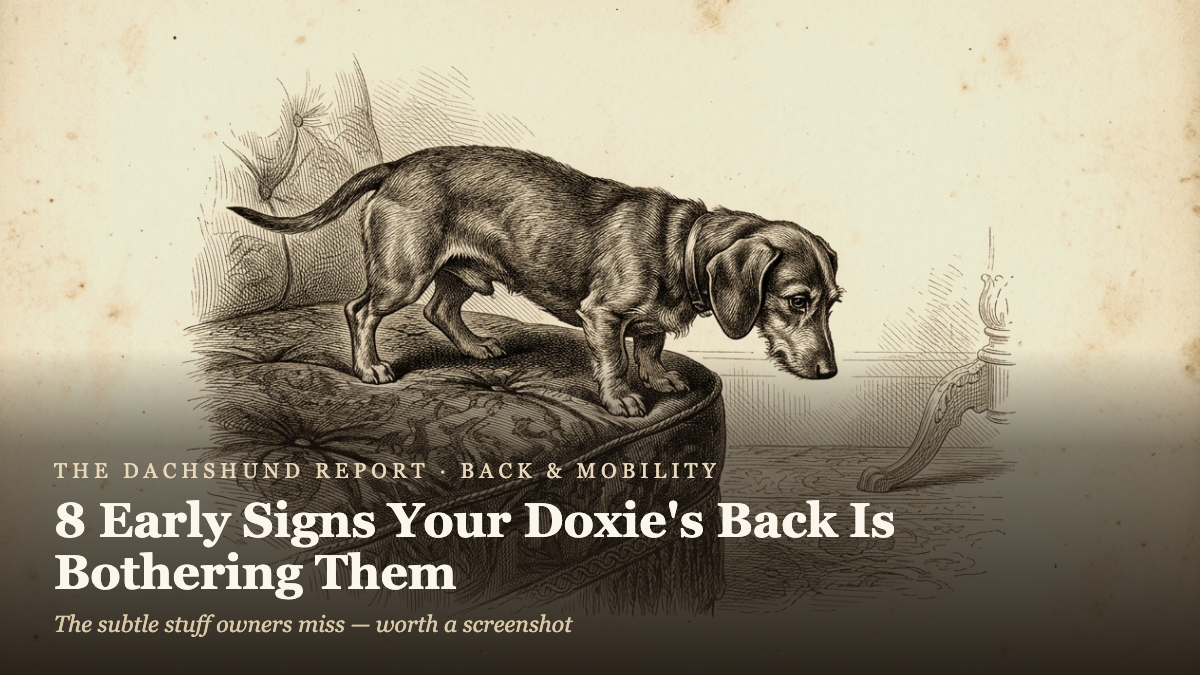
8 Early Signs Your Doxie's Back Is Bothering Them

The earliest signs of back pain in dachshunds are subtle: reluctance to jump, a hunched or arched back, yelping when touched or picked up, trembling, a tense belly, slow or careful movement, wobbly back legs, and hiding or "acting off." Any of these deserves a same-day call to your vet — and back-leg weakness or dragging is an emergency, right now, tonight.
Here's a little scene every doxie owner knows:
Your dog runs the house like a tiny long dictator. Couch to lap to window ledge to food bowl, all day, at full speed, tail going like a metronome.
Then one evening... they stand at the bottom of the couch and just look at it.
And you tell yourself they're tired.
I want to gently take that thought out of your head and replace it with this one: dachshunds don't skip the couch jump for no reason.
These dogs are the most back-prone breed on Earth — studies put lifetime disc disease at 15% to as high as 1 in 4 — and the early signs aren't dramatic. Nobody's screaming. Nothing's dragging.
It's quiet. It's a hesitation. A shiver. A yelp you almost didn't hear.
So here are the 8 early signs, the way I wish someone had listed them for me years ago. Print it, screenshot it, tattoo it on your arm — dealer's choice.
What are the early signs of back pain in a dachshund?
1. The skipped jump.
The couch hesitation. The dog who suddenly "prefers" the floor. The one who used to helicopter onto the bed and now waits to be lifted.
Vets list reluctance to rise, jump, or climb as one of the classic early signs of disc trouble. It's your dog doing their own risk assessment — and deciding something hurts.
2. The hunch.
A subtle upward curve in the back, like a comma. Sometimes with the head held low and stiff.
Veterinarians describe the hunched or arched back as a hallmark pain response — the dog is rounding their spine trying to take pressure off an angry disc. Once you've seen it, you can't unsee it. Take a photo of your doxie standing normally today so future-you has a comparison.
3. The yelp when you pick them up.
Not the offended "how DARE you" doxie noise. (You know the one.)
A sharp cry when your hands go around their middle, or when they twist in your arms — vets flag yelping when touched or picked up, and pulling away from petting, as a sign of real back pain. A dog that suddenly doesn't want to be handled is telling you exactly where it hurts.
4. Trembling or shivering when it's not cold.
Doxies shiver for a hundred reasons — cold, drama, the vacuum's mere existence.
But trembling is also a documented pain response in dogs with disc disease. Shivering plus ANY other sign on this list stops being "he's just being a doxie" and becomes a vet call.
5. The tense, tucked belly.
A dog guarding their spine often tightens their whole core — belly tucked up hard, back slightly roached, moving like they're carrying something fragile.
Because they are.
6. Moving like an old dog overnight.
Slow, careful, deliberate. Not following you upstairs. Thinking hard about the single step off the porch. Emergency vets describe early disc episodes as reluctance to move and sensitivity along the spine — a sudden personality change from "parkour gremlin" to "careful little elder" over a day or two is not aging. Aging doesn't happen on a Tuesday.
7. Wobbly or drunk-looking back legs.
Now we're leaving "early sign" territory and entering "go now" territory.
Slight wobbliness or incoordination in the rear legs — swaying hips, paws that slip or cross, back feet that scuff the floor — means the disc may be pressing on the spinal cord itself. This is a same-day vet visit, full stop.
8. Legs that collapse, drag, or knuckle under.
The genuine emergency. Vets describe back legs collapsing after a few steps — sitting back down mid-walk, standing up and folding, paws flipping under so the dog stands on the top of their foot.
If you see this: do not wait until morning. Do not "see how he does." Carry your dog (one hand under the chest, one under the hips, level like a tray), put them in the car, and go to the emergency vet. With disc disease, the clock matters — the difference between a dog treated within hours and a dog treated "eventually" can be the difference in everything.
What should I do if I spot one of these signs?
Three rules. They're simple and they've saved a lot of backs:
One sign, even mild = call your vet today. Describe exactly what you saw. Let a professional decide if it's a "come in now" or a "watch closely." That call costs nothing.
Signs 7 or 8 = emergency vet, now. Wobbling, dragging, collapsing — this is the drop-everything scenario.
Until you're seen: no jumping, no stairs, no zoomies. Carry them level, keep them calm and confined. And please don't give human pain meds — several are genuinely dangerous for dogs. Let the vet do the prescribing.
And listen — most of the time, the vet visit ends with relief. A pulled muscle, a mild episode, rest and meds, a doxie milking the sympathy for three weeks. (They will absolutely milk it.)
But you'll never regret the cautious call. Doxie owners are the emergency vet's favorite frequent flyers, and every good vet will tell you: that's exactly how it should be with this breed.
Anyways...
Go do the photo thing from sign #2. And while you're at it, it's worth understanding why these little sausages are built this way — I wrote the full story in Dachshund Back Problems: The Owner's Handbook, plus the surprisingly counterintuitive research on whether doxies should be climbing stairs at all.
Your wiener's back will thank you. Silently. While ignoring you from the couch.
FAQ
How do I know if my dachshund's back hurts?
Look for reluctance to jump, a hunched back, yelping when picked up, trembling, a tense belly, slow careful movement, wobbly back legs, or hiding. Dachshunds hide pain well, so subtle changes in behavior — especially refusing jumps they normally love — are often the first tell. Any sign warrants a vet call the same day.
What does IVDD look like in the early stages?
Early IVDD usually looks like pain, not paralysis: hesitating before jumps, an arched back, crying when handled, shivering, and moving stiffly or slowly. Weakness, wobbling, or dragging the back legs means the spinal cord is being affected — that stage is an emergency.
When is a dachshund back problem an emergency?
Immediately, if you see wobbly or crossing back legs, paws knuckling under, legs collapsing, dragging, or your dog unable to stand. Go to an emergency vet right away — treatment outcomes for disc disease are strongly tied to how fast the dog is treated.
Can a dachshund recover from a back injury without surgery?
Many dogs with milder episodes recover with strict vet-supervised crate rest and medication. Whether that's the right path for your dog is entirely your vet's call, based on an exam — which is why early recognition and a fast appointment matter so much.
Should I let my dachshund jump on the couch?
Repeated hard landings from furniture are exactly the kind of impact a dachshund spine handles worst, so most owners add a ramp or pet stairs and train the dog to use them. It's cheap insurance for the most injury-prone back in the dog world.
Free: The Dachshund Back Handbook
I put this whole checklist — plus the furniture setup, the weight math, the right way to pick up a doxie, and the exact list I'd bring to a vet visit — into one free, printable guide.
It's short, it's free, and it might be the most useful thing you ever read about your wiener dog.
Grab the free Back Handbook here
(Educational only — not veterinary advice. When in doubt, call your vet. Always call your vet.)