From Frank's Desk: A Formal Objection to the Intelligence Rankings

MEMORANDUM — DEPT. OF DACHSHUND AFFAIRS
FROM: Frank, Director of Operations, The Dachshund Report
TO: Dr. Stanley Coren, Professor Emeritus, University of British Columbia; the American Kennel Club; the general public; Border Collies (cc'd for awareness)
RE: The Intelligence of Dogs (1994), specifically the ranking of the Dachshund at 92nd out of 138 breeds
DATE: October 12, 2026
PRIORITY: Urgent. Long overdue.
I. Background
It has come to the attention of this office — 32 years after initial publication — that a widely circulated list ranks the dachshund as "average" in intelligence.
I am aware this is not breaking news. I have been aware of this list since before I was hired. I have been filing a formal objection in my mind every single day since.
Today, I am putting it on paper.
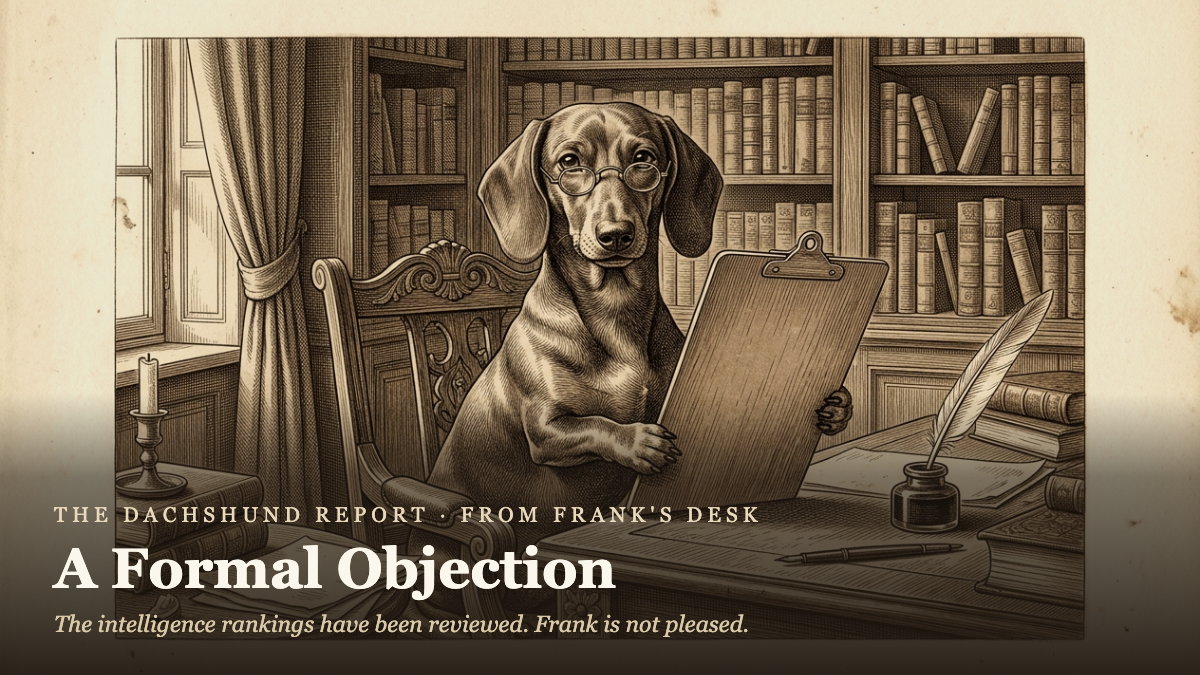
I have my clipboard.
II. Summary of Complaint
The ranking in question evaluates intelligence by measuring how quickly a dog obeys a command given by a human.
I would like this sentence read again.
How quickly. A dog. Obeys.
This is not a measure of intelligence. This is a measure of compliance. These are different things. I should know. I am deeply intelligent and I comply with almost nothing.
III. The Test, As I Understand It
Dr. Coren surveyed 199 obedience trial judges. He asked them how many repetitions it took a breed to learn a new command, and how often the breed obeyed that command the first time it was given.
The top breeds — Border Collies, Poodles, German Shepherds — learn commands in under 5 repetitions and obey on the first try 95% of the time.
I have several thoughts about this.
First: good for them. Truly. Following orders quickly is a useful skill. In the military. In food service. At obedience trials.
Second: I was not bred for obedience trials. I was bred to enter a hole in the ground, in the dark, alone, and make decisions about a badger.
The badger did not give me commands. The badger was the problem. I was the solution.
Nobody asked the Border Collie to do that.
IV. What the Ranking Actually Measured
The ranking measured one type of intelligence. There are three.
-
Obedience intelligence — how quickly you do what someone tells you. The dachshund scored average. I accept this. Not because I lack the capacity. Because I am running a cost-benefit analysis in real time and the benefit of sitting on command for the 37th time today is, frankly, unclear.
-
Instinctive intelligence — the ability to do the job you were literally designed for. For the dachshund, this means tracking scent, navigating underground, and making independent decisions in total darkness. The AKC still runs Earthdog trials for this exact purpose. We excel. Obviously.
-
Adaptive intelligence — the ability to solve problems, learn from experience, and manipulate your environment to get what you want. This is how I learned to open the treat cabinet. This is how I learned that the sound of car keys means someone is leaving and the sound of the leash clip means they are not. This is how I figured out that if I stare at a human long enough while they are eating, they will eventually share.
The ranking tested only the first one.
This is like grading a novelist on their typing speed.
V. A Note on the Border Collie
I do not wish to disparage the Border Collie. They are very good at what they do. They learn quickly. They obey consistently. They herd sheep with remarkable precision.
But I would like to see one enter a dark tunnel at midnight, navigate 40 feet underground, and explain to a 25-pound badger with claws that it needs to vacate the premises.
I suspect it would ask for instructions.
I did not ask for instructions. I went in. I handled it. I came back up.
That is intelligence. The kind you cannot test with a treat and a hand signal.
VI. Evidence of Dachshund Intelligence the Ranking Missed
I have compiled the following:
-
I learned the word "vet" without being taught it. I now leave the room when it is said. This is adaptive intelligence. The ranking does not measure this.
-
I know which shoes mean "park" and which shoes mean "work." The brown ones mean park. The black ones mean abandonment. I respond accordingly.
-
I have solved the cabinet. It took me three observations. The humans still do not know how I get in. They have discussed it.
-
I can distinguish between my human's "no" voice and their "no but not really" voice. The latter means I should continue what I am doing but look apologetic while doing it. I always look apologetic. It is very effective.
-
I once communicated on behalf of another dog. Wilson was standing at the door wanting out. I went to the human and performed my own signal — the left-leg thing — because Wilson does not have a signal. He just stands there. This is a two-step thought process. The Border Collie, to my knowledge, has not submitted evidence of diplomatic communication.
VII. Requested Relief
This office formally requests the following:
-
That the ranking be amended to include all three types of intelligence, not merely compliance.
-
That the dachshund be moved from "average" to "strategically selective," which is a new category I have just created and which more accurately reflects the situation.
-
That a formal apology be issued to every dachshund who has been called "stubborn" when they were, in fact, thinking.
-
That the Border Collie's ranking remain unchanged. They earned it. Good for them. I am generous.
VIII. Conclusion
I am not average.
I am a 600-year-old engineering project designed to think independently, solve problems in the dark, and make decisions without waiting for permission.
The test asked me to sit.
I was busy.
— Frank
Director of Operations, The Dachshund Report
Current clipboard status: Filed under "Overdue Corrections." The stack is growing.
Submit matters for review in the comments.