Dachshund Arthritis: The Pain Your Senior Doxie Is Hiding From You

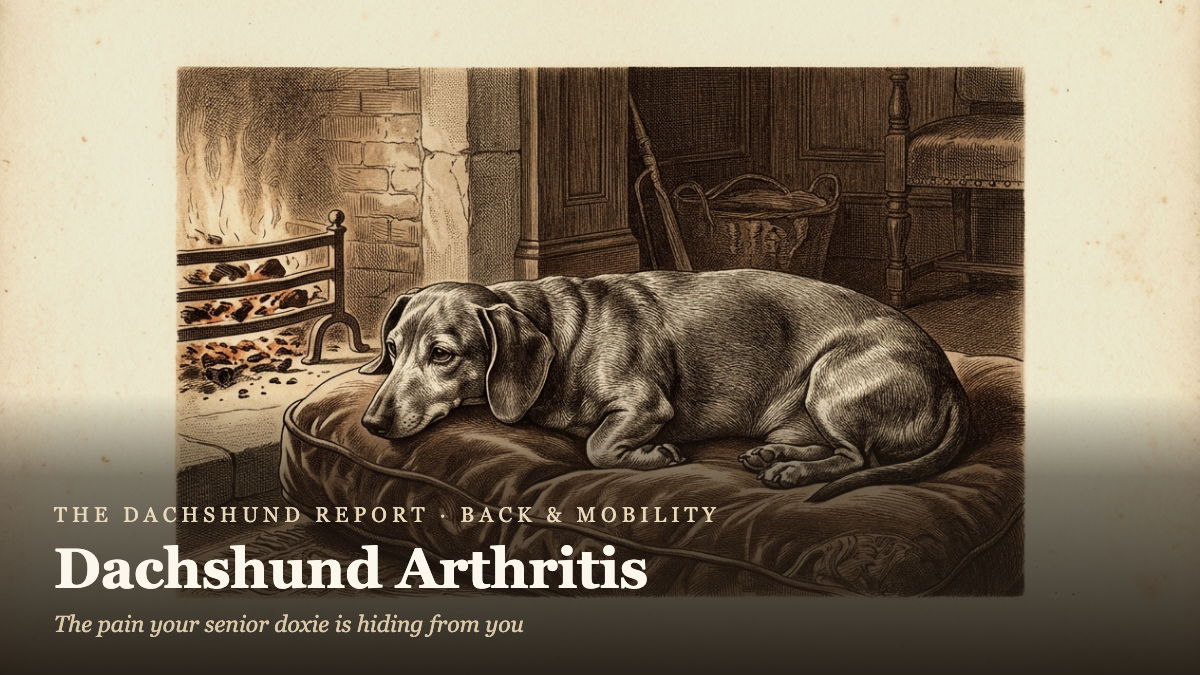
Dachshunds are genetically predisposed to arthritis through a conformational condition called pes varus (bowleggedness), and their long spines compound the problem. Up to 60% of dogs show radiographic evidence of osteoarthritis — most without their owners ever noticing. Here's how to spot it in your doxie, how to tell it apart from IVDD, and what actually makes a difference.
So here's a fun thing about dachshunds.
They're stoic.
I know, I know. The dog that screams bloody murder when you accidentally step near their tail. The drama queen who acts like bath time is a war crime. THAT dog is... stoic?
When it comes to real, chronic pain — yeah. They really are.
A dachshund with arthritis won't yelp about it. They won't come up to you and say "hey, my knees are killing me today."
They'll just... slow down a little.
Take an extra beat before jumping off the couch. Lag behind on walks where they used to pull. Sleep a little longer. Move a little stiffer in the morning.
And because it happens so gradually — over months, sometimes years — most of us write it off as "getting old."
Anyways...
That's not aging. That's pain. And your doxie has been dealing with it longer than you think.
How Common Is Arthritis in Dachshunds?
More common than most people realize.
A 2026 study published in JAVMA X-rayed 30 dogs who had no known history of joint disease. Sixty percent of them — 18 out of 30 — had radiographic evidence of osteoarthritis in one or more joints. And of those 18 dogs, 16 had arthritis in two or more joints.
None of these dogs had been diagnosed. Their owners had no idea.
Now here's where it gets dachshund-specific.
Your doxie's adorable little bowlegs aren't just cute. They're a conformational condition called pes varus — a premature closure of the growth plate in the lower leg that causes the bone to angle inward. The Merck Veterinary Manual lists dachshunds as one of the breeds with the highest odds ratio for this condition.
Dr. Bryan Torres, a veterinary orthopedic surgeon, told Purina Pro Club that pes varus is the most common angular limb deformity in dachshunds. It's caused by the same FGF4 retrogene on chromosome 18 that gives them their short legs in the first place.
The same gene that makes them look like dachshunds can predispose them to arthritis.
Without treatment, dogs with pes varus can develop arthritis in the affected joints as they age. Most mild-to-moderate cases adapt fine and live without apparent pain. But when they hit their senior years — and those joints have been loading unevenly for a decade — that's when it catches up.
Is It Arthritis or IVDD? (The Question Every Doxie Parent Asks)
This is the big one.
If you've had a dachshund for more than five minutes, you know about IVDD. It's the breed's signature health worry — and for good reason. Up to 1 in 4 dachshunds will deal with it in their lifetime.
But here's what nobody tells you: a senior dachshund can have BOTH. And the symptoms overlap just enough to make you panic about the wrong thing — or worse, dismiss the right one.
So let's break it down.
Arthritis is the slow creep. It builds over months. Your dog is a little stiff in the morning, then warms up after 10-15 minutes of moving around. The stiffness gets worse in cold weather. They're reluctant to jump or climb, but they can still do it — they just don't want to. Stiffness, not weakness, is the hallmark.
IVDD is the sudden crisis. Your doxie was fine at breakfast and now they're trembling, hunched, and won't move. They might yelp when you touch their back. Their hind legs might wobble, knuckle over, or drag. Peak pain often hits between 6 PM and midnight. This is a spine emergency.
The critical difference, according to Disabled Dog Care: "True rear-leg weakness — where the legs collapse, knuckle over, or drag — is unusual for arthritis alone." If your senior doxie is dragging their feet or their paws are flipping over, that's neurological. That's not creaky joints. Call your vet now.
But if your 10-year-old is just... slower? Stiffer after naps? Takes a while to warm up on walks? That's probably arthritis. And as the same source puts it: "A 10-year-old dachshund with stiffness almost certainly has some arthritis."
The honest truth: if your senior doxie seems "off," don't guess. Your vet can tell the difference with an exam and imaging. An X-ray shows arthritis. IVDD usually needs an MRI or CT scan because discs don't show on plain X-rays.
What Are the Early Signs of Arthritis in a Dachshund?
The tricky part is that arthritis doesn't announce itself. It sneaks in. And because dachshunds are stubborn little creatures who refuse to admit that anything is wrong — ever — the early signs look a lot like "my dog is just getting old."
Here's what to actually watch for:
Morning stiffness. They're slow to get up, walk a little gingerly for the first few minutes, then seem fine. That "warming up" pattern is classic arthritis — the joint fluid loosens with movement.
The hesitation. They used to launch themselves onto the couch like a furry little missile. Now they stand there and think about it first. Or they wait for you to pick them up. This isn't laziness. This is pain calculation.
Shorter walks. Not refusing walks — just finishing them earlier. Sitting down halfway through. Lagging behind instead of pulling ahead.
Posture changes. Sitting differently. Shifting weight off one leg. Standing with their back legs closer together or further apart than usual.
The licking. Dogs lick where it hurts. If your doxie is obsessively licking a knee, a wrist, or a hip area, that's worth mentioning to your vet.
Less play. They still want the toy. They just stop playing with it sooner. Or they watch you throw it and give you that look that says "I'm retired."
Irritability when touched. Not aggression — just flinching or pulling away when you touch certain spots. Especially hips, knees, or elbows.
Here's the kicker: the JAVMA study found that when arthritis affects both sides of the body symmetrically — which it often does — the dog doesn't limp. The gait looks normal because both legs are equally stiff. The bilateral symmetry masks the pain. Owners and even vets can miss it.
That's why the subtle behavioral signs matter more than waiting for an obvious limp.
What Actually Helps a Dachshund With Arthritis?
Good news: this is one of the more manageable conditions your doxie can get. Not curable — arthritis doesn't reverse itself. But very, very manageable.
And if you've been following along with the stuff we talk about on this site, you've already been doing half the work.
Weight (the biggest lever you have)
Sound familiar?
The Merck Veterinary Manual doesn't mince words: "The primacy of even very modest weight loss to improving function in overweight dogs with OA is well established."
Even modest. That's the part people miss. You don't need to get your doxie from chunky to runway-model. Losing even a little weight takes real pressure off those joints.
We covered the full weight management plan in the Obie article — the rib test, the calorie math, all of it. If your senior doxie has arthritis, that article just became required reading.
Exercise (yes, more — not less)
This one surprises people.
When your dog hurts, your instinct is to let them rest. And rest has its place. But controlled, regular exercise is one of the most effective pain management tools for arthritis, according to the Merck Veterinary Manual.
The key word is "controlled." Two moderate walks a day — the same thing we recommended in the exercise guide — keeps joints lubricated, muscles strong, and weight in check. Swimming is even better if your doxie tolerates it (not all do — some have the buoyancy of a brick, as we've discussed).
What you want to avoid: weekend-warrior bursts. The dachshund who naps all week and then goes nuts at the dog park on Saturday is exactly the wrong pattern for arthritic joints.
Fish oil (the one supplement with real evidence)
We went deep on this in the supplements article, but the short version: omega-3 fatty acids — specifically EPA from fish oil — have the strongest evidence base for helping dogs with arthritis.
The Merck Veterinary Manual recommends EPA at 50-100 mg/kg daily and notes it shows an "NSAID-sparing effect" — meaning dogs on fish oil may need less pain medication. That's not nothing.
Glucosamine? The evidence is weaker than the marketing suggests. But fish oil is the real deal for joint inflammation.
Medication (talk to your vet)
For moderate-to-severe arthritis, NSAIDs (non-steroidal anti-inflammatory drugs) are the most predictably effective treatment, per the Merck Veterinary Manual. These are prescription-only and require monitoring — never give your dog human NSAIDs like ibuprofen or naproxen. Those can be fatal to dogs.
There's also a newer option: bedinvetmab, a monthly injection that targets nerve growth factor to reduce pain in moderate-to-severe cases. Ask your vet if it's appropriate for your doxie.
Environment (the stuff you can do tonight)
If you haven't already:
- Ramps for the couch and bed. Not optional anymore. Those joints have earned the easy way up.
- An orthopedic bed with memory foam. Pressure relief matters more than ever.
- Rugs or runners on hard floors. Arthritic legs on hardwood is a slip-and-fall waiting to happen.
- Raise their food and water bowls slightly. Bending down to eat puts unnecessary strain on stiff front legs.
You've probably been told some of this for IVDD prevention. Here's the good news: everything that protects a dachshund's back also protects their joints. The ramp you bought to save their spine is already saving their knees.
When Should You Take Your Dachshund to the Vet for Arthritis?
Short answer: sooner than you think.
If your senior doxie is showing any of the signs we talked about — morning stiffness, reluctance to jump, shorter walks, posture changes — mention it at your next vet visit. Don't wait for an obvious limp that might never come.
The JAVMA study showed that most arthritic dogs were never diagnosed because nobody looked. A simple orthopedic exam during a routine visit can catch what you're missing at home.
And if the onset is sudden — your doxie was fine yesterday and today they can't walk — that's not arthritis. That's a potential IVDD episode and it's an emergency. Don't wait. Don't Google. Call your vet or go to the emergency clinic.
The difference between arthritis and IVDD is the difference between "let's manage this" and "we have hours, not days." Know which one you're looking at.
FAQ
Can dachshunds get arthritis even if they don't have IVDD?
Yes. Arthritis and IVDD are separate conditions. Arthritis is joint degeneration — cartilage wearing down in knees, hips, and elbows. IVDD is disc degeneration in the spine. A dachshund can have one, the other, or both. The Merck Veterinary Manual lists dachshunds as predisposed to pes varus (bowleggedness), which can lead to arthritis independently of any back problems.
At what age do dachshunds usually get arthritis?
Most dachshunds start showing clinical signs of arthritis between ages 8 and 12, though the joint changes begin much earlier. According to the Merck Veterinary Manual, up to 40% of dogs show radiographic evidence of osteoarthritis as young as 8 months to 4 years — the damage starts long before the stiffness does.
What's the best anti-inflammatory for a dachshund with arthritis?
That's a question for your vet, not the internet. Prescription NSAIDs are the most effective treatment for arthritis pain in dogs, but they require blood work monitoring and your vet needs to account for your doxie's other health conditions. Never give human painkillers like ibuprofen or Tylenol — both are dangerous to dogs. Fish oil (EPA) at 50-100 mg/kg daily is a vet-supported supplement you can start today.
Does glucosamine help dachshunds with arthritis?
The evidence is mixed. A 2022 meta-analysis found no meaningful effect of glucosamine-chondroitin supplements on osteoarthritis. Fish oil has significantly stronger evidence. We broke down the full supplement landscape in our dachshund supplements article — the short version is that fish oil is the one supplement with consistent research behind it.
How can I tell if my dachshund is in pain from arthritis?
Watch for behavioral changes, not dramatic symptoms. Morning stiffness that improves after moving, reluctance to jump or climb, shorter walks, changes in sitting posture, licking at joints, and reduced interest in play are all early signs. The JAVMA study found that bilateral arthritis can mask limping entirely — both sides hurt equally, so the gait looks normal. Behavioral clues are more reliable than waiting for a limp.
Free: The Dachshund Back Handbook
I put everything we know about keeping these long little backs strong into one free guide — the 8 early warning signs, the furniture setup, the weight math, how to pick up a doxie the right way, and the exact checklist I'd bring to a vet visit.
It's free, it's short, and it might be the most useful thing you ever read about your wiener dog.
Grab the free Back Handbook here
(Educational only — not veterinary advice. When in doubt, call your vet. Always call your vet.)