Best Dog Beds for Dachshunds: What Actually Matters for a Long Back

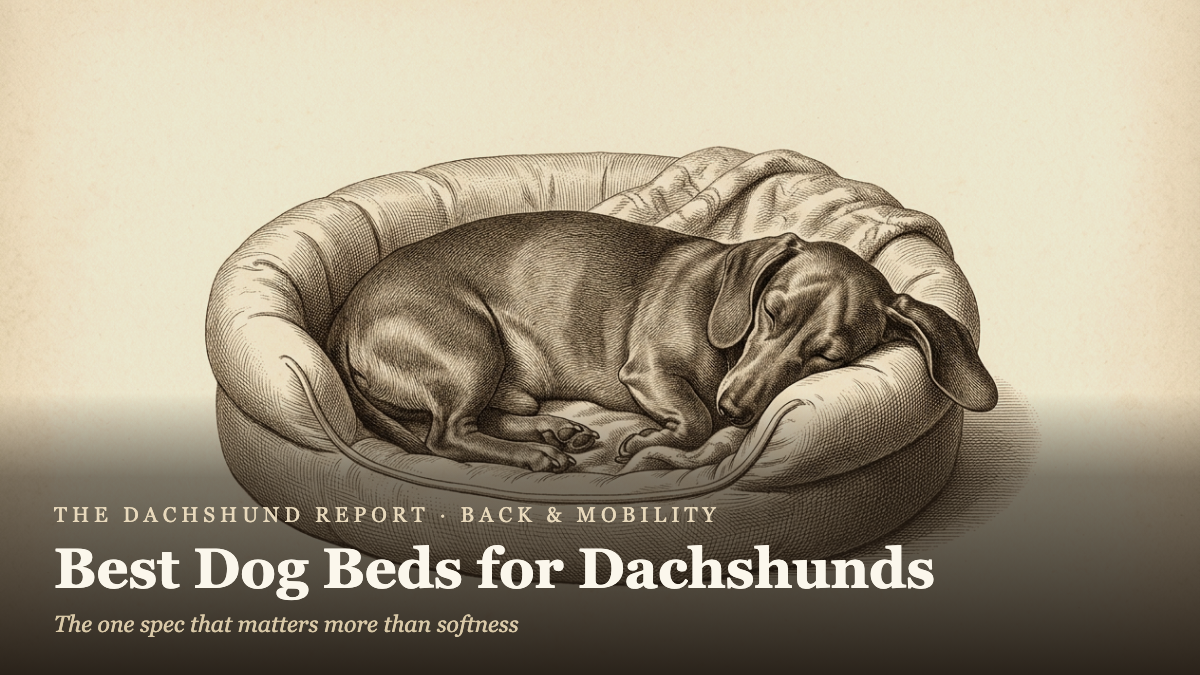
The best dog bed for a dachshund is an orthopedic bed with memory foam or egg-crate foam that supports the full length of their spine, sits low enough that they don't have to jump in and out, and — ideally — lets them burrow. Dachshunds have the highest rate of spinal disc disease of any breed, so a bed isn't just comfort. It's infrastructure.
You know what nobody told me when I first started learning everything I could about these little sausage dogs?
That the bed matters.
Not in a "oh, get something cute from HomeGoods" way. In a "this is actually a spine-health decision for a breed where up to 1 in 4 will face disc disease depending on variety" way.
And yet every "best dog bed" list on the internet is written for Labs and Golden Retrievers. Big fluffy pillow, toss it in the corner, done.
Your dachshund is not a Lab.
Your dachshund is a 15-pound animal with the longest spine-to-leg ratio in the dog world, a genetic predisposition to disc problems that can cost $10,000+ in surgery, and an obsessive need to burrow under things.
The bed should work for that dog.
So here's what actually matters — and what doesn't.
What Should You Look for in a Dachshund Dog Bed?
Three things. That's it. Every bed decision comes down to these three.
1. Real orthopedic support (not just the word "orthopedic" on the box).
"Orthopedic" is an unregulated marketing term in the pet industry. Any bed can slap it on the label.
What you actually want is memory foam or egg-crate foam — material that distributes your dachshund's weight evenly across their spine instead of letting their midsection sag into a hammock shape. VCA Hospitals recommends "an orthopedic or memory foam bed to reduce pressure on sore joints and improve sleep quality" for dogs with joint concerns.
For a dachshund, the spine IS the joint concern. The whole spine.
A University of Pennsylvania clinical trial found that dogs sleeping on therapeutic orthopedic beds showed reduced pain and improved mobility over 28 nights. That study used large breeds, but the principle — even weight distribution reduces pressure on compromised joints — applies to any dog whose skeleton is under mechanical stress.
And no breed's skeleton is under more mechanical stress than your dachshund's.
2. Low entry height.
This one sounds obvious until you realize how many orthopedic beds sit 6-8 inches off the ground. That's a jump for a dog whose legs are 5 inches long.
The whole point of keeping your doxie off the couch and setting up ramps is to eliminate repetitive impact on their spine. Then you buy a bed they have to leap into twelve times a day.
Look for beds that sit flush with the floor or have a low-profile entry point — ideally under 4 inches, or with a dipped front panel they can walk into.
3. The burrow factor.
Dachshunds burrow. They were literally bred to dig into underground badger dens. It's not a quirk — it's 400 years of purpose-built instinct.
A dachshund who can't burrow in their bed will burrow under your couch cushions, under your comforter, under the laundry pile. They're going to burrow somewhere.
A bed with a hood, cave design, or attached blanket lets them satisfy that instinct in a place that also supports their back. That's the sweet spot.
Best Dog Beds for Dachshunds (the ones worth looking at)
I'm not going to list fifteen beds and call them all "great." Here are four that actually check the three boxes above — support, entry height, and burrow factor — with real specs.
FurHaven Snuggery Orthopedic Burrow Bed
This is the dachshund internet's favorite bed, and for once, the crowd is right.
- What it is: A round, nest-shaped bed with egg-crate orthopedic foam and an attached hood/blanket your doxie can crawl under
- Size: 26-inch (for dogs up to 30 lbs — fits standards and minis)
- Foam: Egg-crate orthopedic base (not memory foam — egg-crate provides airflow + support)
- Entry height: Sits nearly flush with the floor — no jumping required
- Burrow factor: High. The attached blanket hood is the entire point. Your dachshund will disappear into this thing within 30 seconds
- Price: Around $27–$37 depending on color and retailer
- Where: Amazon (55,000+ ratings) and Chewy
- Washable: Yes — removable, machine-washable cover
The hood has a flexible plastic hoop you can remove if your dog prefers an open bed, but in my experience... dachshund owners never remove the hood. That's not why you bought it.
Bedsure Orthopedic Bolster Sofa Bed
If your doxie is more of a "lean against something" sleeper than a burrower, this is the one.
- What it is: A sofa-style bed with three-sided bolsters and an egg-crate foam base
- Size: Small (20x25 inches) fits most dachshunds; medium available for big standards
- Foam: High-density egg-crate foam for even weight distribution
- Entry height: Low — the open front sits about 3 inches off the ground
- Burrow factor: Low (no hood). But the bolsters give head and neck support, which PetMD notes "can be helpful for dogs that need extra neck and head, and spine support"
- Price: Around $30–$40 depending on size
- Where: Chewy and Amazon
- Washable: Yes — removable cover, machine-washable
This is the bed for the dachshund who sleeps with their chin propped on something. You know the one. Head on the armrest, body stretched out like a tiny furry croissant.
Casper Bolster Dog Bed
The premium pick. Casper makes human mattresses (you've seen the subway ads), and they applied the same foam-layer engineering to their dog bed.
- What it is: A rectangular bed with supportive foam bolsters on three sides and a low-profile front entry
- Size: Small (17x27 inches — the proportions actually suit a dachshund's long body well)
- Foam: Dual-layer — pressure-relieving memory foam over durable support foam
- Entry height: Low front dip for easy access
- Burrow factor: None (open design). This is pure support, not a cave
- Price: Around $125
- Where: Chewy and Casper.com
- Washable: Yes — zippered nylon cover, machine-washable, hidden zippers so they don't scratch your floors
Is it four times the price of the FurHaven? Yes. Is the foam meaningfully better? Also yes. The dual-layer setup gives you that "sinks in but doesn't bottom out" feel that cheap foam beds lose after six months.
If your dachshund already has back problems or is recovering from an episode, this is the bed that earns its price tag.
PetFusion Ultimate Lounge
The one PetMD picked as their "Best in Show" orthopedic bed, and it works well for dachshunds in the medium size.
- What it is: A rectangular bolster bed with solid memory foam base (not shredded, not egg-crate — solid 4-inch slab)
- Size: Medium (25x20 inches) fits standards
- Foam: 4-inch solid memory foam base with bolster support on three sides
- Entry height: Low front entry
- Burrow factor: None
- Price: Around $70–$85
- Where: Amazon and Chewy
- Washable: Yes — removable cover
The solid-slab memory foam is the differentiator here. Egg-crate foam is good. Solid memory foam that doesn't flatten is better — but it costs more and runs warmer. Trade-offs.
What Beds Should You Avoid for a Dachshund?
Just as important as what to buy.
Elevated/cot-style beds. These are great for big dogs who overheat. They're terrible for dachshunds. A cot bed is a jump, and the mesh hammock surface lets the spine sag into exactly the position you're trying to avoid. Your dachshund's back needs support from below, not suspension.
Pillow-style beds with loose polyfill. You know the kind — the big puffy circles from the pet store. They feel soft for about two weeks, then the fill migrates to the edges and your dachshund is sleeping on a fabric-covered floor. No spinal support. No longevity.
Anything too tall. If your dachshund has to jump in or out, the bed is doing more harm than good. Period. The same logic that applies to couches applies here.
Does the Bed Actually Help Their Back?
I want to be honest about this.
No dog bed will prevent IVDD. Intervertebral disc disease in dachshunds is primarily genetic — it's driven by a gene (CDDY) that causes premature disc hardening, often before a dachshund's first birthday. No foam is going to change your dog's DNA.
But here's what a good bed does do:
It reduces cumulative mechanical stress on a spine that's already predisposed to problems. It eliminates pressure points that cause stiffness and pain — especially in older dachshunds or those with early warning signs. And Dr. Julie Buzby, a veterinarian, specifically recommends memory foam and egg-crate foam beds, noting that thick cushioning helps prevent the formation of pressure sores by supporting a dog's weight evenly.
Think of it like this: you can't prevent a car accident by buying good tires. But good tires reduce wear on everything they touch, every single day.
That's what the bed does. It's the tires.
How Many Beds Does a Dachshund Need?
Lol.
The real answer is: however many spots in your house your dachshund has already claimed. Most dachshund owners I've talked to end up with two or three — one in the bedroom, one in the living room, and inevitably one that the dachshund ignores in favor of burrowing under the couch blanket anyway.
If you're going to buy one, put it where they sleep the most. If you're going to buy two, the FurHaven Snuggery for the bedroom burrow and the Bedsure Bolster for the living room lean is a solid combo for under $70 total.
FAQ
What size dog bed does a dachshund need?
Most standard dachshunds (16–32 lbs) do well with a small or medium bed — generally 20–30 inches. Miniatures (under 11 lbs) can use small or even cat-sized beds. The key measurement is length: your dachshund should be able to stretch out fully without hanging off the edge. Measure nose-to-tail and add a few inches.
Is memory foam or egg-crate foam better for dachshunds?
Both work. Memory foam conforms more closely to your dog's body and provides denser support — it's the better choice for dachshunds with existing back or joint issues. Egg-crate foam is lighter, more breathable, and more affordable. It distributes weight well but compresses faster over time. For a healthy dachshund, either is a significant upgrade over polyfill.
Should dachshunds sleep in elevated beds?
Generally, no. Elevated cot-style beds require jumping up and down — which loads the spine with exactly the kind of repetitive impact that's risky for a breed prone to disc problems. They also provide hammock-style suspension instead of firm support underneath the spine. A floor-level orthopedic bed is a better fit for most dachshunds.
Do dachshunds prefer beds with hoods or caves?
Most do. Dachshunds were bred to hunt underground — burrowing is hardwired into the breed. A bed with an attached blanket or hood satisfies that instinct and often helps anxious dachshunds feel more secure. That said, some dachshunds prefer an open bolster bed. You know your dog.
How often should you replace a dachshund's orthopedic bed?
When the foam stops bouncing back. Press your palm into the center of the bed, remove it, and watch. If the indent stays for more than a few seconds, the foam has lost its support. For egg-crate foam, that's typically 12–18 months with daily use. For solid memory foam, 2–3 years. A flat bed isn't orthopedic — it's just a pillow with a marketing budget.
Free: The Dachshund Back Handbook
I put everything we know about keeping these long little backs strong into one free guide — the 8 early warning signs, the furniture setup, the weight math, how to pick up a doxie the right way, and the exact checklist I'd bring to a vet visit.
It's free, it's short, and it might be the most useful thing you ever read about your wiener dog.
Grab the free Back Handbook here
(Educational only — not veterinary advice. When in doubt, call your vet. Always call your vet.)