Why Do Dachshunds Burrow Under Blankets? (They Were Built for It)

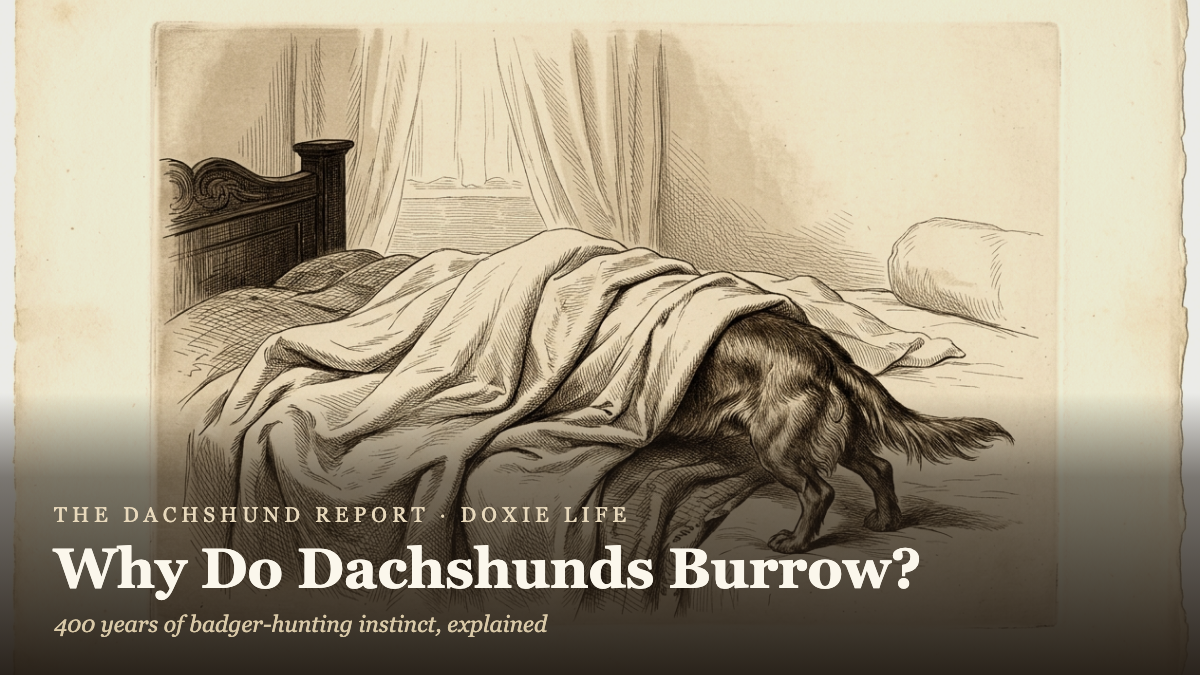
Dachshunds burrow because they were literally bred to do it — "dachs" means badger, "hund" means dog, and for over 400 years this breed was engineered to chase badgers into underground tunnels and fight them in the dark. Every part of the dachshund body — the short legs, the barrel chest, the paddle-shaped paws, the well-developed lungs — was designed for life below ground. When your doxie disappears under your comforter, it's not being cute. It's doing its job.
You know the scene.
You're making the bed. You smooth the comforter. You toss the pillows. And somewhere in the middle of all that, a 12-pound sausage dog has vanished.
Like... vanished.
You check the floor. You check the closet. You're about to check the neighbor's yard.
Then the blanket moves.
Just a little lump. Breathing calmly. Completely unbothered.
Every dachshund owner has lived this moment. And most of us just laugh and say "she's burrowing again."
But the real story behind why your doxie does this is way more interesting than you'd think. And it starts in Germany. About 400 years ago. With a badger.
What Were Dachshunds Actually Bred to Do?
The name says it all if you speak German.
Dachs = badger. Hund = dog.
The Dachshund Club of America puts it plainly: this breed was developed in Germany beginning as early as the 15th century to hunt badgers — animals that are genuinely dangerous, weigh 25–30 pounds, and live in networks of underground tunnels called setts.
Think about that for a second. Your dog — the one who just stole a sock — comes from a line of dogs bred to crawl alone into a dark hole in the ground and fight an animal roughly its own size. In the dark. Underground. By itself.
The AKC breed standard still describes the dachshund as "courageous to the point of rashness." That's not marketing. That's a job description.
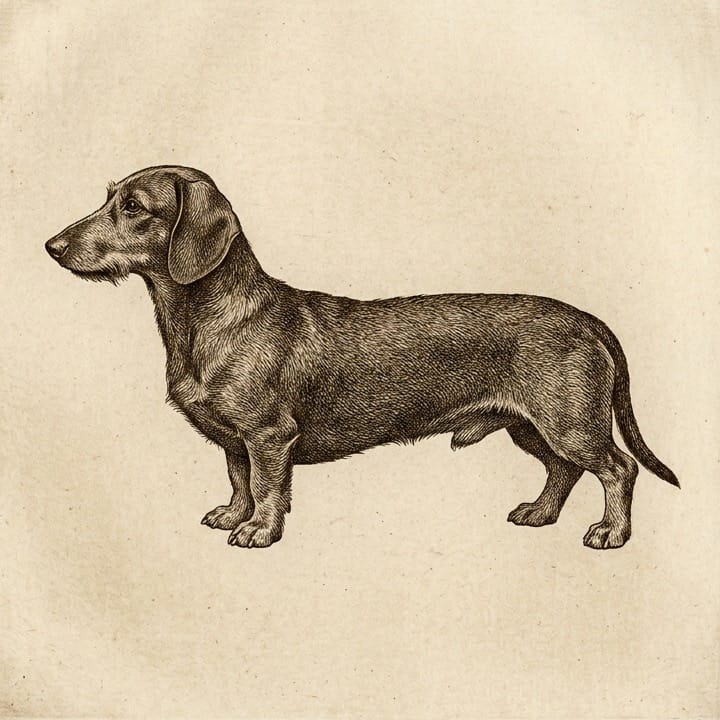
And the body? Every single piece of it was designed for underground work:
- Short legs — not a birth defect. Bred deliberately to fit inside tunnels.
- Barrel chest — the breed standard calls for a chest that allows "complete development of heart and lungs" — built for oxygen management underground where air is thin.
- Paddle-shaped front paws — built for digging through dirt and clay.
- Long, sturdy tail — functioned as a handle for hunters to pull the dog out if it got stuck in a burrow.
- Floppy ears — not just adorable. They fold over the ear canal to keep dirt out while digging.
- Loose skin — lets the dog turn around in tight spaces without tearing.
- The bark — disproportionately loud for a small dog. That's so the hunter above ground could track the dog's location by sound while it was underground.
Your dachshund doesn't burrow under blankets because it's cold. It burrows under blankets because 400 years of selective breeding shaped every bone in its body to disappear into tight, dark, enclosed spaces — and its brain still runs that software.
Is It Safe for Dachshunds to Sleep Under Blankets?
This is the question I get asked the most, and the answer from veterinarians is reassuring.
Veterinarians generally agree that healthy adult dogs are not at significant risk of suffocating under blankets. PetMD's vet-reviewed guide on blanket safety recommends using "lightweight" and "breathable" blankets and notes that most dogs will naturally reposition if airflow becomes restricted.
Dogs can sense changes in oxygen and will move if they're uncomfortable. Their noses are positioned to create natural air pockets even under fabric. And dachshunds specifically have been doing this for centuries — their respiratory systems are literally built for low-oxygen environments underground.
The exceptions — and these matter:
- Brachycephalic breeds (flat-faced dogs like pugs and bulldogs) have a harder time. Your dachshund doesn't have this problem — it has a long snout designed to filter dirt from air.
- Very young puppies or senior dogs with respiratory conditions should be monitored more carefully.
- Heavy, weighted blankets are worth avoiding since they restrict the dog's ability to reposition.
But a standard comforter on a bed with a healthy adult dachshund? Let them burrow. It's not a behavior problem. It's a breed feature.
Is It Instinct, Comfort, or Temperature — or All Three?
All three. And they stack on top of each other in a way that's unique to this breed.
Layer 1 — The hunting instinct. This is the 400-year-old programming we just covered. No other common pet breed was selected specifically for underground work over this many generations. The drive to enter enclosed spaces is deeper in a dachshund's DNA than it is in virtually any other companion dog.
Layer 2 — The denning instinct. This one is older than any breed. All dogs descended from wolves, and wolves are den animals. They sleep in enclosed spaces — caves, hollowed logs, dugout dens — because it's safer than sleeping in the open. Your dog's crate preference, its tendency to sleep under tables, its love of the space behind the couch — that's the wolf. But in a dachshund, the wolf denning instinct sits on top of a purpose-bred tunneling drive. It's a double instinct: one from canine ancestry, one from breed-specific selection. The burrowing impulse in a dachshund isn't just stronger than in other dogs — it's architecturally different.
Layer 3 — Thermoregulation. Dachshunds are small dogs with a high surface-area-to-mass ratio. They lose body heat fast. Burrowing under blankets creates a warm microenvironment — the same reason they'll seek out sun patches, warm laps, and heated floors. Smooth-coated dachshunds are the most cold-sensitive (minimal insulation), which may be why many owners report their smooths burrow more obsessively than wire-haired dachshunds, who were bred with a rough coat for brush and thorn protection.
Layer 4 — Security and comfort. Being swaddled in fabric mimics the tight, enclosed feeling of a burrow. It's genuinely calming. The same principle behind deep pressure therapy — the reason weighted blankets work for humans with anxiety — applies to dogs. The gentle pressure against the body activates the parasympathetic nervous system. Your dachshund isn't just hiding. It's decompressing.
So when you see a dachshund disappear under a blanket, it's not one thing. It's four things happening at once — instinct, ancestry, biology, and neurology — all pointing at the same behavior.
Do All Three Coat Types Burrow the Same Way?
Not exactly. And this is one of those details that makes dachshund people nod and go "that's SO true."
The three dachshund varieties — smooth, wire-haired, and long-haired — were bred for different terrain:
- Smooth dachshunds were the original, bred for standard underground badger work. They tend to burrow the hardest and the deepest — fully under the blanket, head and all, no daylight. They're also the most cold-sensitive, so the thermoregulation layer is strongest.
- Wire-haired dachshunds were crossed with terriers to handle rough brush, brambles, and thorns above ground. They still burrow, but many owners report they're more likely to nest — arrange the blankets around themselves rather than tunnel completely underneath.
- Long-haired dachshunds were bred for forest and water work, crossed with spaniels. They're often described as the most laid-back of the three, and their burrowing tends to be more relaxed — under the blanket, but usually with the head poking out. Their longer coat provides more natural warmth, so the temperature-driven urgency is lower.
These are generalizations — your individual dachshund might be the exception to every one of them. But if you've ever wondered why your smooth dachshund acts like the blanket is a matter of survival while your friend's wire dachshund just pushes it around — breeding is the answer.
What Does Burrowing Have to Do With Stubbornness?
Everything, actually.
Dachshunds are famous for being stubborn. But "stubborn" is a human word for something more interesting.
When a dachshund was underground in a badger sett, its owner couldn't see it, couldn't direct it, and couldn't help it. The dog had to make its own decisions — go left or right, push forward or back up, fight or wait. Every moment underground required autonomous judgment.
A dachshund that waited for instructions from a human above ground was a dead dachshund.
So the breed was selected, generation after generation, for dogs that trusted their own instincts over external direction. Dogs that would decide for themselves. Dogs that — if you gave them a command they disagreed with — would politely ignore you.
Any dachshund owner can tell you: this independence can be frustrating. You call, they look at you, and they stay exactly where they are.
But when your dachshund decides it's bedtime, disappears into the blankets without asking you, and ignores every attempt to lure it out — that's not a behavior problem.
That's the same brain that kept its ancestors alive underground.
Can You Still See This Instinct in Action?
Yes. It's called Earthdog.
The AKC Earthdog program is a series of non-competitive tests where dogs navigate man-made underground tunnels to locate caged rats (the rats are safely protected behind barriers — no animals are harmed). The tunnels get longer and more complex at each level.
Dachshunds and terriers are the eligible breeds. And watching a dachshund encounter an Earthdog tunnel for the first time — a dog that has never been near a burrow in its life, that was raised in an apartment, that has never seen a rat — is something else.
They know what to do. Instantly.
Four hundred years of breeding doesn't go away because you live in a condo. It just redirects itself to the nearest blanket.
FAQ
Should I buy a burrow bed for my dachshund?
Most dachshunds love them. A cave-style or hooded bed gives your doxie a dedicated burrowing spot that's always available — especially useful if you don't want paw prints rearranging your comforter every night. Look for one with a removable, washable cover (dachshunds are not clean burrowers). But honestly, most dachshunds will still choose your bed and your blankets over a purpose-built cave bed. That's the badger dog in them — they prefer the spot you didn't want them in.
Is my dachshund burrowing because it's anxious?
Sometimes, but usually not. Burrowing in dachshunds is primarily instinct-driven, not anxiety-driven. The breed does it when relaxed, when happy, when bored, and when tired. If the burrowing is paired with other anxiety signs — panting, pacing, whining, destructive behavior when you leave — then the burrowing may be a symptom of something bigger, and a vet visit is a good idea. But a dachshund that calmly tunnels under the covers and falls asleep? That's a dachshund being a dachshund.
How do dachshunds breathe under blankets?
Their long snouts create natural air pockets in fabric. Unlike flat-faced breeds, dachshunds have efficient airways built for underground work where air is limited. Most blankets are porous enough to let air through. Dogs can also sense changes in oxygen levels and will move if the air becomes stale. That said, avoid heavy weighted blankets and check on senior dogs or puppies more frequently.
Why does my dachshund dig at the blankets before lying down?
It's nesting — and it's exactly what their ancestors did in burrows. Wild canids circle and dig before lying down to create a comfortable depression and check for threats. Dachshunds take it further because they're also shaping the "tunnel" to their liking. The scratching, circling, and rearranging is preparation behavior, not destruction. If they're shredding your good sheets, redirect them to a dedicated blanket or burrow bed.
Do dachshund puppies burrow from birth?
Many dachshund breeders report burrowing behavior in puppies as young as a few weeks old — they'll tunnel under littermates, towels, and anything soft. The behavior strengthens as they grow. It's one of the earliest breed-specific behaviors to emerge, which tells you how deep the instinct runs — this isn't learned behavior. It's hardwired.
Your Daily Dose of Dachshund Love
If you liked this one, we send out stories like this on the regular — breed deep dives, health tips, and the kind of doxie content that makes you look at your wiener dog a little differently.
No spam. Just dachshunds.
(The Doxie Report is written for entertainment and education — not veterinary advice. When in doubt, call your vet.)