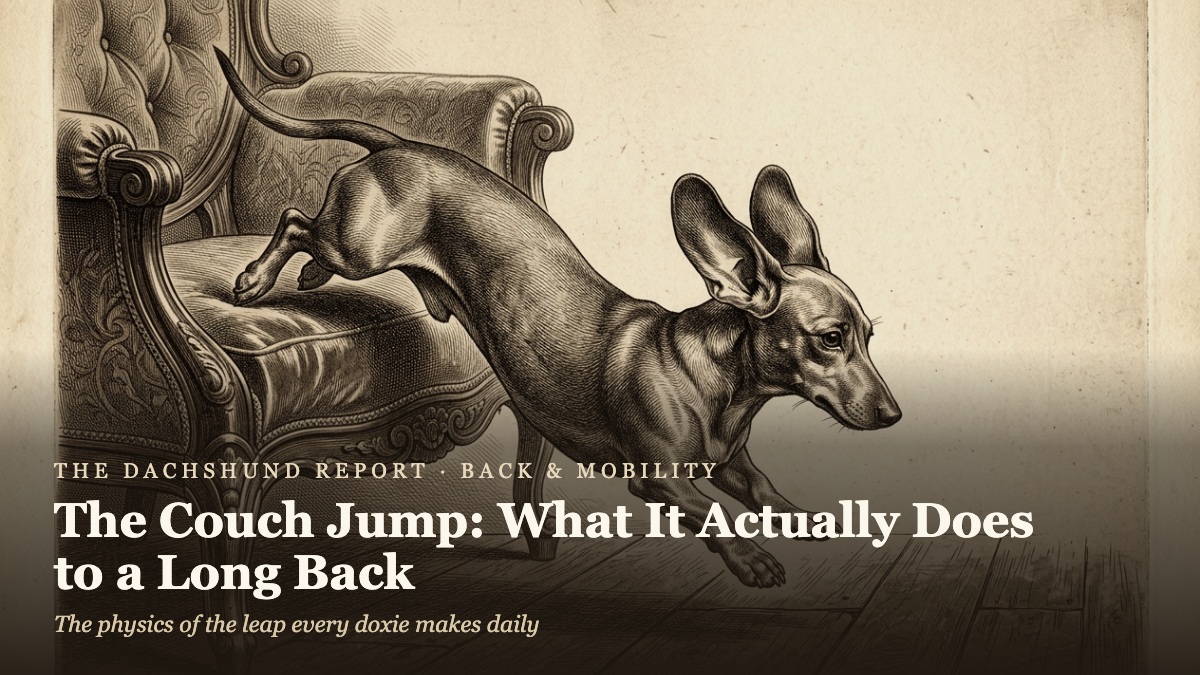
The Couch Jump: What It Actually Does to a Long Back

A single couch jump almost never injures a healthy dachshund — but it's one of the highest-impact moves a long back makes all day, repeated thousands of times a year onto discs that age prematurely in this breed. Research hasn't shown furniture-jumping causes back disease on its own (genetics, weight, and fitness matter more), but veterinarians — including Cornell's canine health center — commonly recommend a ramp or steps so the trip down becomes a walk instead of a drop.
You know the sound.
You're in the kitchen. You touch the treat bag — barely touch it — and from the living room comes the thump.
Four ounces of paws, twelve pounds of sausage, one hardwood floor.
And somewhere deep in your Doxie-parent soul, a tiny alarm goes off: should he be doing that?
I've stood in that kitchen. I've heard that thump. So let's actually answer the question — with receipts, not Facebook-group panic.
Is it bad for dachshunds to jump off the couch?
Here's the honest version: the jump up is exercise. The jump down is the one worth thinking about.
To understand why, you need to know one slightly unfair fact about our little long dogs. Dachshunds are what vets call a chondrodystrophic breed — the gene that gives them those glorious stumpy legs also changes their spinal discs. According to the Cornell Richard P. Riney Canine Health Center, the soft, jelly-like center of the disc begins hardening prematurely — starting between birth and one year of age. A disc that should work like a fresh gummy bear spends most of a doxie's life working like a stale one.
That hardened disc doesn't absorb shock the way it's supposed to. And when it fails, it can fail the dramatic way — Cornell describes Type I disc disease as the center of the disc rupturing through tears in the outer layer, pressing on the spinal cord.
Now picture the couch jump again.
Going up: a push from those surprisingly jacked little hindquarters. Controlled. Muscle-building, even.
Coming down: a front-loaded landing from a height taller than the entire dog, jolting through a spine that's basically a suspension bridge carried on four soup cans.
One landing? Fine, almost always. The five-thousandth landing on a disc that's been quietly stiffening since puppyhood? That's the math your vet is doing when they wince.
That's why Cornell's guidance for these breeds includes providing steps or ramps to reduce jumping on and off objects — not banning movement, just taking the repeated drop out of the daily routine.
Wait — didn't a study find that furniture-jumping dogs did BETTER?
Ah. You've met my favorite plot twist.
Yes — in DachsLife 2015, the largest dachshund lifestyle study ever done (2,031 dogs, published in Canine Genetics and Epidemiology), dogs who were not allowed to jump on and off furniture actually had higher odds of back disease than dogs who were allowed.
I wrote about this same beautiful weirdness in the stairs article, because the researchers found the same pattern there: movement-restricted doxies did worse, not better.
Two things can explain it, and both matter:
Muscle. A doxie who moves freely all day — climbs, hops, trots, patrols the yard for crimes — builds the spinal musculature that supports those discs. The bubble-wrapped couch potato isn't protected. He's deconditioned.
Reverse causality. Some owners banned furniture after their dog's back trouble started — which makes "no jumping" look risky in the data when really it's "already hurt." The researchers flag this themselves.
So no, the science does not say the couch jump is fine. And it does not say the couch jump is doom. It says: fit, lean, freely-moving dachshunds do best — and a survey can't measure what ten years of hard landings does to one unlucky disc.
Which is why my personal answer is the boring middle one: let them be athletes, and take the drop out of the day anyway. The ramp costs you nothing in muscle — the dog still walks up and down it — it only deletes the impact.
What actually protects a dachshund's back?
If you're going to spend worry-energy, spend it here, in order:
Weight. Always weight. In a 2013 study of 700 dogs, researchers found being overweight significantly increased the risk of disc extrusion — and that relatively longer-backed dogs carried more risk in the first place. In that study, a Miniature Dachshund's probability of disc extrusion went from 0.30 at a back-length-to-height ratio of 1.1 to 0.68 at 1.5. You can't change your doxie's blueprint. You absolutely control what the blueprint has to carry. (The weight math lives in the full back-problems handbook.)
Fitness. DachsLife found doxies getting less than 30 minutes of exercise a day had higher odds of IVDD, while the over-an-hour crowd had lower odds. Daily walks are spine maintenance, not a treat.
Managing the hard landings. The couch, the bed, the back of the SUV, your arms (that's a whole article of its own) — anywhere the dismount is a drop onto a hard surface, give them a walkable route down. Ramp or steps at the couch and bed, a rug at the landing zone, runners on slick floors so the landing gear doesn't slide out sideways.
Knowing the whispers. A doxie who suddenly hesitates at a couch he's launched off for years isn't being dramatic. That hesitation is a message — reluctance to jump is one of the 8 early signs a doxie's back is bothering them, and it's one vets specifically list. Sudden reluctance = phone call to your vet. Not tomorrow. Today.
How do I stop my dachshund from jumping off the couch?
You don't stop a dachshund with willpower. Anyone who's tried to out-stubborn one knows this. You make the easy path the safe path:
1. Give them a down-route. A ramp or pet steps against the couch — I broke down which ramps are actually worth the money, including the incline spec most of them get wrong. Placement matters — put it where they naturally dismount, usually the spot facing the door you exit through, because let's be honest, they're following you.
2. Bribe shamelessly. Toss a treat at the bottom of the ramp every time they use it for a week. Doxies are many things; above negotiating for food is not one of them. Most dogs make the switch in days.
3. Soften the drop zone anyway. A thick rug where they land, for the times enthusiasm defeats training. It also fixes the slippery-landing problem, which is its own little ankle-roll horror show on hardwood.
4. Don't yell mid-air. Startling a jumping dog changes the landing, and never for the better. Train the route; ignore the freelancing.
5. Puppies and seniors get chauffeur service. Young joints and old eyes both handle drops worst. Lift them down (properly — chest and rear supported, spine level) until the ramp habit sticks.
And if your doxie has diagnosed back disease, has had an episode, or is in recovery — none of this article's "movement is good" talk applies over your vet's instructions. Restricted activity after a disc episode exists for a reason. Your vet outranks me, the studies, and certainly the dog.
Anyways...
Tonight, mine will hear a cheese wrapper from three rooms away, hit the ramp at a full gallop, and take the corner like a furry little rally car.
Athletes use the equipment. That's the whole trick.
FAQ
Is it OK for my dachshund to jump ON the couch?
Jumping up is far less concerning than jumping down — going up is a controlled push from the rear legs, while coming down sends impact through the front end and spine. The DachsLife 2015 study actually found furniture-access dogs had lower odds of back disease, likely reflecting overall fitness. If you add a ramp, most of the worry disappears in both directions.
Can one jump off the couch hurt a dachshund?
It's uncommon in a healthy dog, but yes — it's possible, because dachshund discs degenerate prematurely and a weakened disc can rupture during ordinary movement. If your doxie ever yelps on landing, limps, trembles, walks oddly, or suddenly won't jump at all, treat it seriously and call your vet the same day.
What height is safe for a dachshund to jump from?
There's no vet-established "safe height" number, and I won't invent one. The sensible rule: lower is gentler, soft landings beat hard ones, and anything at couch height or above — roughly the dog's own height or more — is worth a ramp. Height matters less than repetition, surface, and the individual dog's weight and condition.
My dachshund jumped off the couch and is now shaking or limping. What do I do?
Call your vet now — don't wait to see if it passes. Pain, trembling, limping, a hunched back, or wobbly walking after a jump are exactly the signs vets tell dachshund owners never to sit on, because disc problems progress fastest in the first hours. Keep them still and contained (a crate or small room) until you're told otherwise.
Do ramps actually work for dachshunds?
A ramp converts a drop into a walk, which is the entire goal — and providing ramps or steps is part of Cornell's published guidance for chondrodystrophic breeds. The catch is training: a ramp your doxie ignores protects nothing, so anchor it in place, make it grippy, and pay the treat toll for a week.
Free: The Dachshund Back Handbook
The couch is one corner of the bigger picture — I put the whole thing in one free guide: the 8 early warning signs, the furniture setup, the weight math, how to pick up a doxie the right way, and the exact checklist I'd bring to a vet visit.
It's short, it's free, and it might be the most useful thing you ever read about your wiener dog.
Grab the free Back Handbook here
(Educational only — not veterinary advice. When in doubt, call your vet. Always call your vet.)