Best Harness for Dachshunds: What the Research Says (and What Every Roundup Leaves Out)

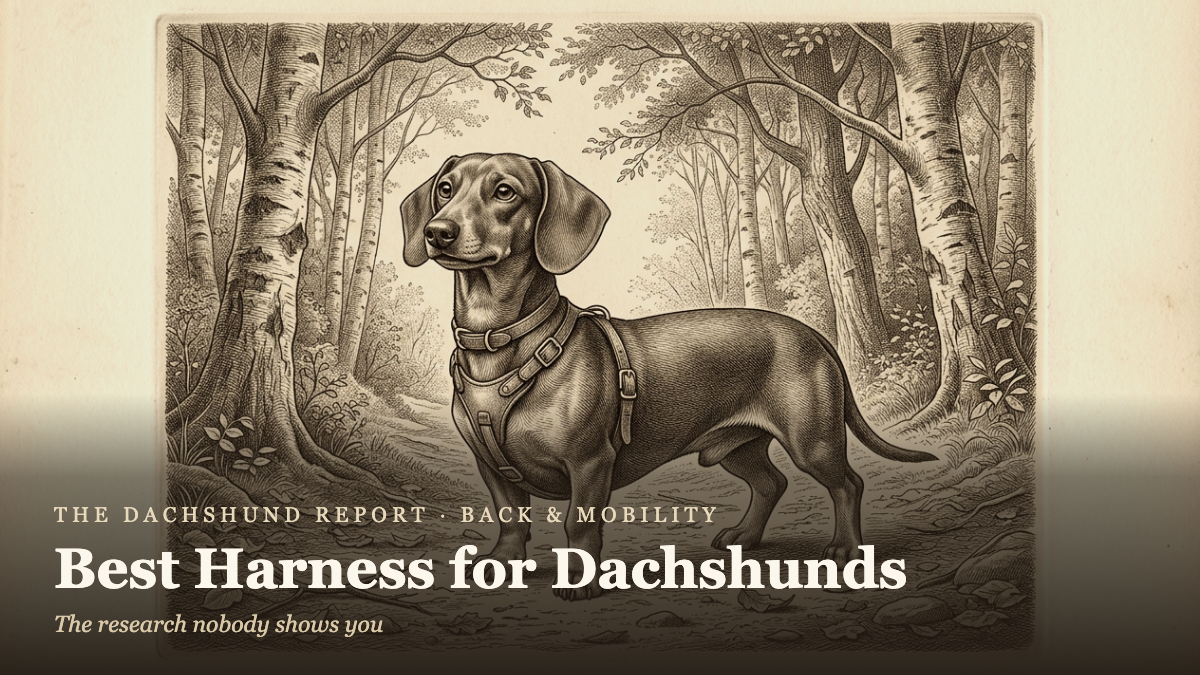
The best harness for a dachshund distributes leash pressure across the chest — never the neck or spine — fits snugly without restricting shoulder movement, and uses a back-clip attachment point. But the harness alone doesn't protect your doxie's back. The biggest dachshund health study ever conducted found that harness dogs actually had more IVDD — and the reason why should change how you shop.
Here's a fun little fact that nobody putting together a "Top 10 Best Dachshund Harnesses" listicle wants you to know.
The largest dachshund health study ever conducted — DachsLife 2015, surveying 2,031 dachshunds across the UK — found that dogs over age 3 who were exercised in harnesses were 2.3 times more likely to have experienced IVDD than dogs walked on collars.
Two point three times.
Let that sit for a second.
Every product roundup on the internet tells you a harness is "essential for your doxie's back." And here's the biggest study of its kind saying... the opposite?
Not exactly.
But the real answer is more interesting — and more useful — than "just buy this one."
Why Did Harness Dogs Get More IVDD?
Before you go throw your harness in the trash, here's what the researchers (and every vet who's read this study) will tell you: correlation is not causation.
The most likely explanation is reverse causality. Dogs who already had back problems — or whose owners were already worried about their backs — were more likely to be switched to a harness. The harness didn't cause the IVDD. The IVDD caused the harness.
It's the same reason the study found that dogs carried up stairs had higher IVDD rates. Those owners weren't creating the problem by carrying their dogs. They were carrying their dogs because the problem already existed.
Makes sense once you see it.
But here's the part nobody talks about: the study also found that dogs who pulled on their leads showed no increased IVDD risk — regardless of whether they wore a collar or harness. And 90-95% of dachshund disc herniations occur in the middle to lower back, not the neck.
So what does that actually mean for you?
It means the harness isn't a back brace. It's not a magic spine protector. It's a tool — and like any tool, the right one used correctly helps, and the wrong one used poorly does nothing. Or worse.
What Actually Matters in a Dachshund Harness
Forget the affiliate-stuffed roundups for a second. Here's what every dachshund owner should look for, based on what vets and canine physiotherapists actually say.
1. Zero Neck Pressure
This is the non-negotiable. Dodgerslist, the most-referenced IVDD recovery resource online, puts it plainly: a harness for a dachshund should never "wrap around the neck nor sit on the soft tissue of the neck."
A collar yanks the neck. A bad harness squeezes it. Both are problems for a breed whose neck vertebrae are part of the same vulnerable spinal column that makes dachshund back problems the #1 health conversation in every doxie group on the internet.
2. Chest-Distributed Pressure
The whole point of a harness is to spread leash force across the chest and ribcage — not concentrate it on one point. Pedigree's breed-specific guide recommends "a padded harness rather than the naked nylon type that can pull fur and chafe your dog's skin."
Padding matters. Dachshunds have thin skin over a long torso — a nylon strap cutting into their chest on a 30-minute walk is not a small thing.
3. Shoulder Freedom
This one gets missed constantly.
Amber Calleran, a canine chiropractor quoted by Dachshund IVDD UK, warns that poorly fitted harnesses cause "back issues, poor musculature, over-developed neck and shoulder muscles (often unevenly), joint problems and poor foot balance."
A harness that sits too far forward — over the shoulder blades instead of behind them — restricts the natural gait. Your dachshund compensates. Compensation changes how they move. Changed movement patterns stress the spine.
The chest strap should sit behind the shoulder blades, allowing them to move freely. The belly strap should sit about one hand's width back from the front legs.
4. Back-Clip Leash Attachment
Front-clip harnesses (where the leash attaches at the chest) are designed to redirect pulling dogs. They work by torquing the dog's body sideways when they pull.
For a dachshund? That torque goes straight through the longest back in the dog world. Use a back clip. Always.
5. Step-In or Over-Head (It Depends)
The doxie community is split on this one. Here's the honest answer: it depends on your dog.
Step-in harnesses are easier for dogs who hate things going over their head. But they're generally less secure — a determined dachshund (and they're all determined) can back out of some step-in designs.
Over-head harnesses with side-release buckles are usually more secure and, if the neck opening is wide enough, shouldn't bother most dogs.
Either way: the fit matters more than the style.
How to Measure Your Dachshund for a Harness
Dachshunds don't fit standard sizing charts. A medium Lab harness and a medium dachshund harness are not the same animal. Literally.
Here are the measurements that matter for long-backed breeds:
- Neck circumference: 12-16 inches (standard dachshund)
- Chest/belly circumference: 18-24 inches
- Back length (neck to tail base): 8-10 inches for the harness bridge
The fit test: slide your index finger under every strap. It should slip in easily but not loosely. If you can fit your whole hand, it's too loose. If your finger won't fit, it's too tight.
A harness that rides up, shifts sideways during a walk, or needs constant adjusting is the wrong size — even if the tag says it's right.
The Harnesses Worth Looking At
I'm not going to give you a ranked list of 15 harnesses with affiliate links to all of them. Here's what actually matters for a dachshund, based on what the breed community actually uses and what the specs above demand.
Ruffwear Front Range Harness (~$40-45)
The Wirecutter's top overall pick and the most-recommended harness in dachshund groups on Facebook and Reddit. Lightweight, padded, back-clip, doesn't twist. Two leash attachment points (front and back — use the back clip for your dachshund). Comes in sizes that actually fit dachshunds (XS fits most minis, S fits most standards).
The doxie community's honest take: "slightly pricier but super long lasting."
Puppia Soft Vest Harness (~$18-25)
A favorite for everyday walks. Soft air-mesh, step-in style, minimal bulk. The padding is lighter than the Ruffwear, which some owners prefer for warmer climates.
The trade-off: less adjustability. If your dachshund is between sizes, it might not dial in perfectly.
Noodle and Friends "Never Choke" Dachshund Harness
Specifically recommended by Dodgerslist — one of only two brands they name. Designed specifically for dachshunds, which means the proportions are right without having to guess at sizing charts made for corgis and beagles.
PetSafe Sure-Fit Harness (~$15-20)
The other brand Dodgerslist names. Budget-friendly, adjustable at five points, sits properly on most dachshund body types. Not as padded as the Ruffwear, but the fit mechanics are solid.
The Collar Question (Because You're Wondering)
After reading about the DachsLife harness paradox, you might be thinking: "So should I just use a collar?"
Dachshund IVDD UK's recommendation is actually surprisingly nuanced: "Use collars for general exercise" — unless your dog has had a cervical (neck) disc issue, in which case switch to a harness.
But here's what I'd add: that recommendation assumes your dog doesn't pull. If your dachshund turns into a tiny little freight train the moment they see a squirrel — and let's be honest, most of them do — a collar concentrating all that force on the neck of a breed that's already carrying the most back-vulnerable spine in the dog kingdom is not a bet I'd take.
The safe middle ground: collar for ID tags, harness for the leash. Always.
If your doxie pulls, work on leash training (it's possible — I promise — they're not actually impossible to train). In the meantime, a properly fitted harness absorbs the chaos better than a collar ever will.
The One Thing No Harness Can Do
A harness protects the neck. A good harness distributes force properly. The right harness lets your dachshund walk comfortably without restriction.
But no harness prevents IVDD.
IVDD is a genetic condition driven by the CDDY gene that causes premature disc hardening — often before your dachshund's first birthday. No piece of equipment changes that biology.
What does move the needle: regular exercise that builds the muscle tone supporting that long spine. A healthy weight that doesn't compress already-vulnerable discs. Knowing the early signs so you catch a problem in hours, not days.
The harness is one piece. An important piece. But just one.
FAQ
Do dachshunds need a harness or a collar?
Both, ideally. A flat collar carries ID tags and registration — it stays on all the time. A harness carries the leash on walks. This way, all pulling force goes through the chest, not the neck. Dodgerslist recommends always attaching the leash to a harness for dachshunds and other IVDD-prone breeds.
Why did the DachsLife study find harness dogs had more IVDD?
The DachsLife 2015 study found harness-wearing dogs over age 3 were 2.3x more likely to have experienced IVDD. Researchers attribute this to reverse causality — dogs already diagnosed with or at risk for IVDD were switched to harnesses because of the condition, not the other way around. The harness didn't cause the problem; the problem caused the harness choice.
What size harness does a dachshund need?
Standard dachshunds (16-32 lbs) typically need a small harness with a chest/belly circumference of 18-24 inches and neck circumference of 12-16 inches. Miniature dachshunds (under 11 lbs) usually need XS. Always measure rather than guessing from weight alone — dachshunds are longer and lower than other dogs in the same weight class, which throws off standard sizing.
Should I use a front-clip or back-clip harness for my dachshund?
Back-clip. Front-clip harnesses redirect pulling by torquing the dog's body sideways — a motion that puts rotational stress through a dachshund's unusually long spine. Back-clip harnesses keep force aligned with the body's natural direction of travel.
Can a harness prevent IVDD in dachshunds?
No. IVDD is a genetic condition caused by the CDDY gene that leads to premature disc hardening, often within the first year of life. No harness, brace, or piece of equipment can prevent it. A harness protects the neck from collar-related strain during walks, which is valuable — but spinal disc health is determined by genetics, weight management, and exercise, not walking equipment.
Free: The Dachshund Back Handbook
I put everything we know about keeping these long little backs strong into one free guide — the 8 early warning signs, the furniture setup, the weight math, how to pick up a doxie the right way, and the exact checklist I'd bring to a vet visit.
It's free, it's short, and it might be the most useful thing you ever read about your wiener dog.
Grab the free Back Handbook here
(Educational only — not veterinary advice. When in doubt, call your vet. Always call your vet.)