
Dachshund Pancreatitis: The Emergency Nobody Sees Coming

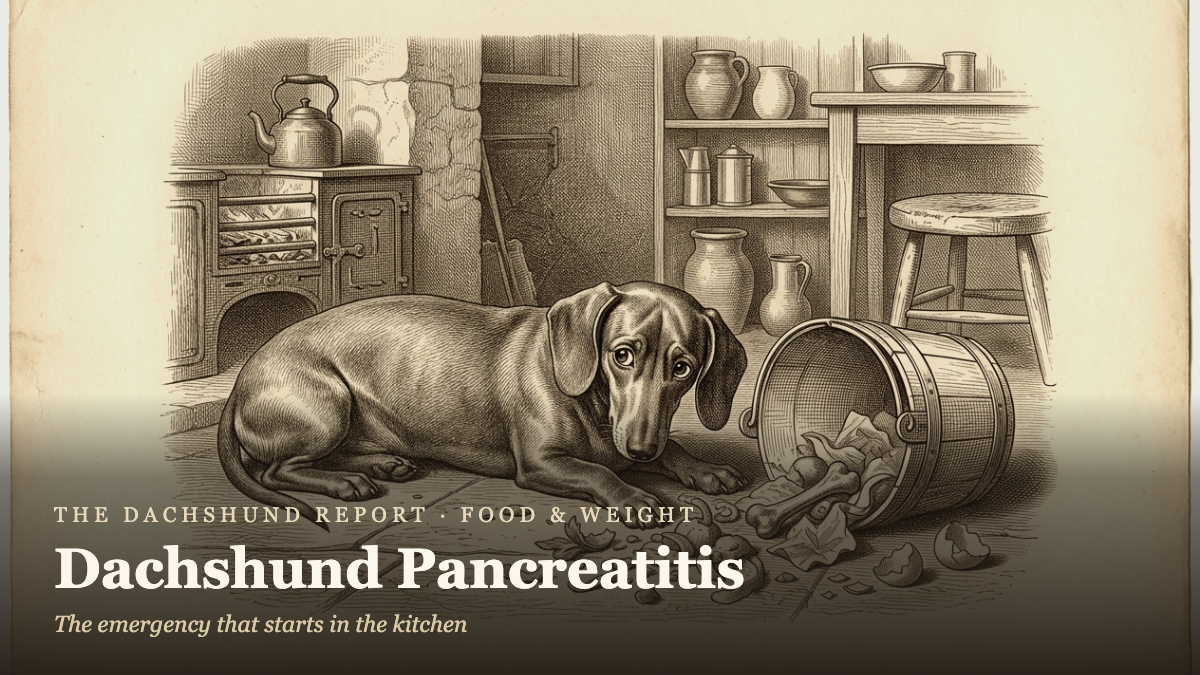
Dachshunds are one of several breeds genetically predisposed to pancreatitis — a painful inflammation of the pancreas often triggered by high-fat food, table scraps, or obesity. Warning signs include vomiting, loss of appetite, abdominal pain, and a distinctive "praying position." Treatment typically costs $500 to $5,000, and the single most important thing you can do right now is stop feeding your dachshund from your plate.
Nobody Googles "dachshund pancreatitis" on a good day.
If you're here, you're either in the middle of a scare, or you just left the vet with a word you've never had to think about before.
Or maybe — and this is the one I'm hoping for — you're the type of doxie parent who reads everything before it becomes a problem. That's who this is for.
Because here's the thing nobody tells you when you bring home a dachshund:
Everybody warns you about the back. Nobody warns you about the pancreas.
And your dachshund's breed is on the list.
Why Are Dachshunds Prone to Pancreatitis?
Not all dogs carry the same risk. The Merck Veterinary Manual names dachshunds alongside Miniature Schnauzers, Yorkshire Terriers, Cocker Spaniels, and Poodles as breeds with a higher prevalence of pancreatitis.
A 2022 review in the Journal of Veterinary Internal Medicine confirms it: dachshunds appear in the breed predisposition table for acute pancreatitis, alongside terrier breeds, miniature poodles, and cocker spaniels.
Why? The exact genetic mechanism is still being studied. But the cocktail of risk factors that come standard with dachshund ownership — a breed that runs overweight more easily than most, a body designed to carry weight it shouldn't, and an owner community that cannot resist the begging face — puts the pancreas in a position it was never meant to be in.
And then somebody drops a piece of bacon.
What Actually Happens During a Pancreatitis Attack?
Your dachshund's pancreas makes digestive enzymes. Normally, those enzymes activate in the small intestine where they belong.
During pancreatitis, they activate too early — inside the pancreas itself.
The pancreas starts digesting itself.
That's not a metaphor. That's literally what's happening. And it's as painful as it sounds.
The inflammation can be mild (your dog feels lousy for a few days) or severe (organ failure, shock, hospitalization). A 2025 study of 146 dogs with pancreatitis found that dogs with pancreatitis alone survived at a rate of 95.66%. But when kidney injury developed alongside it, survival dropped to 35.72%.
Most cases don't get that far. But the gap between "mild episode" and "ICU" is narrower than most owners realize.
What Does Pancreatitis Look Like in a Dachshund?
This is where it gets tricky — because dachshunds are drama queens about everything and stoic about the things that matter.
The same 2025 study tracked the most common signs across hundreds of cases:
- Loss of appetite: 81.51% of dogs
- Vomiting: 80.13%
- Abdominal pain: 69.17%
- Lethargy: 45.89%
- Diarrhea: 42.46%
The signature move is what vets call the "praying position" — rear end up in the air, front legs and head pressed to the floor, like they're bowing. It's how a dog tries to take pressure off a burning abdomen. If your dachshund does this, call your vet immediately.
But here's the problem: mild pancreatitis might not look like much. A day of skipping breakfast. A little less energy than usual. Maybe some vomiting that you chalk up to "he ate something weird."
In a breed that already has a reputation for being dramatic about dinner and lazy about mornings, the early signs of pancreatitis can hide in plain sight.
The rule is simple: vomiting plus skipped meals plus belly pain — even if each one alone seems minor — is a vet call. Not a "wait and see." A call.
What Triggers a Pancreatitis Attack?
This is the part that matters most, because most of the triggers live in your kitchen.
The JVIM review identifies these dietary risk factors:
- High-fat diets — the number one trigger
- Table scraps — especially fatty ones
- Trash ingestion — the classic dachshund heist
- Unusual food items — anything outside the normal diet
Dr. Sue Lim at Texas A&M explains the mechanism: high-fat food spikes triglycerides in the blood (hypertriglyceridemia), and that excess fat is what triggers the pancreas to misfire.
Translation: that one piece of turkey skin at Thanksgiving isn't "just a treat." For a genetically predisposed 12-pound dachshund, it's a potential $5,000 vet bill wrapped in gratitude. (If your dog is already showing food sensitivity, our food allergies guide covers the elimination process.)
Other risk factors from the same review:
- Obesity — overweight dogs are at higher risk (and if you've read our overweight dachshund guide, you know how fast the weight creeps up on a wiener dog)
- Certain medications — including some steroids and seizure drugs
- Endocrine disorders — hypothyroidism, Cushing's disease, diabetes
- Age — risk increases as your dachshund gets older
The holiday season is the danger zone. Fatty leftovers, well-meaning relatives slipping food under the table, a trash can full of turkey drippings. Vets see pancreatitis spikes every November and December.
The Dachshund Double Problem: Weight + Predisposition
Here's where it compounds.
Dachshunds are already one of the breeds most likely to run overweight. Packer et al. (2013) studied 700 dogs and found that even moderately overweight dachshunds had increased rates of disc extrusion. But obesity doesn't just threaten the back — the JVIM review lists obesity as an independent risk factor for pancreatitis too.
So an overweight dachshund isn't carrying one risk. They're carrying two — one in the spine and one in the pancreas — and the fix for both is the same: controlled calories, measured meals, and treats that earn their place in the daily calorie budget.
If you're not sure where your dachshund stands, the rib test from our weight guide takes ten seconds. Can you feel ribs with light pressure? Good. Can you see them from across the room? Too thin. Can't find them at all? That's the problem.
And while you're at it, check our treats guide — a single Greenies Petite chew is 52 calories, which is an enormous chunk of a mini dachshund's daily budget. If you're handing out high-calorie treats on top of meals, the pancreas is keeping score.
What Happens at the Vet?
If your vet suspects pancreatitis, expect blood work (a specific pancreatic lipase test called cPLI or Spec cPL), possibly an ultrasound, and a clinical exam.
Treatment, per the Merck Veterinary Manual, is primarily supportive:
- Pain management — this is critical. Pancreatitis hurts, and unmanaged pain slows recovery.
- Anti-nausea medication — to stop the vomiting cycle
- IV fluids — especially in moderate to severe cases
- Nutritional support — small amounts of low-fat food, introduced gradually (vets no longer recommend fasting for extended periods)
Severe cases mean hospitalization — typically two to four days of IV fluids, monitoring, and medication.
PetMD puts the cost range at $500 to $5,000, depending on severity. Mild cases that catch it early sit at the low end. Severe hemorrhagic pancreatitis with hospitalization hits the high end fast.
The good news: mild pancreatitis typically resolves within one to two weeks with proper treatment.
A newer treatment option — fuzapladib sodium (Panoquell-CA1) — has received FDA conditional approval for acute canine pancreatitis, showing faster clinical improvement. Ask your vet if it's available.
Life After Pancreatitis: The Low-Fat Rules
One bout of pancreatitis changes the playbook.
Dogs that have had pancreatitis are at higher risk for another episode. And the Merck Veterinary Manual notes two serious long-term consequences:
- Exocrine pancreatic insufficiency (EPI) — when enough enzyme-producing cells are destroyed, your dog can't digest food properly. Treatable with enzyme supplements, but permanent.
- Diabetes mellitus — when insulin-producing cells are damaged. Requires ongoing management.
Neither is common after a single mild episode. But they're real possibilities after severe or repeated attacks.
The prevention playbook is the same whether your dachshund has had one episode or zero:
- Low-fat dog food — your vet may prescribe a therapeutic diet (Hill's i/d Low Fat, Royal Canin Gastrointestinal Low Fat, or Purina EN are common options). For healthy dogs, aim for food where fat is ≤10% on a dry-matter basis. (Our dog food guide covers the full breed-first breakdown.)
- No table scraps. Period. Not "just a little." Not "but it's lean." No.
- Low-fat treats only — and counted within the daily calorie budget. (Our treats guide has the calorie math.)
- Secure the trash. A dachshund who can reach the kitchen trash is a pancreatitis risk walking. These dogs were bred to dig into badger dens — a flip-top trash lid is nothing.
- Maintain a healthy weight. This is the lever you control every single day.
The hardest part? Those eyes. The ones that were engineered in a German lab specifically to make you hand over food.
Don't fall for it. The begging face is a con. A beautiful, irresistible, well-practiced con — and giving in is how a $3 treat becomes a $3,000 vet visit.
FAQ
Can dachshunds die from pancreatitis?
Yes, severe pancreatitis can be fatal — though most cases are mild to moderate and respond well to treatment. A 2025 study found that dogs with pancreatitis alone survived at 95.66%, but survival dropped dramatically when kidney injury developed alongside it. Early treatment is the difference. If your dachshund is vomiting, refusing food, and showing belly pain, don't wait.
What foods trigger pancreatitis in dachshunds?
High-fat foods are the primary dietary trigger. The JVIM review specifically names high-fat diets, table scraps, trash ingestion, and unusual food items as risk factors. For a dachshund, that means bacon, turkey skin, cheese, fatty meat trimmings, butter, and anything fried are off the table — literally. Even a single high-fat meal can trigger an attack in a predisposed dog.
How do I know if my dachshund has pancreatitis or just an upset stomach?
A one-time vomit after eating grass is probably nothing. But vomiting combined with loss of appetite, lethargy, and abdominal pain — especially if your dog takes the "praying position" (rear up, front down) — is a vet call, not a wait-and-see. The Merck Veterinary Manual notes that mild pancreatitis can look like a generic stomachache, which is exactly why it gets missed. When in doubt, call your vet.
Is pancreatitis in dachshunds preventable?
You can't eliminate the genetic predisposition. But you can control almost every trigger: feed a low-to-moderate fat diet, skip the table scraps, keep treats within the daily calorie budget, secure the trash, and maintain a healthy weight. Most pancreatitis cases involve at least one controllable risk factor. Your dachshund's genes loaded the gun — your kitchen pulls the trigger, or doesn't.
How much does pancreatitis treatment cost for a dachshund?
PetMD estimates $500 to $5,000. Mild cases caught early and treated outpatient sit at the low end. Severe cases requiring multi-day hospitalization, IV fluids, imaging, and specialist care hit the high end. Pet insurance covers pancreatitis in most policies — but only if you buy it before the first episode, since it's then considered a pre-existing condition.
Free: The Dachshund Back Handbook
I put everything we know about keeping these long little backs strong into one free guide — the 8 early warning signs, the furniture setup, the weight math, how to pick up a doxie the right way, and the exact checklist I'd bring to a vet visit.
It's free, it's short, and it might be the most useful thing you ever read about your wiener dog.
Grab the free Back Handbook here
(Educational only — not veterinary advice. When in doubt, call your vet. Always call your vet.)



