Best Dog Food for Dachshunds: A Breed-First Guide

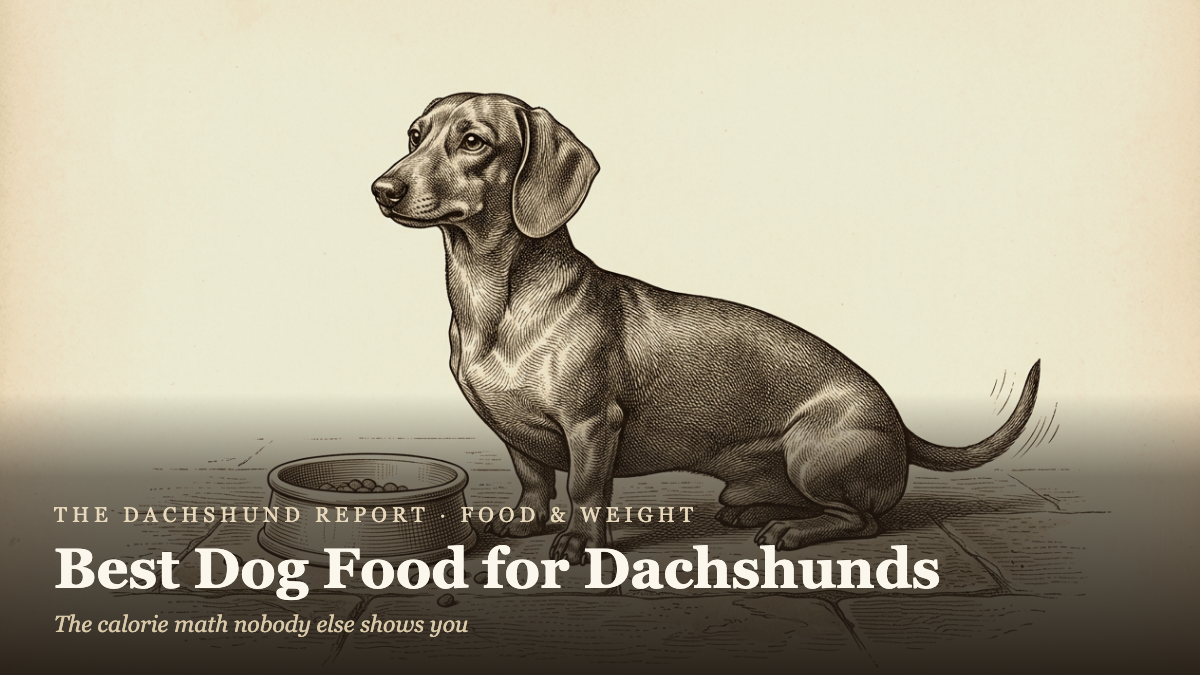
The best dog food for a dachshund is one that delivers high-quality animal protein, moderate fat, and enough joint-supporting nutrients (glucosamine, omega-3s) to feed a body that's built like a footlong hot dog with four tiny legs — while keeping weight in check, because every extra pound presses directly on the longest spine in the dog world. Standard dachshunds (16–32 lbs) need roughly 500–830 calories a day; miniatures (11 lbs and under) need less. The right food makes a measurable difference: a landmark JAVMA study found that dogs fed to maintain ideal body condition lived nearly two years longer than overfed dogs.
Here's a confession that'll get me kicked out of the dachshund blogger club:
I don't think there's one "best" dog food for dachshunds.
There. I said it.
Every article ranking for this query has a tidy list of five to ten products with affiliate links and a "Winner!" badge on the first one. And look — some of those foods are genuinely good. But the lists miss the point.
A dachshund's food isn't just fuel. It's a back decision. It's an IVDD decision. It's the difference between a wiener dog who hits ten years old running across the yard and one who hits ten years old being carried to the yard.
So before I get into brands, I'm going to tell you what actually matters in the bowl — and why.
Why does food matter more for dachshunds than other breeds?
Because of the back.
I've written about this so much that my keyboard autocompletes "intervertebral disc disease" at this point, but it bears repeating: up to one in four dachshunds will deal with IVDD in their lifetime — we break down what that means for your dog here. Their discs harden prematurely — sometimes within the first year of life. And the single biggest controllable risk factor for disc problems is weight.
Research on 700 dogs found that being overweight significantly increased the risk of disc extrusion. Dachshunds who are genetically predisposed to back problems AND carry extra weight are playing a game they can't win.
Here's how food fits in:
Every calorie your doxie eats either helps or hurts that spine. Too many calories → weight gain → extra load on discs that are already living on borrowed time. Too few of the right nutrients → weak supporting muscles, poor joint maintenance, and a body that can't do its own damage control.
Food isn't a side note. It's the daily back-health decision most doxie parents don't realize they're making.
What nutrients should dachshund food actually have?
Let's cut through the marketing. Here's what the science says your doxie's bowl needs:
High-quality animal protein (18–25%+ dry matter). AAFCO minimum for adult maintenance is 18% protein; puppies need at least 22.5%. But minimums are floors, not targets. Look for a named animal protein (chicken, turkey, salmon, beef) as the first ingredient — not "meat meal" or "animal by-products."
Moderate fat (10–15% for adults). Enough for coat health and energy, low enough to prevent weight creep. Active dogs and puppies can handle closer to 15–20%. Sedentary couch dachshunds — and let's be honest, that's most of them — do better on the lower end.
Omega-3 fatty acids (EPA and DHA). These support joint health and cognitive function. Fish oil is the most common source. A food with an omega-6 to omega-3 ratio under 5:1 is doing its job — Dr. Tim's Kinesis hits 3.25:1, which is impressive.
Glucosamine and chondroitin. Joint support isn't just a senior-dog concern for dachshunds. Royal Canin's Dachshund Adult formula includes glucosamine at 520 mg/kg and L-carnitine for muscle tone maintenance. You don't need these baked into the kibble — a separate joint supplement works too. But the breed benefits from them earlier than most.
Calcium and phosphorus in the right ratio. Supports bone and joint health. This is built into any AAFCO-compliant food, but worth checking on cheaper brands.
Fiber. Dachshunds will eat until they physically cannot eat anymore. They're genetically wired to believe every meal is their last. Adequate fiber helps them feel full without adding calorie load.
How many calories does a dachshund actually need?
This is the question nobody in the current Google results answers well. So here it is.
The standard veterinary formula is the Resting Energy Requirement (RER), multiplied by an activity factor. For a neutered adult dachshund, the multiplier is roughly 1.6 (Merck Veterinary Manual).
Standard dachshund (16–32 lbs):
| Weight | Daily calories |
|---|---|
| 16 lbs | ~495 kcal |
| 20 lbs | ~580 kcal |
| 25 lbs | ~690 kcal |
| 32 lbs | ~830 kcal |
Miniature dachshund (11 lbs and under):
| Weight | Daily calories |
|---|---|
| 8 lbs | ~320 kcal |
| 10 lbs | ~375 kcal |
| 11 lbs | ~400 kcal |
Now here's the part every other article skips: your bag of food has a kcal/cup number on it. Find it. Divide your dog's daily calorie need by that number. That's your cups per day.
If your food is 350 kcal/cup and your 20-lb standard doxie needs 580 calories a day, that's about 1.65 cups total — split across two meals. That's it. That's the math most owners never do, and it's why most dachshunds are overweight.
Treats? The AKC 10% rule — treats should never exceed 10% of daily calories. For a 10-lb mini, that's about 37 calories of treats per day. A single Milk-Bone biscuit is 40 calories. One. Let that sink in.
Should dachshunds eat grain-free food?
Short answer: it's not necessary, and there's a reason to be cautious.
In 2018, the FDA investigated reports of dilated cardiomyopathy (DCM) in dogs eating grain-free diets high in legumes. The research is still evolving and dachshunds are not among the breeds most commonly affected, but the honest take is this: most dachshunds tolerate grains just fine. Brown rice, oatmeal, and barley are perfectly good carbohydrate sources. Unless your doxie has a diagnosed grain allergy (actual allergy, confirmed by a vet — not a suspicion), grain-inclusive food is the safer default.
What about fresh food vs. kibble?
This is the question I get most in DMs.
Fresh food — the gently cooked, human-grade stuff from brands like Ollie, Spot & Tango, and JustFoodForDogs — has real advantages. Higher moisture content, less processing, and ingredients you can actually identify by looking at them. Ollie is AAFCO-compliant for all life stages and formulated by vet nutritionists.
The catch? Cost. Feeding a 20-lb dachshund fresh food runs roughly $3–6 per day. Quality kibble is $1–2 per day. Freeze-dried raw splits the difference at $2–4 per day.
Here's my honest take: the best food is one you'll consistently feed at the right amount. A dachshund fed the correct portion of good kibble will be healthier than one overfed premium fresh food. The portion matters more than the price tag.
What should I look for on the label?
Five things. Takes sixty seconds.
- Named animal protein as the first ingredient. "Deboned chicken" or "salmon" — not "poultry meal."
- An AAFCO statement that says the food is "complete and balanced."
- The kcal/cup or kcal/kg number. You need this for the portion math above.
- No artificial colors, flavors, or sweeteners. Dachshunds don't care what color their food is.
- A small-breed or breed-specific formulation. Kibble size matters — dachshunds have pointed muzzles and tiny jaws, and oversized kibble means they swallow without chewing, which means worse digestion.
What about dachshund puppies?
Dachshund puppies need food labeled "for Growth" or "for All Life Stages" — meeting the AAFCO growth nutrient profile with at least 22.5% protein. DHA from fish oil supports brain and eye development during those first critical months.
Transition to adult food around 9 to 12 months. Dachshunds are a small breed, so they mature faster than a Great Dane — they don't need puppy food as long as a large breed does. Your vet can tell you when.
And speaking of seniors: dachshunds aren't considered "senior" until about 10 years of age — later than most people think. Small breeds live longer. When yours hits that mark, look for a senior formula with reduced calories and boosted joint support.
Foods worth looking at
I'm not going to rank these with fake "Winner!" badges. These are foods that meet the criteria above, have transparent ingredient lists, and are either vet-formulated or backed by feeding trials. Your doxie's individual needs (allergies, activity level, pickiness — and dachshunds are legendarily picky) will determine which one actually works.
Kibble:
- Royal Canin Dachshund Adult — breed-specific kibble shape, glucosamine, L-carnitine. 26% protein, 12% fat. The only food designed specifically for the breed's jaw and joint needs.
- Wellness Complete Health Small Breed Adult — deboned turkey, oatmeal, small kibble. 31% protein, 17% fat. Reasonably priced grain-inclusive option.
- Dr. Tim's Kinesis All Life Stages — outstanding omega-3 ratio (3.25:1), fish oil, brown rice. 29% protein, 18% fat.
Fresh/gently cooked:
- JustFoodForDogs — vet-formulated, 100% human-grade, minimally processed. 34.5% protein.
- Open Farm Harvest Chicken — human-grade, gently cooked. 38% protein.
Puppy-specific:
- Royal Canin Dachshund Puppy — breed-specific bone and joint support formula.
- Diamond Naturals Small Breed Puppy — budget-friendly, grain-inclusive, chicken-first. 36% protein.
Senior:
- Royal Canin Dachshund 8+ — reduced calorie, enhanced joint support for aging long backs.
Does diet affect back health?
Here's where I have to be careful — and honest.
No food prevents IVDD. The disc degeneration in dachshunds is genetic. It starts before they're born. No kibble changes that.
But diet controls weight. And weight is the lever you actually have. Keeping your doxie lean — through the right food in the right amount — reduces the mechanical load on a spine that's already working overtime. That's not a claim. That's physics.
The combination of proper nutrition and regular exercise is the closest thing to a back-health insurance policy a dachshund owner has. It doesn't guarantee anything. But it stacks the odds in your dog's favor, and that's worth doing.
FAQ
Do dachshunds need special dog food?
They don't need a dachshund-branded bag, but they do need food that accounts for their unique anatomy — small kibble for their narrow jaw, controlled calories for their weight-sensitive back, and joint-supporting nutrients that most breeds don't need until they're old. A quality small-breed formula with named animal protein and moderate fat checks every box.
How much should I feed my dachshund?
It depends on weight and activity level, but a standard dachshund (16–32 lbs) needs roughly 500–830 calories per day. Check the kcal/cup number on your bag and do the math — most dachshunds are overfed because owners eyeball portions instead of measuring. Check out the full feeding chart for exact amounts by weight.
Is wet food or dry food better for dachshunds?
Both work. Wet food has more moisture and is easier to chew, which helps seniors and picky eaters. Dry kibble is more cost-effective and helps with dental health. Many owners mix both. What matters more than the format is the calorie count and ingredient quality.
Are dachshunds prone to food allergies?
Some are — the most common allergens in dogs are beef, dairy, chicken, and wheat. If your doxie has persistent itching, ear infections, or GI issues that don't resolve, your vet can run an elimination diet to identify the trigger. Don't switch to a "hypoallergenic" food on a hunch — get a diagnosis first.
Should I give my dachshund supplements?
Joint supplements (glucosamine, chondroitin, fish oil) are worth discussing with your vet, especially for a breed that faces the IVDD lottery. Some foods already include them. If yours doesn't, a separate supplement is an option — but quality varies wildly. Your vet knows which ones actually have evidence behind them.
Free: The Dachshund Back Handbook
I put everything we know about keeping these long little backs strong into one free guide — the 8 early warning signs, the furniture setup, the weight math, how to pick up a doxie the right way, and the exact checklist I'd bring to a vet visit.
It's free, it's short, and it might be the most useful thing you ever read about your wiener dog.
Grab the free Back Handbook here
(Educational only — not veterinary advice. When in doubt, call your vet. Always call your vet.)