Dachshund Food Allergies: What's Really Behind the Itchy Belly

Most dachshund food allergies are caused by proteins — beef, dairy, and chicken are the top three triggers. The only reliable way to diagnose a food allergy is an 8-to-12-week elimination diet supervised by your vet. Blood and saliva tests are not accurate. If your doxie is itching, licking their paws, or getting recurring ear infections, food could be the reason — but environmental allergies are actually more common, so work with your vet before changing anything.
You know the scratch.
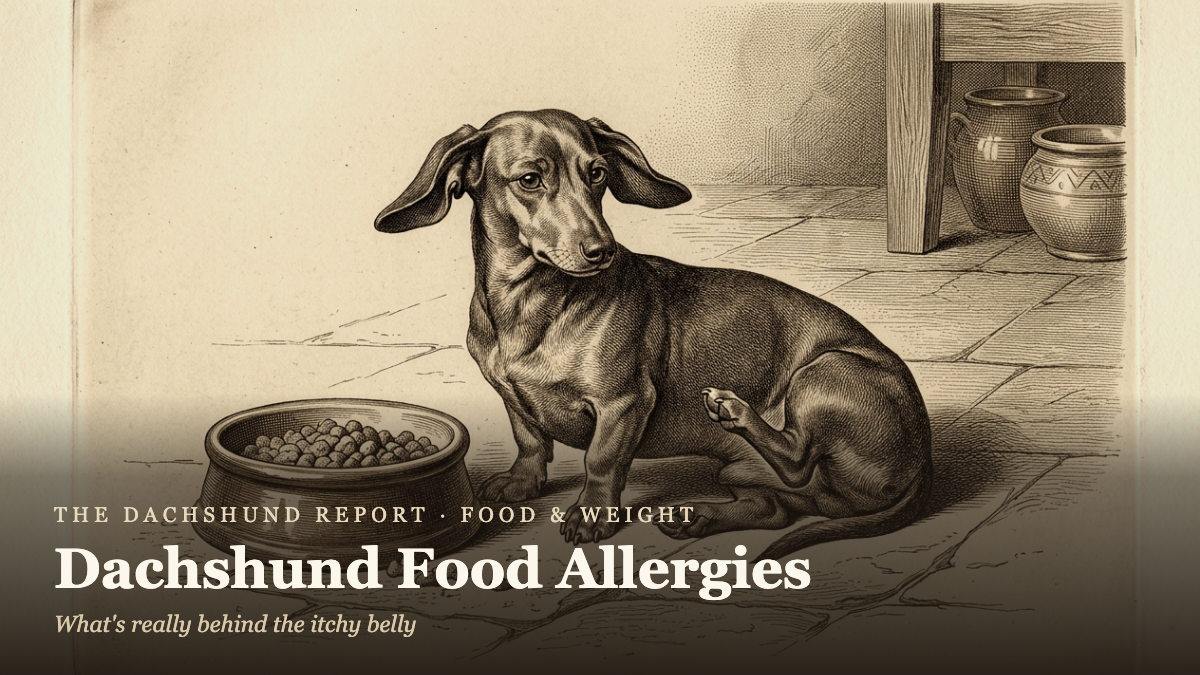
Not the normal "I found a good spot" scratch. The one that doesn't stop. The one where your doxie is going at their belly like they're trying to dig to China, except the hole is their own skin.
You've tried the oatmeal shampoo. You've switched their bed. You've side-eyed every blade of grass in the yard.
And then someone in the Facebook group drops the bomb: "It's probably their food."
So now you're standing in the pet store aisle at 9pm, reading the back of a bag that costs more than your own groceries, wondering if your 15-pound sausage dog is allergic to chicken.
Maybe. But probably not the way you think.
Here's what the research actually says — and why dachshunds get a raw deal when it comes to itchy skin.
Is It Actually a Food Allergy?
Here's the thing most people don't realize: true food allergies in dogs are less common than environmental allergies. According to Today's Veterinary Practice, only about 5% to 15% of dogs with skin or ear problems are truly food-allergic.
That means for every ten doxies scratching themselves silly, maybe one or two have a food problem. The rest? Pollen. Dust mites. Mold. Flea spit. The boring stuff.
But here's why it matters: food allergies and environmental allergies look almost identical. Same itch. Same ear infections. Same angry red belly.
The difference is what's happening under the hood.
A food allergy is your dog's immune system overreacting to a specific protein — their body treats chicken or beef like an invader and launches a full immune response. A food intolerance is different. That's more like an upset stomach — no immune system involvement, just a digestive system that doesn't agree with an ingredient.
Both can make your doxie miserable. Both get treated the same way: find the trigger, remove the trigger.
But you can't do that from a pet store aisle. You need your vet.
What Are Dogs Actually Allergic To?
Here's where it gets interesting.
A 2016 review published in BMC Veterinary Research analyzed every published food allergy case they could find — hundreds of dogs across Australia, Europe, and North America. The breakdown:
- Beef — 34% of dogs with confirmed food allergies
- Dairy — 17%
- Chicken — 15%
- Wheat — 13%
- Lamb — 5%
Notice what's at the top? The exact proteins in most dog food.
That's not a coincidence. The Merck Veterinary Manual puts it plainly: "The most common food allergens often correspond with the most commonly fed food sources."
Your dog can't develop an allergy to something they've never eaten. It takes repeated exposure — usually months or years — for the immune system to decide it has a problem with a protein it used to tolerate just fine.
Which is why the "grain-free will fix it" advice you see everywhere is usually wrong. Dogs are rarely allergic to grains. They're allergic to proteins. And the chicken in a grain-free kibble is the same chicken in a regular one.
Why Dachshunds Get the Short End of the Stick
Dachshunds aren't on the top-ten list for atopic dermatitis the way Golden Retrievers and West Highland Terriers are. But they have their own skin problems that make allergies hit harder — and look scarier.
Acanthosis nigricans. This is a skin condition where the skin in your doxie's armpits and groin turns dark, thick, and sometimes greasy. The Merck Veterinary Manual notes that the primary form is essentially unique to dachshunds — it's genetic, shows up before age one, and there's no cure (just management).
But here's the kicker: many cases of dark, thickened skin in dachshunds that look like acanthosis nigricans are actually being caused by an underlying allergy — food or environmental. The Merck Manual specifically says that in dachshunds, "many cases of cutaneous hyperpigmentation diagnosed as primary acanthosis nigricans are actually caused by underlying disease."
Translation: your doxie's dark armpits might not be acanthosis nigricans at all. They might be the symptom of a food allergy that nobody thought to test for.
And then there's the belly problem. Dachshunds ride about two inches off the ground. Their belly touches everything — the grass, the carpet, the freshly mopped floor. That constant contact means more exposure to contact allergens, which can layer on top of a food allergy and make the whole picture muddier.
What Does a Food Allergy Actually Look Like in a Dachshund?
The signs are maddeningly similar to environmental allergies. According to VCA Animal Hospitals, the most common signs of food allergies in dogs are:
Skin signs (most common):
- Persistent itching — especially paws, ears, belly, and rear end
- Recurring ear infections (if your doxie is getting ear infections more than once a year, food is worth investigating)
- Red, inflamed skin
- Hair loss, especially around the face or paws
- Hot spots or chronic skin infections
Gut signs:
- Vomiting
- Diarrhea or soft stools
- Excessive gas (and yes, dachshunds are already championship-level gassy — but food allergies make it worse)
- Weight loss
The sneaky ones:
- Chronic paw licking and chewing (that rust-colored staining on light-colored paws? That's saliva oxidation from constant licking)
- Scooting (not always worms — food allergies can cause anal gland inflammation)
One thing that separates food allergies from seasonal allergies: food allergies don't take summers off. If your doxie itches the same amount in January as July, food is more likely than pollen.
The Only Test That Actually Works
I'm going to save you some money here.
Those $100-$200 blood tests and saliva kits that claim to identify food allergies? According to PetMD, they "have not been shown to reliably diagnose food allergy in dogs."
Let me say that again: the at-home allergy tests that half the internet recommends don't work. Your vet knows this. The companies selling them... also know this.
The only reliable method is an elimination diet trial. It's not sexy. It's not fast. But it's the one that actually gives you answers.
Here's how it works, per VCA Hospitals and the AKC:
Step 1: The prescription diet (8-12 weeks)
Your vet puts your doxie on a hypoallergenic diet — either a hydrolyzed protein diet (where the proteins are broken down so small the immune system can't recognize them) or a novel protein diet (a protein your dog has never eaten before, like kangaroo, venison, or rabbit).
This is prescription food from your vet. Not the "limited ingredient" bag from the pet store. Here's why: a study reviewed in JAVMA found that 33% to 83% of over-the-counter "novel protein" diets contained undeclared proteins when tested. The hydrolyzed diets didn't have this problem.
So that "single-protein lamb" bag from the pet store might also contain chicken. And if your dog is allergic to chicken, you just wasted two months.
Step 2: The strict part
For 8 to 12 weeks — Dr. Feinstein recommends 12 so you can span two seasons and rule out pollen — your doxie eats ONLY the prescription food. Nothing else.
No treats. No table scraps. No dental chews. No flavored medications. No flavored toothpaste. No rawhide. If there are other pets in the house, they eat separately. Everyone in the family has to be on board.
I know. It sounds extreme. But the whole point is to eliminate every possible trigger so you can see what happens when the only variable is the food.
Step 3: Wait and watch
According to PetMD, when dogs are on a strict hypoallergenic diet, 85% improve by week five, and more than 95% improve by week eight.
If your doxie's itching stops, ears clear up, and belly calms down — you've got your answer. Food was the problem.
Step 4: The challenge (optional but smart)
Once your doxie is symptom-free, your vet may reintroduce old ingredients one at a time — one new protein every 14 days — to pinpoint exactly which one causes the reaction. That way you know it's beef specifically, not "all food."
Some vets skip this step. As Dr. Feinstein told the AKC: "Dogs won't grow out of an allergy, so in my mind there's no point in reintroducing food we think gave them an allergic reaction."
Fair point. If the new food works, stick with it.
What to Do While You Wait for the Vet Appointment
Here's what I'd actually do if I suspected my doxie had a food allergy:
- Write down the symptoms. How often they scratch, where they scratch, when the ear infections started, what their poop looks like. Your vet will love you for this.
- Photograph the skin. Especially the belly, armpits, paws, and ears. Skin changes can come and go, and a picture from last Tuesday is worth more than "it was red, I think."
- Don't switch foods yet. I know it's tempting. But switching to a random "hypoallergenic" bag from the pet store before your vet can assess the situation just muddies the water. You might accidentally pick a food with the same protein, and now you've wasted time and money and your doxie is still itching.
- Check the basics. Is your current food AAFCO-complete? Are you feeding the right amount for their weight? Sometimes what looks like an allergy is just a dog eating too much of the wrong thing.
Can You Prevent Food Allergies?
Honestly? Not really.
There's no vaccine. There's no supplement that stops allergies from developing. Food allergies are an immune system malfunction, and we don't fully understand why some dogs develop them and others eat the same food for 14 years without a sniffle.
What you can control:
- Keep your doxie at a healthy weight. Excess weight stresses every system, including the immune system.
- Feed a quality diet with named protein sources. Not because it prevents allergies, but because you want to know what your dog has been exposed to if you ever need to run an elimination trial. "Meat meal" on a label doesn't tell you or your vet anything.
- Don't rotate proteins constantly just for variety. The more proteins your dog is exposed to, the fewer novel proteins your vet has to work with if allergies develop. Counterintuitive, but the Merck Veterinary Manual explains why: you can't use a protein as a novel trial ingredient if your dog has already eaten it.
What About Those Dark Patches?
If your dachshund has dark, thickened skin in their armpits or groin, don't just assume it's "a dachshund thing."
Yes, primary acanthosis nigricans is a breed-specific condition. But the secondary form — which looks identical — can be caused by allergies, hormonal disorders, or skin infections. And the secondary form is treatable once you address the underlying cause.
Your vet can tell the difference. If the dark skin appeared gradually after puppyhood, or if it's accompanied by itching, it's worth investigating.
A food allergy you didn't know about could be the reason.
FAQ
What is the most common food allergy in dachshunds?
The same as most dogs: protein sources. A 2016 review in BMC Veterinary Research found beef (34%), dairy (17%), and chicken (15%) are the most common triggers across all breeds. There's no evidence dachshunds are allergic to different proteins than other dogs — but their breed-specific skin sensitivities (like acanthosis nigricans) can make reactions more visible and harder to diagnose.
Do blood tests or saliva kits work for diagnosing food allergies?
No. According to PetMD, blood and saliva tests "have not been shown to reliably diagnose food allergy in dogs." The only accurate method is a veterinarian-supervised elimination diet trial lasting 8 to 12 weeks. Call your vet.
Can dachshunds be allergic to grain-free food?
Yes. Grain-free food still contains proteins — usually chicken, beef, fish, or turkey — and proteins are the most common allergens, not grains. Switching to grain-free won't help if your doxie is allergic to the chicken that's in both the regular and grain-free versions.
How long does an elimination diet take to work?
According to PetMD, 85% of dogs on a strict hypoallergenic diet improve within five weeks, and more than 95% improve by eight weeks. The AKC recommends running the trial for at least 12 weeks for the most accurate results.
Is itchy skin in dachshunds always a food allergy?
No — and it's usually not. Environmental allergies (pollen, dust mites, mold) and flea allergies are far more common causes of itchy skin in dogs. Only 5% to 15% of dogs with skin or ear problems are truly food-allergic. But one clue: food allergies don't have a season. If your doxie itches equally in winter and summer, food is worth investigating with your vet.
Free: The Dachshund Back Handbook
I put everything we know about keeping these long little backs strong into one free guide — the 8 early warning signs, the furniture setup, the weight math, how to pick up a doxie the right way, and the exact checklist I'd bring to a vet visit.
It's free, it's short, and it might be the most useful thing you ever read about your wiener dog.
Grab the free Back Handbook here
(Educational only — not veterinary advice. When in doubt, call your vet. Always call your vet.)