
Why Does My Dachshund Lick So Much? (It's Not Just Love)

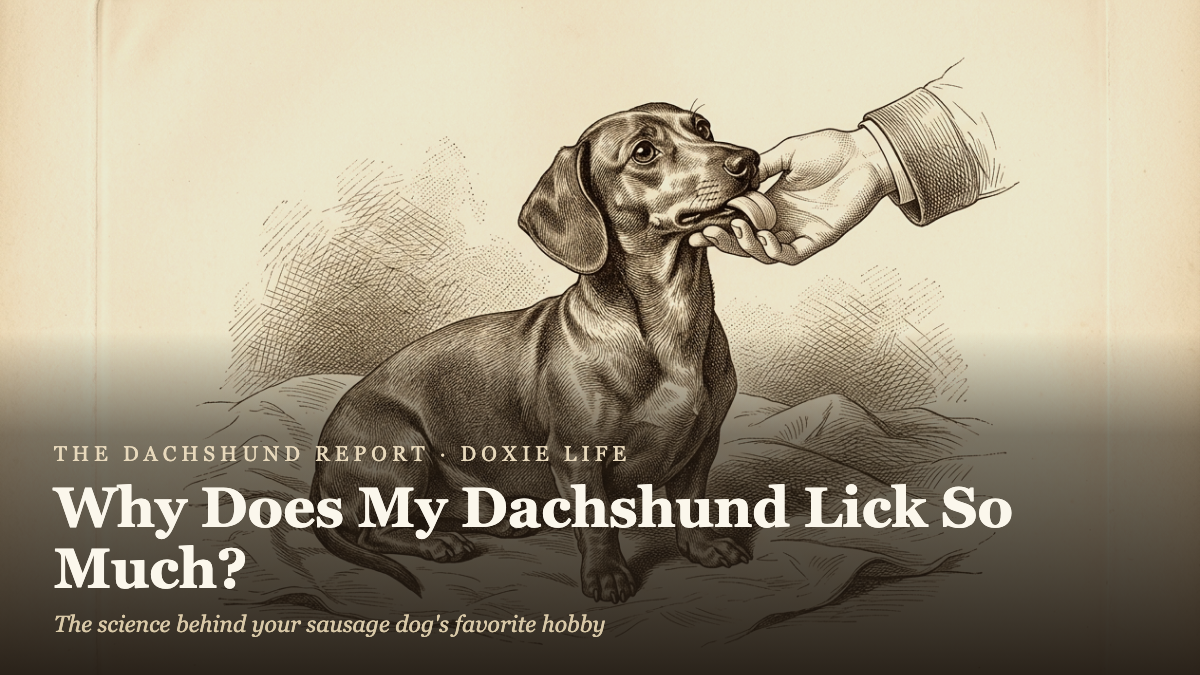
Dachshunds lick more than most breeds because of a combination of strong one-person bonding instincts, breed-specific skin conditions, and a self-reinforcing endorphin loop that makes licking feel genuinely good. Most of it is normal affection. But if your doxie is licking floors, walls, or their own paws obsessively, it can be a sign of a medical issue — and dachshunds are predisposed to several of them.
So here's a confession.
I used to think all doxie owners were exaggerating about the licking thing.
"He won't stop licking my face."
"She licks the couch cushions at night."
"He licks the air... just... the air."
And then I spent a weekend with a friend's miniature smooth named Peanut.
Peanut licked my hand within three seconds of meeting me. Then my wrist. Then my elbow. Then the floor where my elbow had been. Then the couch where I'd been sitting. Then the blanket I threw over the couch to protect it from Peanut.
It was like watching a tiny German vacuum cleaner with a tongue instead of a nozzle.
And I thought... okay. You guys weren't exaggerating.
So I did what I always do when something about this breed makes no sense. I looked it up.
And what I found is actually kind of fascinating.
Why Do Dachshunds Lick People So Much?
The short answer: because it literally makes them feel good. And your dachshund specifically? Probably more than most dogs.
When a dog licks, their brain releases endorphins — the same chemicals that make you feel calm after a long run. That's according to VCA Animal Hospitals. Licking produces a genuine neurochemical reward.
But it goes deeper than that.
A 2015 study published in Science — one of the most prestigious journals on the planet — found that mutual gaze between dogs and their owners increases oxytocin in both species. That's the bonding hormone. The one that fires when a mother holds her baby.
Dogs co-evolved that loop with us. Physical contact, including licking, is part of the same system.
Now here's where it gets breed-specific.
Dachshunds are velcro dogs. They bond intensely with one person. They follow you to the bathroom. They lose their minds when you leave for 20 minutes and come back like you just returned from war.
That single-person bonding wiring means the oxytocin loop runs hot. Your dachshund doesn't just like you. They're biochemically attached to you.
And licking is how they keep that connection firing.
Then there's the boring-but-real explanation: you taste interesting. VCA Animal Hospitals notes that sweat is salty, lotion has flavor, and food residue is basically a buffet. Your dachshund has 300 million scent receptors. To them, your skin is a walking menu.
And finally — puppies learn licking from their mothers within hours of being born. It starts as a survival behavior (mom licks to stimulate breathing and circulation) and becomes a social greeting that sticks for life. Wild canids lick adult pack members' mouths to request food. Your dachshund isn't requesting food when they lick your chin.
They're saying hello. Aggressively.
Why Does My Dachshund Lick Everything? (Floors, Walls, Furniture)
This is where it stops being cute and starts being important.
If your dachshund is licking surfaces — the floor, walls, carpet, couch — and not just people or themselves, that's a different behavior with a different cause tree.
Veterinary behaviorist Dr. Valarie Tynes (board-certified DACVB) writes in dvm360 that excessive licking of surfaces is "most likely a result of a medical condition leading to nausea or gastrointestinal distress."
A study by Becuwe-Bonnet and colleagues in the Journal of Veterinary Behavior found that GI disorders were identified as the cause in the majority of dogs presenting with excessive surface licking. The disorders included pancreatitis, acid reflux, irritable bowel syndrome, foreign bodies, and delayed gastric emptying.
This matters more for dachshunds because this breed is already prone to pancreatitis, food allergies, and sensitive stomachs.
If your doxie has started licking floors or walls and it's new behavior — don't wait on it. Call your vet. Nausea is the most common medical driver, and dachshunds have the GI profile to back it up.
VCA Animal Hospitals lists lip licking as a clinical sign of gastroesophageal reflux (GERD) in dogs. That's not quirky. That's a symptom.
Why Does My Dachshund Lick Their Paws?
Different body part, different cause list.
The number-one reason a dachshund licks their paws: allergies.
Cornell University's College of Veterinary Medicine describes atopic dermatitis as affecting 10-15% of all dogs, with licking, scratching, and hair loss as the primary signs. That brown staining you see on a dog's paws? That's from saliva. It's called salivary staining, and it's a telltale sign of chronic paw-licking.
And here's the part that's specific to your sausage dog.
The UK Dachshund Breed Council's DachsLife 2018 survey found that skin allergies and conditions were the second most prevalent condition affecting dachshunds — right behind IVDD. That finding was significant enough that they ran an entire follow-up survey in 2021 specifically investigating skin and coat conditions in the breed.
Your dachshund isn't licking their paws because they're weird. They're statistically more likely than most breeds to have itchy, irritated skin.
There's also a condition called primary acanthosis nigricans — a genetic skin disease that occurs almost exclusively in dachshunds, according to the Merck Veterinary Manual. It causes darkened, thickened skin that can itch and drive licking behavior. The fact that this condition is essentially a dachshund-only disease tells you something about this breed's relationship with their own skin.
Other paw-licking causes: yeast infections between the toes, a thorn or splinter, arthritis in a single joint (watch for licking focused on one specific paw), or anxiety — especially if it's all four paws with no visible irritation.
When Does Licking Become a Problem?
There's a line between "my dachshund loves me" and "something is wrong."
The Animal Medical Center in New York classifies excessive licking into three categories: medical disorders, behavioral disorders, and combination disorders. The medical side includes GI issues, pain in the licked area, allergies, and skin infections. The behavioral side includes compulsive disorders and anxiety.
The endorphin thing I mentioned earlier? It can become a trap.
Research has shown that licking releases enough endorphins to create a self-reinforcing cycle. A 1992 study in the Archives of General Psychiatry actually used canine compulsive licking as an animal model of obsessive-compulsive disorder. Separate research found that narcotic antagonists could reduce the behavior — evidence that the endorphin mechanism is a real driver.
Your dachshund isn't choosing to be obsessive. Their brain is rewarding a loop.
Here's the veterinarian checklist for when to call your vet — adapted from Dr. Tynes's differential diagnosis:
- New surface licking (floors, walls, carpets) — could signal GI disease or nausea
- Paw licking with brown staining — likely allergies or skin condition
- Licking one specific spot on their body — possible pain, joint issue, or IVDD-related discomfort
- Licking combined with gulping, lip-smacking, or grass-eating — nausea; call your vet today
- Any licking that's increasing in frequency — don't wait for it to plateau
The rule with dachshunds is always the same: when in doubt, call your vet. This breed carries too many predispositions — skin allergies, GI sensitivity, IVDD pain, separation anxiety — to assume licking is "just a dachshund thing."
Sometimes it is just a dachshund thing.
But sometimes it's your dachshund trying to tell you something, the only way they know how.
FAQ
Is it normal for dachshunds to lick more than other breeds?
Yes, to a degree. Dachshunds bond intensely with their people (they're famously clingy), and licking is one of their primary bonding behaviors. The endorphin and oxytocin loop that licking activates runs especially strong in breeds with tight single-person attachment. Most dachshund licking is normal affection — it only becomes a concern when it changes in frequency, shifts to surfaces or objects, or is accompanied by other symptoms like loss of appetite or restlessness.
Why does my dachshund lick the sheets at night?
Sheet-licking and bedding-licking can be a sign of nausea or GI discomfort, especially if it's a new behavior. Becuwe-Bonnet's study found that gastrointestinal disorders drove the majority of excessive surface licking cases in dogs. It can also be a self-soothing behavior related to anxiety or boredom, but if it starts suddenly, get a GI check before assuming it's behavioral.
Can I train my dachshund to stop licking me?
You can redirect it. The most effective approach is not to punish licking (that can increase anxiety, which increases licking) but to redirect your dachshund's attention when the licking starts — offer a chew toy, ask for a "sit," or simply stand up and walk away. They'll learn that licking ends the interaction. Just know that you'll never fully eliminate it. That tongue is part of the package.
Should I be worried about brown staining on my dachshund's paws?
Brown or reddish-brown staining on the paws or between the toes is a telltale sign of chronic licking — it's caused by compounds in saliva that oxidize on fur. In dachshunds, the most common cause is allergies — environmental or food. Since skin conditions are the second most prevalent health issue in the breed, this is worth a vet visit, not a Google search.
Not a vet. Not even close. If your doxie's licking has changed, increased, or shifted to weird targets — call your actual vet. They went to school for this.
Want more breed-specific dachshund health and behavior intel like this? We send a daily dose of Dachshund Love — stories, research, and the stuff nobody else tells you about living with a wiener dog.



