
Dachshund Sensitive Stomach: Why Your Doxie's Gut Is Pickier Than You Think

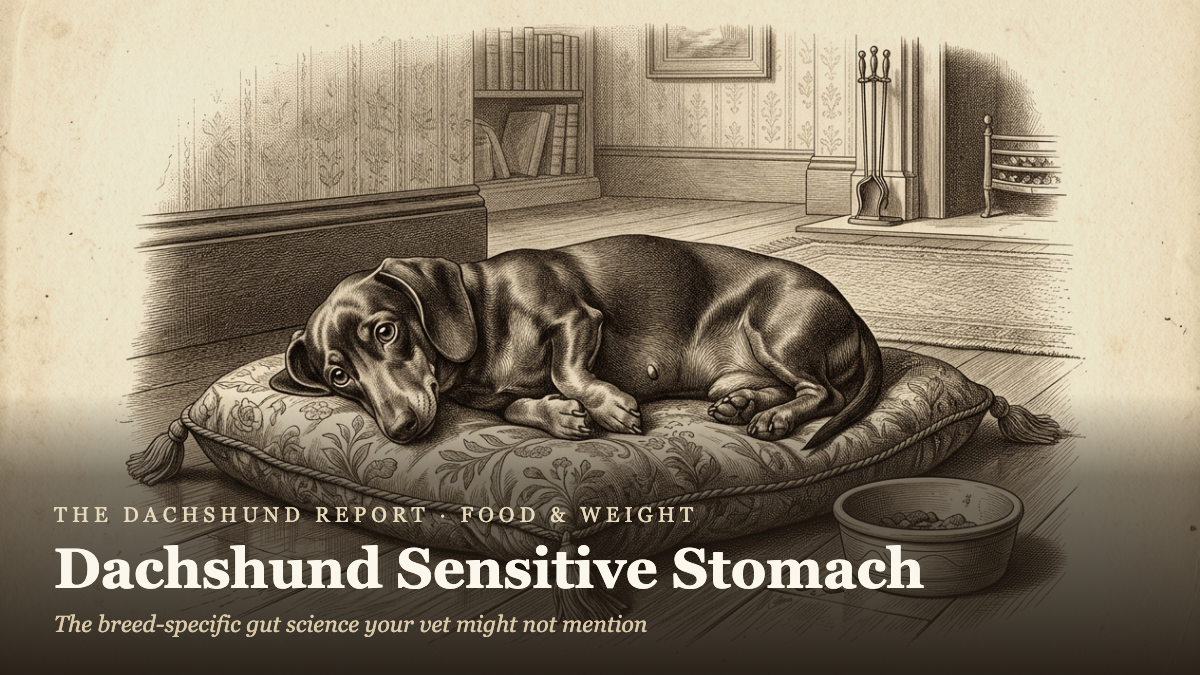
Dachshunds are among the breeds with a documented predisposition to gastrointestinal problems — including adverse food reactions, hemorrhagic gastroenteritis, and even a breed-specific form of inflammatory bowel disease found almost exclusively in miniature dachshunds. If your doxie's stomach seems pickier than every other dog you've ever met, it's not in your head.
You know the drill.
You find the perfect food. Your doxie eats it like it's the last meal on earth for about two weeks.
Then one morning you wake up to... well.
You know what you wake up to.
And you're back at square one, Googling "best dog food for sensitive stomach" at 6am while your wiener dog stares at you like nothing happened.
I've heard this story a hundred times from doxie parents. And I used to think it was just a picky-eater thing — like maybe dachshunds were just the divas of the dog world.
Turns out, there's actual science behind it.
And it's more specific to this breed than most people realize.
Do Dachshunds Actually Have Sensitive Stomachs?
Short answer: more than most breeds, yes.
Dachshunds are listed among the breeds with an increased risk of adverse food reactions — alongside Labrador Retrievers, Cocker Spaniels, and Miniature Schnauzers. That's according to a 2023 review in the Journal of the American Veterinary Medical Association by Mueller and Olivry, two of the most-cited researchers in veterinary dermatology and food allergy.
"Adverse food reactions" is the umbrella term vets use because it covers both true food allergies (immune-mediated — the body attacks a protein it shouldn't) and food intolerances (non-immune — the gut just can't handle it). The symptoms look the same from the outside: diarrhea, vomiting, gas, and sometimes itchy skin.
But it gets more specific than that.
The Merck Veterinary Manual lists dachshunds among small and toy breeds overrepresented for Acute Hemorrhagic Diarrhea Syndrome — what used to be called hemorrhagic gastroenteritis. That's the scary one. Sudden bloody diarrhea, often in an otherwise healthy dog. Median age of affected dogs is around five years old.
If that's ever happened to your doxie, you know the terror.
The good news: mortality is under 10% in dogs that get appropriate fluid therapy in time.
The less good news: it happens more often in our breed than in most.
The Miniature Dachshund GI Problem Nobody Talks About
Here's where it gets really breed-specific.
Researchers — primarily in Japan, where miniature dachshunds are the most popular breed — have identified something called inflammatory colorectal polyps, or ICRP. It's a chronic inflammatory bowel condition characterized by granulomatous inflammation in the colon.
In plain English: recurring inflammation that creates polyp-like growths in the large intestine.
And it shows up almost exclusively in miniature dachshunds.
A 2023 study published in Veterinary Pathology went even deeper. Researchers did whole-exome sequencing on miniature dachshunds and found five breed-specific genetic variants — SNPs — associated with intestinal inflammation. One variant in particular (TG c.4567C>T) increases local thyroglobulin expression in colorectal tissue, which drives the inflammation.
Translation: miniature dachshunds can carry a genetic predisposition to gut inflammation that's literally written into their DNA.
Now — this doesn't mean your mini dachshund definitely has ICRP. Most won't. But if your mini has chronic, recurring GI issues that don't respond to typical food changes, this is something your vet should know about. It responds to immunosuppressive therapy, not just a bag swap at the pet store.
What Are the Most Common Triggers?
For your average dachshund with a touchy stomach (not the rare genetic conditions), the usual suspects are:
High-fat foods. Dachshunds are already predisposed to pancreatitis — inflammation of the pancreas, often triggered by high-fat meals. The Merck Veterinary Manual lists dachshunds specifically among breeds with increased prevalence. One fatty table scrap, one too-rich treat, and you're at the emergency vet.
Common protein allergens. Beef, chicken, dairy, wheat, and soy are the most frequently identified allergens in dogs with adverse food reactions. If your doxie's been eating chicken-based kibble their entire life and the stomach issues are getting worse, the chicken might actually be the problem. I know — it sounds backwards. But repeated exposure to the same protein is exactly how food sensitivities develop.
Too-fast food changes. Dachshund stomachs don't love surprises. Switching foods cold-turkey instead of transitioning over 7-10 days is one of the most common causes of "sensitive stomach" that isn't really a sensitivity at all — it's just a gut that didn't get a heads-up.
Overeating. This one's on us. A dachshund who's eating more than their daily calorie needs is putting extra strain on a digestive system that's already working harder than a bigger dog's. And if they're overweight, the risk of pancreatitis goes up too.
How Do You Figure Out What's Wrong?
The honest answer: you probably can't, on your own.
If your doxie has occasional soft stool after eating something new — that's normal. If they have recurring diarrhea, chronic gas, vomiting more than once in a blue moon, or blood in their stool — that's a vet visit.
Here's what your vet will likely do:
Rule out the obvious first. Parasites, infections, foreign bodies. A fecal exam and basic bloodwork usually cover this.
Then consider an elimination diet. This is the gold standard for diagnosing food-related GI issues. According to Today's Veterinary Practice, gastrointestinal symptoms from food reactions often start improving within 2-4 weeks on a novel protein or hydrolyzed diet.
A novel protein is one your dog has never eaten — think venison, duck, or rabbit. Hydrolyzed diets break the proteins down so small that the immune system can't react to them. Your vet will recommend one or the other.
The hard part: the elimination trial has to be strict. No treats, no table scraps, no "just a little bit" from the kids. For 6-10 weeks. With a dachshund staring at you the entire time.
I'm not going to pretend that's easy.
But it's the only way to actually know.
If chronic inflammation is suspected: your vet might recommend diagnostics for inflammatory bowel disease. Cornell University's Riney Canine Health Center describes IBD as a diagnosis of exclusion — meaning they rule out everything else first. It affects middle-aged dogs, responds to dietary management and sometimes immunosuppressive therapy, and has a favorable long-term prognosis when caught and managed.
What Actually Helps a Dachshund's Sensitive Stomach?
Once you know what you're dealing with (or while you're figuring it out), here's what the evidence supports:
Feed fewer, consistent ingredients. Limited-ingredient diets reduce the number of potential triggers. If your doxie does well on a specific protein and carb source, don't fix what isn't broken. I wrote about picking the right food here — and if food allergies are in play, that guide covers the elimination approach in detail.
Consider probiotics. Cornell University reports that approximately 70% of a dog's immune system resides in the gastrointestinal tract. Probiotics support healthy gut bacteria and are a well-known therapy for diarrhea and GI upset. Specific strains with research behind them include Bifidobacterium animalis (AHC7) for acute diarrhea and Enterococcus faecium (SF68) for general GI support. Recommended daily intake: 1-10 billion CFUs.
Ask your vet before adding one. Not because probiotics are dangerous — but because the supplement market is a circus, and your vet can point you to a strain and brand with actual evidence.
Watch the fat content. Given the breed's pancreatitis predisposition, lower-fat food is a safer default for dachshunds with stomach issues. That means watching treats, too. The calorie math on treats matters more than most people think.
Slow the transitions. When you do change foods — and sometimes you have to — do it over 10 days minimum. Day 1-3: 75% old, 25% new. Day 4-6: 50/50. Day 7-9: 25% old, 75% new. Day 10: full new. Boring? Yes. But your carpet will thank you.
Keep them at a healthy weight. Obesity worsens basically every GI risk factor dachshunds carry. If you're not sure where your doxie lands, the weight chart is a good starting point — but body condition scoring (which your vet does at every checkup) matters more than the number on the scale.
When It's an Emergency
Call your vet immediately if you see:
- Bloody diarrhea (especially sudden onset — hemorrhagic gastroenteritis can progress fast)
- Vomiting that won't stop or is paired with lethargy
- Abdominal pain (hunching, whimpering when touched, refusing to move)
- Not eating for more than 24 hours
- Signs of dehydration (dry gums, skin that doesn't snap back)
Dachshunds are small. They dehydrate faster than big dogs. What looks like "a bad stomach day" can become serious in hours, not days.
When in doubt, call your vet. Always call your vet.
FAQ
Are dachshunds more prone to stomach problems than other breeds?
Yes. Dachshunds are listed among breeds with increased risk of adverse food reactions (JAVMA 2023) and are overrepresented for hemorrhagic gastroenteritis (Merck Veterinary Manual). Miniature dachshunds also carry a breed-specific genetic predisposition to inflammatory colorectal polyps.
What should I feed my dachshund with a sensitive stomach?
Start with a limited-ingredient diet using a single protein source your dog hasn't had before (novel protein) or a hydrolyzed protein diet recommended by your vet. Keep fat content moderate to low — dachshunds are predisposed to pancreatitis. Transition slowly over 7-10 days and avoid table scraps entirely.
How do I know if my dachshund has a food allergy or just a sensitive stomach?
You can't tell from symptoms alone — food allergies and food intolerances look identical from the outside. The only reliable diagnostic tool is an elimination diet trial lasting 6-10 weeks, supervised by your vet. Blood and saliva "allergy tests" for food are not considered reliable by most veterinary dermatologists.
Are probiotics safe for dachshunds?
Yes, probiotics are generally safe and Cornell University recommends them as a therapy for diarrhea and GI upset. Look for strains with published evidence (Bifidobacterium animalis AHC7, Enterococcus faecium SF68) at 1-10 billion CFUs daily. Ask your vet for a specific brand recommendation.
When should I take my dachshund to the vet for stomach issues?
Any bloody diarrhea, persistent vomiting, abdominal pain, refusal to eat for 24+ hours, or signs of dehydration warrant an immediate vet visit. Dachshunds are small and dehydrate quickly. Chronic recurring symptoms (even mild ones) that don't resolve with a food change also deserve professional attention — it could be IBD or another condition that won't fix itself.
Free: The Dachshund Back Handbook
I put everything we know about keeping these long little backs strong into one free guide — the 8 early warning signs, the furniture setup, the weight math, how to pick up a doxie the right way, and the exact checklist I'd bring to a vet visit.
It's free, it's short, and it might be the most useful thing you ever read about your wiener dog.
Grab the free Back Handbook here
(Educational only — not veterinary advice. When in doubt, call your vet. Always call your vet.)



