
When Do Dachshunds Calm Down? (The Honest Timeline Nobody Gives You)

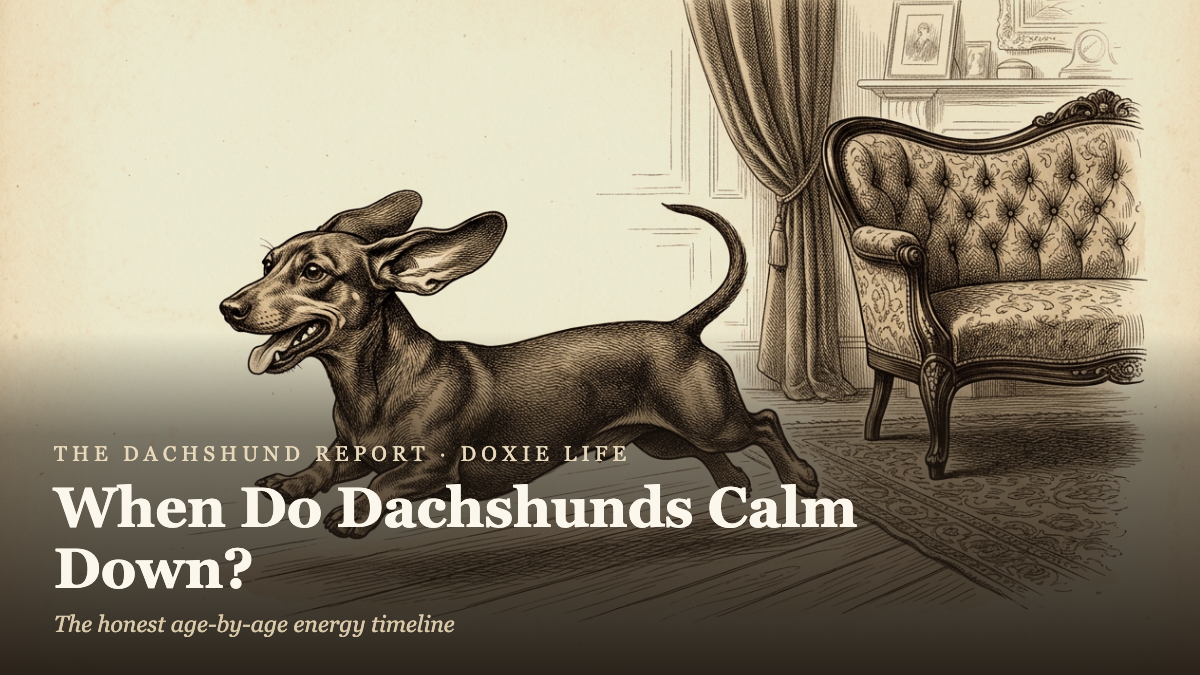
Most dachshunds begin to settle down between 1 and 2 years old, after the adolescent hormone surge fades and their brain's impulse-control wiring finishes developing. But "calm" for a dachshund doesn't look like "calm" for a Golden Retriever — and that's not a flaw. It's 600 years of German engineering working exactly as intended.
You know the moment.
Your dachshund has been asleep on the couch for twenty minutes. Completely still. You're thinking, "Finally."
Then a leaf blows past the window.
And suddenly you're living with a twelve-pound air-raid siren who's also trying to burrow through the couch cushion while simultaneously barking at a squirrel three yards away.
You Google "when do dachshunds calm down" at 2 AM and every result says "around one to two years old."
That's not wrong, exactly.
But it's not the whole story either.
Why Is My Dachshund Puppy So Hyper? (It's in the Blueprint)
Here's the thing nobody tells you when you bring home a dachshund puppy:
This dog was literally bred to fight badgers underground. The AKC breed standard describes the dachshund's temperament as "clever, lively and courageous to the point of rashness."
Lively. Courageous to the point of rashness.
That's not a description of a dog who's going to curl up quietly while you watch TV.
The Dachshund Club of America uses words like "boldness, perseverance, stubbornness, cleverness, and independence."
So when your dachshund puppy is tearing around the house like a furry little torpedo with ears — that's not a phase. That's the operating system booting up.
A 2013 study published in PLoS ONE analyzed over 8,000 dogs using the C-BARQ behavioral survey and found something that'll make every dachshund owner nod: smaller, lighter dogs scored significantly higher on excitability and hyperactivity (p<0.001). The researchers put it bluntly — "apart from trainability, all regression coefficients with height were negative indicating that behavior becomes more problematic as height decreases."
Your dachshund isn't broken.
They're just short.
The Dachshund Energy Timeline: 8 Weeks to Senior
Here's the honest, age-by-age breakdown that those "12-18 months" articles leave out.
8-16 weeks: The Sponge Phase. Everything is new. Everything is a toy. Your shoes, your fingers, your ankles. They're learning the world at full speed. Napping hard, playing harder. This is the highest-energy-per-pound phase, but it comes in bursts — puppies this age sleep 18-20 hours a day. They're just very loud during the other four.
4-6 months: The Testing Phase. Your puppy has figured out the house. Now they're figuring out what they can get away with. Selective hearing begins. That perfect recall you had at 12 weeks? Gone. They've discovered digging, barking at the mailman, and the art of ignoring you entirely.
6-12 months: The Adolescent Storm. This is the phase that breaks people.
A landmark 2020 study from the University of Newcastle, published in Biology Letters, confirmed what every dachshund owner already knows: dogs go through a real adolescence. At 8 months, dogs were more than twice as likely to ignore the "sit" command from their primary caregiver — but not from strangers. Their owners rated trainability at its absolute lowest at 8 months. By 12 months, behavior returned to pre-puberty levels or improved.
The researchers' explanation? The emotional brain (amygdala) matures faster than the impulse-control areas (prefrontal cortex). According to veterinary behavioral specialists, canine adolescence spans roughly 6 months to 2 years, and during that window, the dog's brain is literally wired for impulsivity before the brakes come online.
In dachshunds, this translates to: your 8-month-old knows the rules. They just don't care.
Sound familiar?
1-2 years: The Settlement. Hormones level out. The prefrontal cortex catches up. You start getting glimpses of the adult dog in there — the one who can actually sit on the couch for an entire episode without launching at the window. Most dachshund owners report a noticeable shift somewhere in this range.
But — and this is the part those "12-18 months" articles skip — the shift isn't from hyper to calm. It's from chaotic energy to directed energy. Your dachshund doesn't lose the intensity. They learn how to aim it.
3-5 years: The Settled Adult. This is peak dachshund. They know the routine. They know the rules (even if they choose to ignore a few). They've got their spots, their people, their patrol routes. Still clingy. Still barking at the FedEx guy. But the random zoomies drop off. The destructive chewing stops. They become the dog you imagined having — with some extra personality.
7+ years: The Senior Mellow. Dachshunds live 12-16 years, and somewhere around 7-8, you'll notice the energy dial turning down. Dachshund Health UK notes this is when to watch for the shift — less enthusiasm for long walks, more enthusiasm for the warm spot on the couch. This is a natural gear change, but sudden drops in energy deserve a vet visit — especially in a breed prone to back problems.
Do Dachshunds Ever Actually Calm Down?
Honestly?
Not like a Lab calms down. Not like a Basset Hound who melts into a puddle at three years old and stays there.
A "calm" dachshund is still a dachshund. They'll still bark at the doorbell. They'll still follow you to the bathroom. They'll still have opinions about where you sit, when you eat, and whether the neighbor's cat has a right to exist.
A 2025 genome-wide study on miniature dachshunds found that human-directed sociability — how much your dachshund demands your attention — has a heritability estimate of about 51%. Half of your dachshund's personality is written in their DNA.
You can't train out 600 years of badger-hunting genetics.
But you can learn to work with them.
Does Coat Type Make a Difference?
Actually... yes. A little.
Multiple breed sources — including Hill's Pet and breeders — consistently report temperament differences between the three coat varieties:
Smooth-haired: The classic. Loyal, alert, vocal, and the most "one-person dog" of the three. Often the highest energy in puppyhood.
Long-haired: Generally the gentlest and calmest variety. More even-tempered with new people. If there's a dachshund variety that "calms down" fastest, long-haired owners usually say it's theirs.
Wire-haired: The comedian. Highest prey drive, most feisty, most likely to turn everything into a game. Wire owners, I'm sorry. You picked the one that never fully turns off.
These are tendencies, not guarantees. But if someone told you their dachshund was "chill from day one," odds are good it's a longhair.
How to Help Your Dachshund Calm Down (Without Fighting the Blueprint)
You can't turn a dachshund into a different breed. But you can channel the engine instead of fighting it.
Exercise them properly. Dachshund Health UK recommends at least 60 minutes daily for standards, 30 minutes for minis. And here's the twist — the DachsLife 2015 study found that dachshunds exercised less than 30 minutes a day actually had increased risk of IVDD. A tired dachshund isn't just a calmer dachshund — it's a healthier one.
Mental stimulation matters more than miles. A bored dachshund is a barking, digging, destructive dachshund. Sniff walks (where they lead with their nose, not you), puzzle feeders, and hide-and-seek games tap into their hunting brain. Dachshund Health UK puts it clearly: "A bored Dachshund is likely to be a noisy and destructive Dachshund."
Train with their stubbornness, not against it. Dachshunds don't obey for the joy of obedience. They obey for the treat. Short, fun, food-driven sessions beat long, repetitive drills every time. The moment a dachshund gets bored, the session is over — whether you decided it or not.
Don't punish the zoomies. That burst of energy where your dachshund turns into a tiny missile circling the living room? That's normal. That's healthy. Let it happen. They'll be asleep in three minutes.
Be patient through adolescence. The Newcastle study showed that adolescent dogs aren't being defiant — their brain literally can't keep up with their impulses yet. Punishment during this phase doesn't speed up maturity. It just damages trust.
FAQ
At what age do dachshunds calm down the most?
Most dachshund owners report the biggest shift between 1 and 2 years old, after the adolescent hormone surge and brain development settle. But "calm" is relative — dachshunds are a high-alertness breed by design. The energy doesn't disappear; it becomes more predictable and manageable.
Are male or female dachshunds calmer?
Neither sex has a clear edge. Individual personality, socialization, and whether the dog is spayed/neutered play a bigger role than sex alone. Anecdotally, some breeders say females mature slightly faster, but there's no strong research isolating sex as a driver of when dachshunds settle down.
Why is my adult dachshund still so hyper?
If your dachshund is over 2 and still bouncing off the walls, the most common culprit is under-stimulation — not enough physical exercise, not enough mental engagement, or both. Dachshunds were bred for hours of underground work. A 15-minute walk around the block doesn't scratch that itch. If exercise is adequate and the hyperactivity is sudden or new, check with your vet — thyroid issues and pain (especially back pain) can both present as restlessness.
Do dachshunds get calmer after being neutered/spayed?
Sometimes — but less than people expect. Neutering can reduce hormone-driven behaviors like marking and roaming, but the core dachshund personality — the alertness, the barking, the stubbornness — is breed wiring, not hormones. Don't neuter expecting a personality transplant.
Will getting a second dachshund help mine calm down?
It might, actually. Many owners report that a companion dog helps reduce separation anxiety and provides built-in play — a second dachshund gives the first one someone to wrestle with besides your furniture. But it can also double the barking. Your mileage will vary.
Want More Like This?
If you're the kind of person who reads a 1,500-word article about when your sausage dog will stop acting like a caffeinated tornado — you might like our daily emails.
Short stories, weird facts, and actually useful dachshund stuff. No spam. Just doxie love.
(Not veterinary advice. If your dachshund's energy level changes suddenly — especially if they become lethargic or restless — call your vet.)



