Long-Haired vs Smooth vs Wire: The Three Doxies

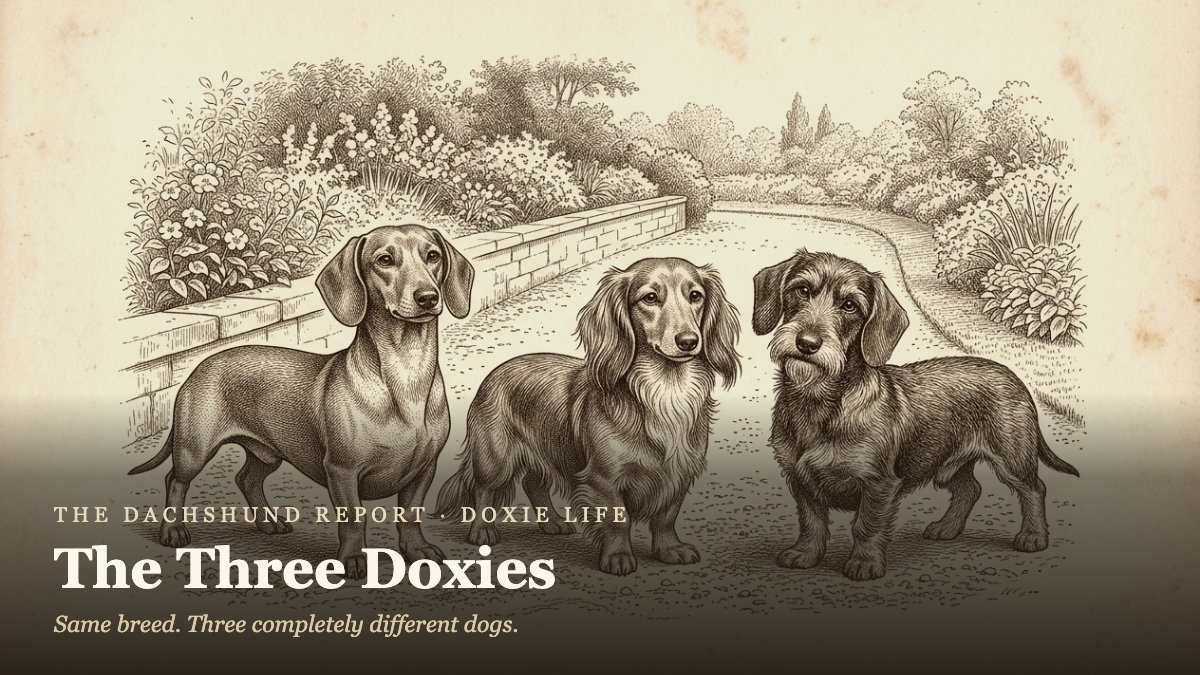
Dachshunds come in three coat types — smooth (short-haired), longhaired, and wirehaired — plus two sizes (standard and miniature), making for six possible combinations. Each coat type has a different origin story, a subtly different personality, and completely different grooming needs. The smooth came first. The wire showed up last, with terrier blood in its veins.
It's the age-old question, really.
What kind of Dachshund do you have?
I personally had never thought much about it until I started digging into the history. I just knew I had a wiener dog and I loved him. End of story.
But then you meet someone at the park with a wirehaired Doxie who looks like a tiny German professor, and they say something like "oh yeah, ours is basically a terrier in a sausage suit."
And you think... wait, is it?
Turns out there are actually three completely different Dachshunds walking around out there.
Same body. Same attitude. Same conviction that every couch belongs to them.
But three very different coats — and each one came from a different chapter of the breed's history.
What Are the Three Types of Dachshunds?
The American Kennel Club recognizes three coat varieties: smooth (short-haired), longhaired, and wirehaired.
Each also comes in two sizes — standard (16 to 32 pounds) and miniature (11 pounds and under) — which means there are technically six types of Dachshund.
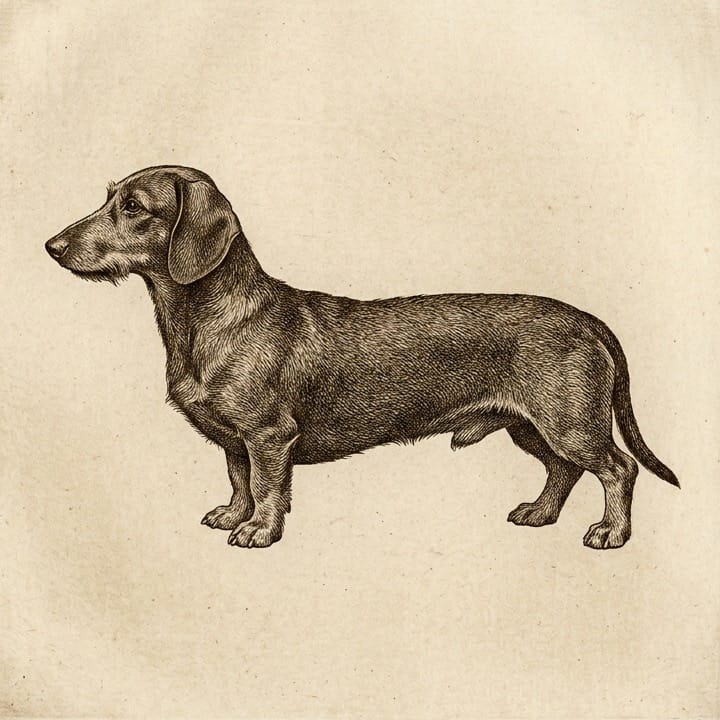
All three share the same long-backed, short-legged chassis that was originally designed to chase badgers underground. The difference is what's on top.
Let me walk you through each one.
Which Dachshund Coat Type Came First?
The smooth-haired Dachshund was the original.
The earliest descriptions — dating back to around 1700 — describe dogs that were "low in stature with long slender bodies and somewhat bent front feet." Those were smooths.
And it makes a ton of sense. They were bred to squeeze into badger tunnels that go up to 15 feet underground. Could you imagine trying to pull all the burrs and dirt out of a longhaired Doxie after that?
Might as well let 'em grow dreads.
Lol, I'm kidding.
But the smooth coat wasn't just easier to maintain — it was functional. Tight, slick fur that didn't snag on roots and rocks inside a tunnel. No excess anything. Just a missile with legs.
The smooth coat gave rise to both the longhaired and wirehaired varieties through deliberate crossbreeding over the next century and a half.
The smooth personality: Loyal, alert, clever, and famously attached to one person. If your smooth Doxie has decided you're their human, congratulations — you've been claimed. Everyone else in the house is a nice bonus. They're described as "intelligent, alert, and playful with strong prey drive" — the original Dachshund temperament that set the standard for everything that followed.
Grooming: About as low-maintenance as it gets. Occasional brushing, the odd bath. That's it. The smooth coat basically cleans itself.
What's Different About Longhaired Dachshunds?
The longhaired variety showed up next, with the first references appearing shortly after 1812. Their official breed standard was written in 1882, specifying that "the coat be similar to a Spaniel."
That spaniel mention isn't accidental. Most breed historians believe longhaired Dachshunds were created by crossing smooth Dachshunds with small spaniels — likely to produce a dog that could handle colder hunting environments without freezing.
And here's the part that's going to make some of you nod very knowingly.
The spaniel cross didn't just change the coat.
It softened the personality.
Longhaired Dachshunds are widely described as the "gentlest and most cuddly" of the three types. They tend to be calmer, less barky, more friendly with strangers, and they bond with the whole household rather than picking a favorite and ignoring everyone else.
If the smooth is a tiny bodyguard, the longhaired is a tiny therapist.
They still have the stubborn streak — they're still Dachshunds, after all. But there's a warmth there that makes longhaired owners say things like "mine would never" with genuine confidence.
Grooming: That silky coat needs regular brushing — a few times a week minimum — and their ears, chest, and tail feathering can mat if you forget. But most longhaired owners will tell you it's a fair trade for the cuddles.
What About Wirehaired Dachshunds?
Oh, the wires.
The wirehaired Dachshund was the last variety to develop, bred in the late 19th century — and here's where things get interesting.
While the longhaired got its softness from spaniels, the wirehaired got its attitude from terriers.
The Dachshund Club of America records that as early as 1797, wirehairs were produced by crossing smooths with Dandie Dinmonts or with wirehaired pinschers. Wikipedia's breed history adds the Schnauzer, German Wirehaired Pointer, and Scottish Terrier to the list of possible crosses.
The goal was a coat that could handle thorny terrain — brambles, bushes, rough scrub that would shred a smooth coat and tangle a longhaired one. The wire coat is dense, rough, and basically acts like armor.
But the terrier blood brought something else along for the ride.
The wire personality: These dogs are the clowns. They've been called "the clown of the breed" — energetic, vocal, playful, independent, and feisty in a way that makes smooth Dachshunds look mellow by comparison. They're the most likely to bark, the most likely to make you laugh, and the most likely to look you dead in the eye while doing the exact thing you just told them not to do.
If the smooth is a bodyguard and the longhaired is a therapist, the wirehaired is a stand-up comedian who also happens to be a bouncer.
And here's a fun one: wirehaired Dachshunds are the most common coat variety in Germany — the breed's home country — which surprises a lot of American owners who mostly see smooths.
Grooming: Wires need their coat hand-stripped (not clipped) two to three times a year to maintain the proper texture. Between strippings, they're actually lower-maintenance than longhairs — the rough coat doesn't mat the same way. That little beard and eyebrow situation? That's not optional. That's the whole look.
Does Coat Type Really Change a Dachshund's Personality?
Yes and no.
The breeding history matters. When you cross a hunting hound with a spaniel, you get a softer dog. When you cross it with a terrier, you get a spicier one. That's not a theory — it's centuries of documented selective breeding.
But — and this is important — training and socialization matter more than coat type. Every source that describes these personality tendencies adds the same caveat: these are general patterns, not guarantees.
Your longhaired might be a terror. Your wire might be a cuddlebug. Your smooth might be the friendliest dog on the block.
The coat type gives you a starting point. What you do with it — the training approach, the socialization, the daily exercise — writes the rest of the story.
What Colors Do Dachshunds Come In?
This is where it gets wild.
All three coat types come in a range of colors and patterns that would make a paint store jealous.
Base colors: Red, cream, black and tan, chocolate and tan, blue and tan, and fawn (Isabella) and tan. Wirehaired Dachshunds also come in a color called "wild boar" — which looks exactly like it sounds.
Patterns: Dapple (merle), brindle, sable, and piebald. These can layer on top of any base color, and some dogs carry multiple patterns.
The AKC recognizes over a dozen official color-and-marking combinations, but the two you see most often walking around the neighborhood are red smooths and wild boar wires.
FAQ
How many types of Dachshunds are there?
There are three coat types — smooth, longhaired, and wirehaired — and two sizes — standard (16 to 32 pounds) and miniature (11 pounds and under). That makes six possible type-and-size combinations, all recognized by the American Kennel Club.
Which Dachshund coat type is the calmest?
Longhaired Dachshunds are generally considered the calmest and most gentle of the three varieties. Their spaniel ancestry is believed to contribute to a softer, more laid-back temperament compared to smooths and wires. That said, every individual dog is different — socialization and training matter most.
Are wirehaired Dachshunds more hyper than smooth?
Wirehaired Dachshunds tend to be more energetic, vocal, and independent than smooth-haired ones, likely because of their terrier ancestry. They're often described as the most playful and comedic of the three types. Whether that reads as "hyper" or "hilarious" usually depends on whether they're your dog or someone else's.
Do different Dachshund coat types need different grooming?
Yes. Smooth Dachshunds need only occasional brushing and bathing. Longhaired Dachshunds need regular brushing several times a week to prevent mats, especially around the ears, chest, and tail. Wirehaired Dachshunds need hand-stripping two to three times a year to maintain coat texture, plus regular beard and eyebrow trimming.
Which Dachshund coat type is the most popular?
In the United States, the smooth-haired Dachshund is the most commonly seen variety. In Germany — the breed's country of origin — the wirehaired Dachshund is actually the most popular. Longhaired Dachshunds fall somewhere in between in both countries.
Get Your Daily Dose of Dachshund Love
If you made it this far, you're one of us. I send a daily email for Doxie people — stories, breed facts, the occasional rant about how underrated these dogs are, and zero spam. Just wiener dog content from someone who gets it.
(No spam, no sharing your email, just Dachshund love. Unsubscribe anytime.)