
Dachshund Puppy Biting: Why Your Little Landshark Won't Stop (and What Actually Works)

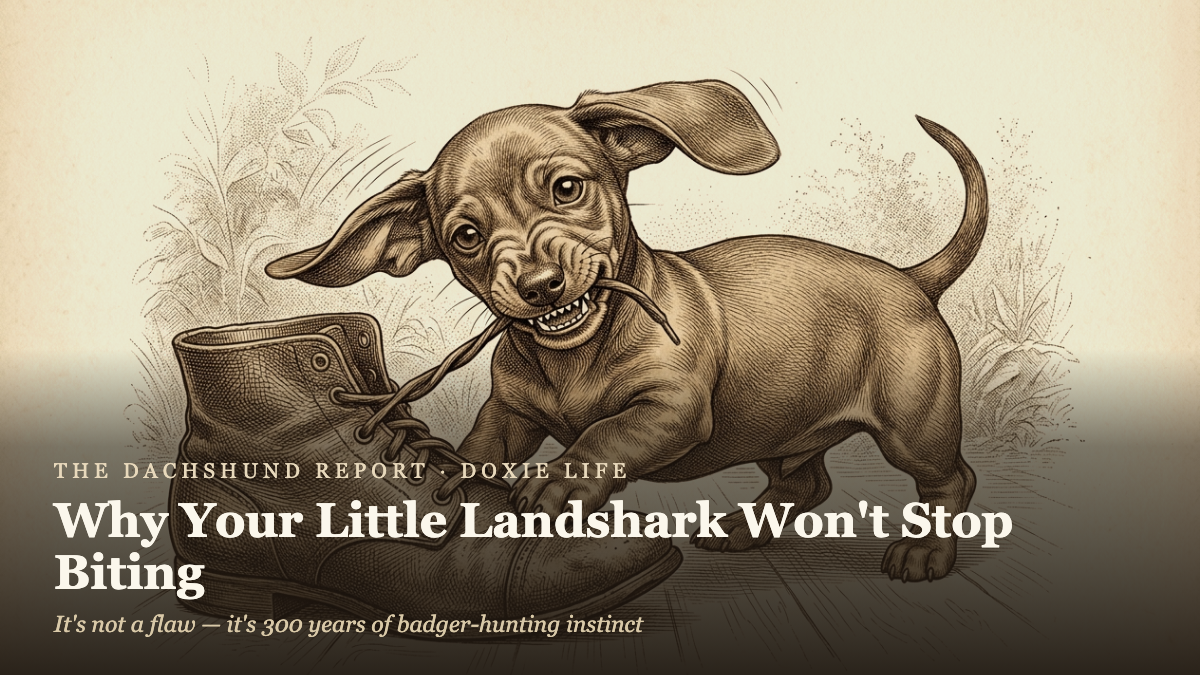
Dachshund puppies bite more than most breeds — and it's not a behavior problem. It's 300 years of badger-hunting instinct expressing itself through 28 needle-sharp baby teeth. The biting peaks around 12-13 weeks during teething and typically resolves by 6-7 months with consistent redirection, never punishment.
So your dachshund puppy has decided that your fingers, your ankles, and the corner of every piece of furniture you own are all chew toys.
Welcome to the club.
I don't currently own a dachshund — I've written about why that is — but I've spent enough years inside this community to know that "my dachshund puppy won't stop biting" is the most-typed sentence in every doxie Facebook group from January to December.
And every time, the responses split into two camps.
Camp one says your puppy is aggressive and you need a trainer yesterday.
Camp two says it's teething and they'll grow out of it.
Both camps are half right and completely unhelpful.
Here's what's actually happening.
Why Do Dachshund Puppies Bite So Much?
Your dachshund puppy isn't biting because something is wrong with them.
They're biting because everything is right with them.
This is a dog that was bred to crawl into underground burrows and fight badgers — animals that can weigh three times as much as a standard dachshund. The AKC describes the breed as "brave to the point of rashness", which is a polite way of saying your puppy was genetically engineered to grab things with its mouth and not let go.
That's not a flaw. That's the product working as designed.
A 2008 study published in Applied Animal Behaviour Science by Duffy, Hsu, and Serpell surveyed thousands of dog owners across dozens of breeds. Dachshunds scored the highest aggression rates toward both strangers and owners — with over 20% of owners reporting bites or bite attempts.
Before you panic: that study measured all dachshunds, not just puppies, and "aggression" in the study included nipping, snapping, and attempts — not just full bites. The point isn't that your puppy is dangerous. The point is that this breed uses its mouth more than almost any other breed alive.
Your Golden Retriever-owning friend whose puppy gently mouths and immediately stops? That's a dog bred to carry a dead bird without crushing it.
Your dachshund was bred to fight a badger in a hole.
Different mouth. Different conversation.
When Do Dachshund Puppies Stop Biting?
Here's the timeline, because knowing when this ends is half the battle.
3-8 weeks: Your puppy's 28 baby teeth come in — they start erupting around 3 weeks and all 28 are in by 6-8 weeks. Every single one of them feels like a sewing needle. These are the teeth currently embedded in your hand.
12-16 weeks: According to veterinary behaviorist Dr. Wailani Sung (DVM, DACVB), biting peaks around 12-13 weeks. This is when baby teeth start falling out and adult teeth push through. Their gums hurt. Your fingers are cold and feel good on sore gums. You do the math.
3.5-5 months: Baby teeth fall out, according to veterinary dentist Dr. Mallory Kanwal (DVM, DAVDC). Incisors go first, then canines, then premolars.
6-7 months: All 42 adult teeth are in. The teething pain is gone. The mouthing behavior should be dramatically reduced — if you've been consistent about redirecting it.
The word "if" is doing a lot of work in that sentence.
Because here's the thing about dachshunds that nobody tells you: the teething will end on its own, but the habit won't. A dachshund that learns at 10 weeks that biting gets a reaction — any reaction, including you yelling "NO" — will keep doing it at 10 months. And a 10-month-old dachshund with 42 adult teeth is a different conversation than a 10-week-old with baby needles.
What Actually Works (From People Who've Survived It)
I'm going to skip the generic "be patient" advice and get to what actually works with this specific breed.
1. Redirect, Don't React
The moment teeth touch skin, your hand goes away and a toy appears.
No yelling. No "bad dog." No dramatic yelping.
Here's why: your dachshund is a breed that was designed to be independently intelligent. They don't respond to corrections the way a Lab does. A Lab hears "no" and thinks "I've disappointed my person." A dachshund hears "no" and thinks "interesting — that got a reaction."
Dr. Sung recommends removing yourself from the puppy's area entirely when bitten — go to another room or behind a barrier, wait 20-30 seconds, then return and offer a toy. The message isn't "don't bite." The message is "biting makes the fun disappear."
2. Never Use Your Hands as Toys
This is the single most important rule, and the one most new doxie parents break within the first 48 hours.
Those little puppy bites are cute at 8 weeks. They are not cute at 8 months.
Every time you wrestle with your puppy using your hands, you're teaching a badger dog that hands are appropriate targets. As formydachshund.com puts it: "Never use your hands to entice play."
Keep a toy within arm's reach at all times. When your puppy goes for your hand, the toy is already there.
3. Teething Relief Is Not Optional
Your puppy's gums genuinely hurt. This isn't drama — it's 42 teeth pushing through bone.
What works:
- Frozen damp washcloth or sock — the cold numbs sore gums. Supervise this one.
- Rubber chew toys (Kong-style) — stuff with peanut butter, freeze it, and you've bought yourself 20 minutes of peace.
- Frozen carrots or blueberries — cheap, safe, and recommended by veterinary dentists for teething relief.
If your puppy has something appropriate to chew on, they're less likely to chew on you. Obvious in theory. Forgotten in practice.
4. The Timeout That Isn't Punishment
When redirection doesn't work — and with a dachshund, there will be days when it doesn't — a brief crate timeout is your best tool.
Not as punishment. As a reset.
An overstimulated dachshund puppy has essentially zero impulse control. They're not choosing to bite — they've flipped into a state where biting is the only thing their brain can do. A 10-15 minute crate session with a chew toy lets them decompress.
The crate has to be a neutral-to-positive space for this to work. If your puppy screams in the crate, that's a crate training problem, not a biting problem — and that's a different article.
5. Other Dogs Are Better Teachers Than You
Puppies learn bite inhibition from other puppies. That's the biological design.
When one puppy bites another too hard, the bitten puppy yelps and stops playing. The biting puppy learns: "that pressure level ends the game." Dr. Sung recommends puppy socialization classes specifically for this — but notes that only actual puppies should participate, not adult dogs.
If you know someone with a vaccinated, puppy-tolerant adult dog, supervised play sessions can also teach your dachshund that mouths have consequences.
When Biting Isn't Normal: The Warning Signs
Most dachshund puppy biting is normal puppy behavior amplified by breed genetics.
But not all of it.
Dr. Sung identifies these signs that biting has crossed from normal exploration into something that needs professional help:
- Holding with pressure — a puppy that clamps down and doesn't release
- Body tension — a stiff, rigid puppy (normal play biting comes with a loose, wiggly body)
- Deep growling — different from the play growl, which is higher-pitched and theatrical
- Head shaking — grabbing and shaking side to side (this is the prey-drive kill behavior)
- Broken skin or bleeding — in adult dogs being bitten, not in you (puppy teeth are sharp enough to break human skin during normal play)
If you're seeing these, contact a certified veterinary behaviorist (DACVB) or certified applied animal behaviorist. Not a trainer from the internet. Not your uncle who "knows dogs." A credentialed professional.
The Dachshund Difference: What Every Generic Guide Leaves Out
Here's what the "how to stop puppy biting" articles written for all breeds miss about dachshunds:
They take longer. A breed built for independent decision-making in underground tunnels doesn't respond to pressure or correction the way a people-pleasing breed does. Dr. Sung's core principle — "always use positive reinforcement" — isn't just kinder. It's the only thing that actually works with a dachshund's brain.
They test you. Your dachshund will stop biting your right hand and immediately try your left hand. They'll stop biting your fingers and start biting your toes. This isn't defiance. This is a dog whose ancestors had to solve problems in real time, underground, with no human guidance. They're testing the boundaries because that's literally what they were designed to do.
Consistency is the whole game. Every person in the household has to use the same response. Every time. If one person wrestles with the puppy using their hands while everyone else redirects, you've taught your dachshund that the rules are negotiable. And a dachshund who thinks the rules are negotiable will negotiate forever.
FAQ
How long does the dachshund puppy biting phase last?
The teething-driven biting phase runs from about 3 to 6-7 months, with the worst of it around 12-16 weeks when baby teeth fall out and adult teeth come in. The habitual biting — the play-nipping that's not about pain — can continue well past teething if it's been reinforced by attention, which is why consistent redirection during the teething months matters so much.
Is my dachshund puppy being aggressive or just playing?
Almost always playing. Normal play biting comes with a loose, wiggly body, a wagging tail, and that theatrical play growl. Dr. Wailani Sung warns that actual aggression looks different: a stiff body, deep growling, holding with pressure, and head shaking. If you're seeing those signs, contact a veterinary behaviorist — not a YouTube trainer.
Do dachshunds bite more than other breeds?
The research says yes. Duffy et al. (2008) found dachshunds scored the highest aggression rates toward strangers and owners among all breeds studied, with over 20% of owners reporting bites or attempts. That's not because they're mean — it's because they were bred to fight underground prey, which selected for a dog that uses its mouth first and asks questions later.
Should I yelp when my dachshund puppy bites me?
The "yelp like a hurt puppy" advice is common but inconsistent with dachshunds. Some respond by backing off. Others get more excited because the noise is stimulating. If yelping escalates the biting, switch to the silent withdrawal method: remove your hand, stand up, and leave the room for 20-30 seconds. Silence works better than drama with this breed.
Can I use bitter apple spray to stop my dachshund from biting?
Bitter apple spray works for furniture and objects — it makes the thing taste terrible. It doesn't work for biting hands or skin because you'd have to coat yourself in it before every interaction. Use it on chair legs and shoelaces. For hand-biting, redirection and withdrawal are more effective.
Sign Up for the Daily Doxie Dose
A short daily email about dachshunds — the weird stuff, the useful stuff, the stuff that makes you text your doxie-parent friends and say "this is SO our dog."
(Educational only — not veterinary advice. When in doubt, call your vet. Always call your vet.)



