
Best Toys for Dachshunds: What a Badger Hunter Actually Wants to Play With

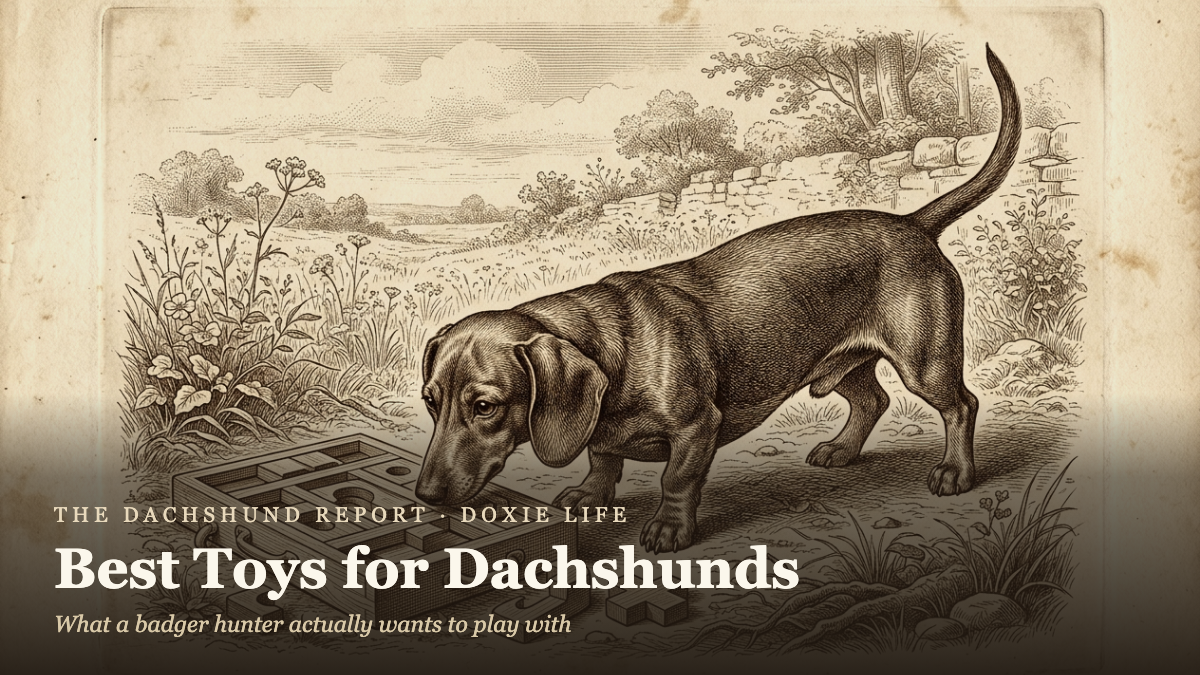
The best toys for dachshunds are puzzle feeders, burrower plushes, and snuffle mats — toys that engage the hunting brain and burrowing instinct this breed was built for. Equally important: avoid toys that encourage jumping, vertical tugging, or twisting, which put unnecessary stress on a spine that's already at 15–24% lifetime IVDD risk.
You know what happens when you give a dachshund a tennis ball?
They look at it. They look at you. They look at the ball again.
And then they walk away, because a dachshund doesn't fetch. A dachshund investigates.
This is a dog that was engineered over 300 years to hunt underground alone, make independent decisions in a pitch-dark badger den, and use its nose to solve problems no human could help with.
And we're out here buying them the same chew bones we buy a Golden Retriever.
No wonder they get bored. No wonder they start digging through the couch cushions, barking at nothing, and eating things they shouldn't.
Here's the thing nobody in the roundup articles tells you: your dachshund's toy needs are breed-specific. And the toy that's wrong for this breed isn't just boring — it might actually be bad for their back.
What Makes Dachshund Toy Needs Different?
Your dachshund has four instincts baked in from centuries of breeding, and every toy should feed at least one of them:
1. The hunting brain. Dachshunds were bred to track prey through underground tunnels and make life-or-death decisions without you. The AKC describes them as "smart and vigilant" with a "brave to the point of rashness" temperament. A toy that just sits there does nothing for this dog. They need toys that make them solve something.
2. The burrowing instinct. If your dachshund has ever disappeared under a blanket and refused to come out, you've seen this in action. They were bred to dig into dens. Toys that let them root around, pull things out of holes, and tunnel into fabric tap into something hardwired.
3. The nuclear nose. The AKC's breed history describes dachshunds as dogs bred to track prey through underground tunnels, with a ribcage providing "ample room for the heart and lungs" to keep scenting underground. Their original job was nose-first problem-solving in the dark. Toys that hide food and make them sniff it out aren't just fun — they're doing the job they were designed for.
4. The jaw. This is a dog that was bred to fight an animal that can weigh 30 pounds and has claws like garden rakes. Those little jaws are much stronger than you'd expect from a 12-pound sausage, and they need something to chew that can take it.
The Back-Safety Rule Nobody Mentions
Here's what every "best toys for dachshunds" list leaves out.
Your dachshund has a 1-in-4 chance of developing IVDD — the disc disease that's the breed's number-one health threat. And certain types of play put direct stress on that long, vulnerable spine.
Tug-of-war — keep it horizontal and gentle. Vertical tugging (lifting the front end off the ground) puts compression and shearing force on the spine. If your dachshund loves tug, keep the toy at ground level, let them do most of the pulling, and never yank. Multiple veterinarians and dachshund health organizations like DISA (Dachshund IVDD Support Australia) recommend caution with activities that put jerking or pulling force on the spine of IVDD-prone breeds.
No jumping for toys. Tossing a toy in the air so your dachshund leaps for it? That landing impact is the same physics as the couch jump — a loaded spinal compression on a breed that's already carrying more vertebral length per body weight than almost any other dog.
No heavy toys that encourage head-shaking. When a dachshund grabs a heavy toy and does the death-shake (that side-to-side whip), the rotational force travels straight down the cervical spine. Light squeaky toys are fine. A heavy rope knot is not.
Bottom line: the best toy for a dachshund is one that works their brain, not one that puts their back at risk.
Best Puzzle Toys (Feed the Hunting Brain)
This is the single most important toy category for a dachshund. A bored dachshund is a destructive dachshund, and puzzle toys are the difference between a dog that destroys your house when you leave and one that's content.
Outward Hound Hide N' Slide (~$20 on Chewy)
A flat puzzle board with six food-hiding compartments covered by twisting knobs and lids. All pieces are attached to the board — no loose parts to swallow. Business Insider's testing team used it with a dachshund named Biscuit, who solved it in under two minutes. That's not a flaw — that's a dachshund brain at work. Start here if your dog has never seen a puzzle toy.
Outward Hound Casino Puzzle (~$10–26 on Chewy)
The advanced version. Six bone-shaped tiles that must be twisted to release side drawers. Even Biscuit the dachshund hadn't fully cracked the mechanism after multiple sessions — and that's exactly the kind of challenge this breed needs. The difficulty is adjustable, so it grows with your dog.
KONG Classic — Small (~$8–12)
The one that's been around for nearly 50 years. Stuff it with peanut butter (xylitol-free — that's non-negotiable), freeze it, and your dachshund has 30–45 minutes of problem-solving to do. The red rubber is right for most dachshunds; the black KONG Extreme is for the ones who chew through everything. Size guide from KONG: the largest ring should be bigger than the back of your dog's mouth. For most standard dachshunds, that's a Small or Medium.
Best Burrower Toys (Feed the Den Instinct)
If your dachshund lives under blankets, this category exists for them.
Outward Hound Hide-a-Squirrel (~$10–15 on Chewy/Amazon)
A plush tree trunk with squeaky squirrels hidden inside. Your dachshund's job is to pull them all out. This is the single most breed-appropriate toy I've found — it's literally a den full of prey. The Small size fits dachshund mouths well. Business Insider named it their top plush puzzle pick.
One warning: the squirrels are small and squeaky. If your dachshund is a shredder who eats stuffing, supervise this one. The joy is in the extraction, not the destruction.
Burrowing Blankets and Tunnel Toys
Not a product recommendation — just a reminder that the best burrower toy might already be on your couch. A fleece blanket with a few treats scattered underneath turns your living room into a badger den. Free, and it feeds the same instinct as a $40 enrichment toy.
Best Snuffle Mats (Feed the Tracking Nose)
Paw5 Wooly Snuffle Mat (~$34 on Chewy)
An 18-by-12-inch mat made of fabric strips that mimic tall grass. You hide kibble or treats in the strips, and your dachshund sniffs them out. Business Insider's testing team rated it their top snuffle mat pick — durable, machine washable, and heavy enough to stay put while a determined wiener dog works it over.
Veterinary behaviorists widely recommend snuffle mats because the act of sniffing is calming for dogs — it's a natural foraging behavior that lowers arousal. That makes snuffle mats especially useful for dachshunds with separation anxiety. Ten minutes on a snuffle mat before you leave the house can take the edge off.
DIY Alternative: The Towel Roll
Roll up a hand towel with treats inside, tie it in a loose knot. Your dachshund unrolls it with their nose. Multiple dachshund owners on r/Dachshund recommend this as a free enrichment option that works just as well as commercial products.
Best Chew Toys (Feed the Jaw)
Dachshunds chew harder than you'd think. Those jaws were built for badgers, not dog biscuits.
KONG Classic (Again)
It appears twice because it does two jobs: puzzle toy when stuffed, chew toy when empty. The rubber is tough enough for dachshund jaws without being so hard it risks cracking teeth (a real concern with some "indestructible" nylon toys — veterinary dentists recommend the "thumbnail test": if you can't dent the toy with your thumbnail, it's too hard for teeth).
Slow-Feeder Bowls as Enrichment
The Outward Hound Fun Feeder (~$12 on Chewy) isn't technically a toy, but it turns every meal into a 10–15 minute puzzle. The maze of ridges forces your dachshund to work for each bite, which slows eating (important for a breed prone to weight gain) and provides mental stimulation twice a day without you lifting a finger.
What to Avoid
Toys that are too small. The Humane World guidelines are simple: if a toy is small enough to fit entirely in your dog's mouth, it's a choking hazard. This especially matters with miniature dachshunds — what's safe for a standard may be too small for a mini.
Heavy rope toys. The death-shake problem. A light rope is fine for gentle tugging. A heavy knotted rope encourages the kind of violent head-whipping that puts rotational stress on the cervical spine.
Stuffed toys for unsupervised play. If your dachshund is a surgeon (the kind who carefully removes every squeaker and pile of stuffing within 4 minutes), don't leave plush toys with them alone. Swallowed stuffing and squeaker parts are a real veterinary emergency.
Laser pointers. They create obsessive behavior in prey-driven dogs — and a dachshund is about as prey-driven as dogs get. The frustration of never catching the "prey" can create anxiety patterns that are hard to undo.
FAQ
How many toys should a dachshund have?
Three to five in active rotation is the sweet spot. The trick is rotating them — put half away for a week, then swap. A "new" toy that's been in the closet for seven days is just as exciting as one from the store. Dachshunds are smart enough to get bored with familiar puzzles, so rotation keeps their hunting brain engaged.
Are squeaky toys safe for dachshunds?
The squeaky toy itself is fine — dachshunds love them because the squeak mimics prey sounds, which feeds the hunting instinct they were bred for. The risk is the squeaker mechanism inside. If your dachshund tends to disembowel stuffed toys, either supervise squeaky toy time or choose toys with squeakers sewn inside durable rubber rather than stuffing.
What toys help with dachshund separation anxiety?
Puzzle feeders and snuffle mats are the two best options. A frozen stuffed KONG given 10 minutes before you leave creates a positive association with your departure and keeps their brain occupied during the hardest window — the first 40 minutes after you leave. Avoid toys that require your participation (tug, fetch); the goal is independent enrichment.
Do dachshund puppies need different toys?
Yes. Puppies under 6 months are teething, and they need softer chew options — frozen washcloths, puppy-formula KONGs (the light blue rubber, which is gentler than red), and appropriately sized plush toys. Avoid hard rubber and nylon until the adult teeth are fully in around 6–7 months. Puzzle toys can start as early as 8 weeks — just make them easy. A muffin tin with treats under tennis balls is a perfect first puzzle.
Is tug-of-war bad for dachshunds?
Not inherently, but the rules are different for a long-backed breed. Keep the toy at ground level so your dachshund doesn't rear up. Let them do most of the pulling — you're the anchor, not the engine. Never lift their front end off the ground. And if your dachshund has any history of back pain or has been diagnosed with IVDD, skip tug entirely and stick with puzzle toys and snuffle mats.
Free: The Dachshund Back Handbook
I put everything we know about keeping these long little backs strong into one free guide — the 8 early warning signs, the furniture setup, the weight math, how to pick up a doxie the right way, and the exact checklist I'd bring to a vet visit.
It's free, it's short, and it might be the most useful thing you ever read about your wiener dog.
Grab the free Back Handbook here
(Educational only — not veterinary advice. When in doubt, call your vet. Always call your vet.)



