
How to Crate Train a Dachshund Puppy (The Reason Nobody Mentions)

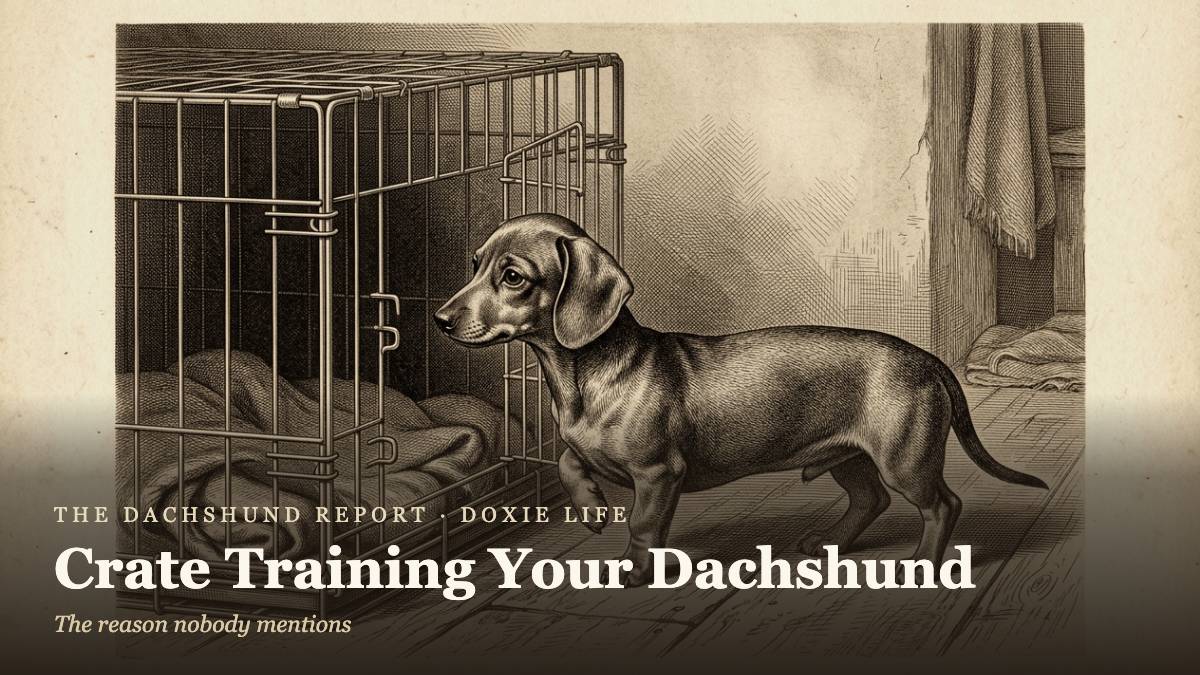
Crate training a dachshund puppy isn't just about housebreaking or keeping your shoes alive — it's medical preparation. One in four dachshunds will face IVDD at some point, and conservative treatment means four to eight weeks of strict crate rest. A dog who's never been crate trained faces that confinement as trauma on top of injury. Start now, while your puppy thinks the crate is a game.
I'm going to tell you something that most crate training guides won't.
They'll give you the schedule. The treat placement. The "don't make eye contact when they cry" advice.
And that's all fine.
But none of them will tell you the real reason you need to crate train a dachshund.
It's not about potty training. It's not about protecting your furniture. It's not even about giving yourself five minutes of peace while the little landshark recharges.
It's about the day your vet says the words "strict crate rest."
And if you own a dachshund... there's a real chance that day is coming.
Why Crate Training a Dachshund Is Different from Every Other Breed
Here's the thing about dachshunds that changes everything about crate training.
One in four dachshunds will deal with IVDD — intervertebral disc disease — at some point in their life. The Dachshund Breed Council's health surveys confirmed it. The academic research (Packer et al., 2016) found 15.7% at any given point, with Standard Smooth-Haired dachshunds hitting 24.4%.
Those aren't small numbers.
And when IVDD hits, the first-line treatment is almost always the same: strict crate rest plus medication. Four to six weeks for non-neurological episodes. At least eight weeks if there's neurological involvement.
The Dachshund Health UK puts it plainly: "If your dog ever suffers from an IVDD incident, your vet may recommend conservative treatment initially. This involves strict crate-rest plus medications. If you have trained your Dachshund to be confident in a crate, it will be much easier to cope with up to 6 weeks of conservative treatment."
DISA — Dachshund IVDD Support Australia — calls it "The Crate Is Your Mate." (If you want the full picture on what IVDD crate rest actually looks like, I wrote a whole guide on it.)
And here's the part that matters right now, while your puppy is healthy and bouncing off the walls:
A dachshund who's never been in a crate, suddenly confined for eight weeks while in pain, while scared, while wondering why they can't feel their back legs...
That's not crate rest. That's a panic attack with a medical bill.
The crate training you do today is the reason your dog survives that experience with their sanity intact.
And it's the reason conservative treatment actually works. Research from Cambridge University Veterinary Hospital found that 96% of deep-pain-positive dogs regained the ability to walk with conservative treatment alone. A dachshund-specific study (Dorn et al., 2022) found 85% achieved functional pet status by 12 weeks — without surgery.
But all of that depends on your dog actually tolerating the crate.
The Bladder Math Nobody Gives You (Dachshund Edition)
Before we get into the how, let's talk about the why-does-my-puppy-keep-peeing-in-the-crate problem.
The general rule from Ohio State's Veterinary Medical Center is one hour per month of age, give or take an hour. So your 8-week-old puppy? Two hours. Max.
Banfield Pet Hospital breaks it down by age:
- 8 weeks: 2 hours max
- 12 weeks: 3 hours
- 16 weeks: 4 hours
- Adults: 6-8 hours (never more)
But here's the dachshund wrinkle.
Small breeds have smaller bladders and higher metabolisms. Your miniature dachshund puppy at 12 weeks might not make it the full three hours. And Dachshund Health UK goes further: "A puppy under 3 months may not be able to cope with more than 30 minutes alone."
That's not three hours. That's thirty minutes.
So if your dachshund puppy is having "accidents" in the crate, the crate isn't the problem. The schedule is the problem.
Set an alarm. Take them out. Come back. Repeat. (If you're deep in the potty training trenches, I have a full guide on how to potty train a dachshund — crate training is step one of that process.)
It's not glamorous. But neither is cleaning pee out of a crate at 3 AM and wondering why your puppy now associates the crate with lying in their own mess.
The Dachshund Problem: A Breed That Needs the Crate but Hates Being Alone
Here's the cruel irony of dachshund crate training.
Dachshunds are among the breeds most predisposed to separation anxiety. That's not an opinion — it's from a 2021 JAVMA review of epidemiological, genetic, and epigenetic factors. A 2014 study of 215 dogs diagnosed with separation anxiety found dachshunds showing up at higher breed-specific frequency.
You already know this if you own one. The bathroom escort. The shadowing. The full-body protest the second you reach for your keys.
Now take that dog and put them in a box.
Dr. Ilana Reisner, a board-certified veterinary behaviorist formerly at the University of Pennsylvania, warns that for anxious dogs, crate confinement can make things worse — the dog may attempt to escape, potentially causing severe self-injury.
This is why the timing matters so much.
Ohio State's Indoor Pet Initiative explains that a crate "can be used to teach independence by preparing the puppy to be calm when left alone. This independence is essential in the prevention of separation anxiety."
Key word: prevention.
Train the crate while your puppy is young, curious, and hasn't developed anxiety yet. By the time they're an adult — and by the time IVDD is a real possibility — the crate isn't a punishment. It's their spot. Their burrow. The place that smells like them and where good things happen.
Do it later, under stress, after an IVDD episode... and you're fighting two battles at once.
How to Actually Do It (The Vet-Sourced Protocol)
Forget anything that starts with "put the puppy in the crate and close the door."
The American Veterinary Society of Animal Behavior is crystal clear: "Only reward-based training methods should be used for all aspects of dog training and behavior modification." Dogs trained with aversive methods showed stress-related behaviors including tense body, lip licking, tail lowering, panting, yawning, and yelping.
With a dachshund — a breed already primed for stubbornness and anxiety — forcing the crate is the fastest way to guarantee they'll hate it forever.
Here's the protocol from UC Davis School of Veterinary Medicine, adapted for what I know about these little sausages:
Week 1: The Crate Exists (That's It)
Put the crate in a common area — living room, kitchen, wherever the family hangs out. Door open. Blanket inside. A few treats scattered in.
Don't make a production out of it.
Your dachshund puppy will investigate on their own terms. Because dachshunds were literally bred to go into dark enclosed spaces and flush out badgers. The instinct to burrow is hardwired.
Let them sniff. Let them walk in and out. Toss a treat in when they're not looking and let them "discover" it. Feed meals near the crate, then inside the crate.
No closed doors this week. Just positive association.
One tip from Ohio State: plug a DAP (dog appeasing pheromone) diffuser in near the crate. It mimics the calming pheromones their mother released during nursing. Small thing. Measurable effect.
Week 2: Brief Closures
Once your puppy is walking into the crate voluntarily — eating in there, maybe napping in there — try closing the door for 30 seconds while you sit right next to the crate.
Then open it. Treat.
Do it again. A minute this time.
Then three minutes. Then five.
UC Davis recommends watching for signs of anxiety during these closures: panting, yawning, salivation, drooling. If you see them, you've moved too fast. Back up a step.
The American College of Veterinary Behaviorists says the crate should be large enough for your dog to "stand up fully, turn around, and lie down completely on its side." For miniature dachshunds, that's typically a 24" crate. Standards usually need a 30".
And — this one's important — never leave a puppy in a crate with their collar on. Strangulation risk. Dachshund Health UK specifically flags this.
Week 3+: Building Duration
Gradually increase the time. Step out of sight for a minute. Come back. Step out for five minutes. Come back.
The goal is boring departures and boring returns. No fanfare. No "I'm so sorry I left you!" guilt parade.
By the end of week three, most puppies can handle 30-60 minutes comfortably. By month four or five, several hours (with appropriate potty breaks).
If your puppy becomes frantic — not whimpering, not protesting, but genuinely panicked — Ohio State says to stop the session immediately and seek help. Frantic is different from fussy. You'll know the difference.
The First Night (and Why It's the Hardest)
Your dachshund puppy's first night in the crate will be the worst night of your relationship so far.
I'm not going to sugarcoat it.
The puppy has just been separated from their mother, their siblings, and everything they've ever known. And now you're putting them in a box and turning off the lights.
Here's what actually helps:
Put the crate in your bedroom. Ohio State's Dr. Meghan Herron recommends this — your puppy "will settle easier if she can sleep with you" since she's mostly sleeping anyway.
Cover the crate with a blanket for that den-like effect. Dachshunds are burrowers by nature. They're wired for enclosed, dark spaces. Use it.
Expect some crying. Dr. Wailani Sung, a board-certified veterinary behaviorist, says it's OK to let a puppy cry for a few minutes to give them a chance to settle. But if your puppy is "screaming for hours," that's not normal protest — it could indicate fear, hunger, or a need to go out.
Consider a pheromone diffuser. A double-blind, placebo-controlled study (Taylor & Mills, 2007) tested DAP on 60 puppies in their first nights at new homes. The DAP group: an average of 1.2 disturbed nights. The placebo group: 8.9 disturbed nights. That's not a subtle difference.
Set your alarm. An 8-week-old puppy needs to go out every two hours. Yes, even at 2 AM. Yes, even at 4 AM. This is not the crate failing. This is a puppy with a bladder the size of a grape doing their best.
The Mistakes That Kill Crate Training
I'll keep this short because these are non-negotiable:
Never use the crate as punishment. Not once. Not even when they just ate your shoe. The crate is a safe place, not a timeout chair. The second it becomes associated with anger, you've lost.
Never leave a puppy crated all day. Adults shouldn't be crated more than 6-8 hours. Puppies, much less — remember the bladder math.
Never force a puppy into the crate. Picking them up and shoving them in teaches them the crate is a trap. The whole point is voluntary entry.
Never crate a puppy in a hot or poorly ventilated area. Dachshunds are small. They overheat. Put the crate in a common room with decent airflow.
Soft crates for dachshunds? Think twice. DISA specifically warns that dachshunds are "great escape artists" and recommends metal crates. One determined set of teeth and a canvas crate is just a suggestion. (I covered the full crate-selection breakdown — sizing, specs, what actually matters for a long back — in Best Crate for Dachshunds.)
When to Call Your Vet
If your puppy shows any of these patterns after two or more weeks of consistent, positive crate training:
- Injuring themselves trying to escape (bent bars, broken teeth, bloody paws)
- Drooling, panting, or trembling every single time the door closes
- Refusing to eat inside the crate despite weeks of positive association
- Diarrhea or vomiting only when crated
That's not a training problem. That might be clinical separation anxiety — and it affects dachshunds at higher rates than most breeds.
A board-certified veterinary behaviorist (DACVB) can evaluate and build a treatment plan. Don't push through it alone. Your vet isn't judging you. They're helping.
The Timeline Nobody Gives You
Because I know you want to know "how long does this actually take":
- Day 1-3: Puppy discovers the crate exists. Treats appear. Curiosity builds.
- Week 1: Eating meals in the crate. Walking in voluntarily. Door still mostly open.
- Week 2: Brief door closures (30 seconds to 5 minutes). You're still visible.
- Week 3: Increasing duration. You leave the room briefly.
- Month 2: Comfortable for 1-2 hours. Night sleeping in crate is normal.
- Month 4-6: Can handle 3-4 hours comfortably. Crate is "their spot."
Some dachshunds get this in two weeks. Some take two months. That's fine.
The only timeline that matters is the one where your dog chooses to walk into the crate. Everything before that is just laying track.
FAQ
How long can a dachshund puppy stay in a crate?
The general veterinary guideline is one hour per month of age, up to about 6-8 hours for adults. But Dachshund Health UK notes that puppies under 3 months may not handle more than 30 minutes alone. Set your alarm. Take them out. Repeat.
What size crate does a dachshund need?
The American College of Veterinary Behaviorists says the crate should be large enough for the dog to stand up fully, turn around, and lie down on their side. For miniature dachshunds, typically a 24" crate. Standard dachshunds usually need a 30". For IVDD-prep purposes, DISA recommends a 36" metal crate.
Should I let my dachshund puppy cry in the crate?
Brief whimpering (a few minutes) is normal protest — give them a chance to settle. But Dr. Wailani Sung, DACVB, says that if your puppy is screaming for hours, something is wrong: fear, hunger, or a full bladder. If the puppy becomes frantic rather than fussy, stop the session and reassess.
Can crate training help prevent separation anxiety in dachshunds?
Yes — when done correctly and early. Ohio State University explains that a crate "can be used to teach independence by preparing the puppy to be calm when left alone. This independence is essential in the prevention of separation anxiety." But forcing an already-anxious adult dog into a crate can make things worse. Start young.
Why do dachshunds need crate training more than other breeds?
Because of IVDD. One in four dachshunds will face intervertebral disc disease, and the standard treatment is four to eight weeks of strict crate rest. A dog comfortable in a crate handles that recovery with far less stress. A dog who's never been crated faces confinement and pain simultaneously — which can compromise recovery and trigger panic.
Free: The Dachshund Back Handbook
I put everything we know about keeping these long little backs strong into one free guide — the 8 early warning signs, the furniture setup, the weight math, how to pick up a doxie the right way, and the exact checklist I'd bring to a vet visit.
It's free, it's short, and it might be the most useful thing you ever read about your wiener dog.
Grab the free Back Handbook here
(Educational only — not veterinary advice. When in doubt, call your vet. Always call your vet.)



