
Best Crate for Dachshunds: The One Spec That Changes Everything for a Long Back

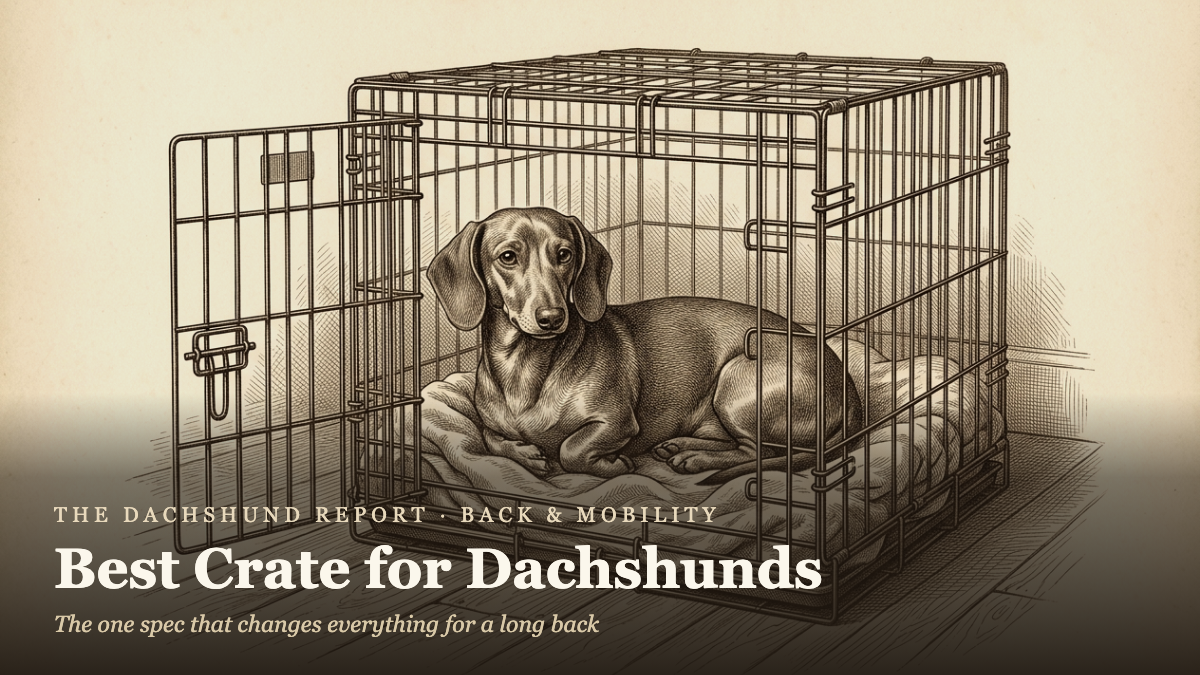
The best crate for a dachshund is a wire crate sized for the breed — 24 inches for miniatures, 30 inches for standards — with a firm (not squishy) pad that supports the spine. For IVDD crate rest, size up to 36 inches to fit a pee pad at one end and a mounted water bowl at the other, and use a non-slip mat underneath.
You know what nobody ever talks about when they're shopping for a dog crate?
The spine.
Every crate guide on the internet tells you to measure your dog nose-to-tail, add four inches, and call it a day. That works great for a Lab. For a dog whose body is basically a suspension bridge between two sets of stubby legs... it misses the whole point.
A dachshund crate isn't just a crate.
It's the emergency room. The recovery ward. The place where, if your dog ever has a back episode — and 1 in 4 dachshunds will — your vet's first instruction is going to be "strict crate rest, six to eight weeks."
And you'll want that crate to be right.
Not "close enough." Not "we'll figure it out." Right.
So let's talk about what actually matters.
What Size Crate Does a Dachshund Need?
This is where every generic crate chart fails the breed.
Most charts sort by weight. A standard dachshund weighs 16-32 pounds, which puts them in the "medium" category alongside Beagles and Cocker Spaniels. But a dachshund is shaped nothing like a Beagle. They're longer, lower, and the ratio of body length to height is unlike any other breed on the planet.
Here's what the breed health organizations actually recommend:
- Miniature dachshund (under 11 lbs): 24" x 18" x 21" — Dachshund Health UK
- Standard dachshund (16-32 lbs): 30" x 19" x 21" — Dachshund Health UK
- Two standards sharing: 31" x 21" x 24"
The height matters less than you'd think — your dachshund is never going to bump the ceiling. What matters is length. The crate should be long enough for your dog to stretch out flat without their nose pressing one wall and their tail pressing the other.
Dachshund-IVDD UK puts it simply: the crate should be "as wide as the dog's length and 1.5 times the length of the dog's body."
That extra half-length isn't luxury. It's room to turn around without twisting the spine.
Why Wire Beats Everything Else for This Breed
You've got three main crate types. Here's how they stack up for a dachshund:
Wire crates: visibility on all sides, maximum airflow, easy to clean, collapsible for travel. The Dachshund IVDD Support Australia (DISA) — the people who deal with spinal injuries every single day — recommend a "metal crate with a roof" and say it bluntly: "Dachshunds are great escape artists. Soft crates, and even baby pens, are no contest for a desperate sausage."
They're not wrong.
Plastic airline crates: more den-like, less visibility. Fine for flying. Not great for a dog who's going to spend eight weeks recovering from a back episode and needs to see the family, stay calm, and feel included. Dachshund-IVDD UK recommends positioning the crate "in an area where the dog feels a part of the family" — hard to do behind solid walls.
Soft-sided/fabric crates: great for well-behaved breeds at a coffee shop. Terrible for a dachshund who's decided that confinement is optional. One determined set of teeth and it's over.
Wire wins. And it's not close.
The IVDD Crate: When the Size Changes
Here's the part that makes dachshund crates different from every other breed's crate.
A normal everyday crate can be snug. Cozy, even. Your dachshund is a burrower by nature — small, enclosed spaces are literally what they were built for.
But an IVDD recovery crate needs to be bigger.
DISA recommends 36 inches for crate rest — "small enough to keep your dog safe and large enough for them to move around to eat and also use a pee pad at one end." That's bigger than the standard-size recommendation because a dog on eight weeks of strict crate rest needs room for:
- A pee pad at one end (because some dogs can't get outside)
- A mounted water bowl on the side (reduces neck strain — recommended by 40% of IVDD owners surveyed)
- A firm pad that supports the spine (70% of surveyed owners recommended memory foam — but DISA says "not too soft or spongy" because spinal support matters more than cushion)
- Space to eat without contorting
That last point is the one nobody thinks about until it's too late. A dog who can't twist to reach a bowl without loading the spine is a dog whose recovery stalls.
Does this mean you need two crates? One for daily life, one for emergencies?
Honestly... maybe. The 36-inch recovery crate is too big for effective potty training (the whole point is that the dog won't soil where they sleep — too much space defeats that). But the 24-inch training crate is too small for six weeks of medical confinement.
The compromise most dachshund people land on: buy the 30-inch for everyday use. If an IVDD episode hits, either size up or use a divider panel to adjust. The 30-inch handles both ends better than either extreme.
What to Put Inside the Crate (This Matters More Than the Crate Itself)
The crate is the frame. What goes inside is the treatment plan.
Non-slip mat underneath. This one's critical. TheseDogDays surveyed over 60 IVDD dog owners, and non-slip mats were called out as "critical for both crates and cages" — a crate that slides on hardwood when your dog shifts position is a spinal injury waiting to happen.
Firm bedding, not fluffy. I know the giant marshmallow bed looks cozy. But a dachshund's back needs support, not a hammock. Dachshund-IVDD UK recommends "vet bed or a folded blanket" — something that keeps the spine neutral. Memory foam is popular (70% of surveyed owners recommended it), but flat, not curved. Think mattress, not cloud.
Mounted water bowl. Clip-on bowls that attach to the crate wall keep water accessible without forcing your dog to bend their neck down to floor level. Seems like a tiny detail. After six weeks, it's not.
A blanket or sheet draped over the top. The den effect. Your dachshund is literally descended from earth dogs who hunted badgers in underground tunnels. A covered crate triggers the same "safe space" instinct. DISA recommends it specifically for reducing stress during confinement.
What to Actually Buy
I'm not going to rank-order ten crates I've never touched and pretend I tested them. Here's what the people who actually deal with dachshund spinal health recommend — with real specs:
For everyday use:
The MidWest iCrate is the most commonly recommended crate across dachshund health communities. It comes in the right sizes (24", 30", 36", 42"), folds flat, has a divider panel (so you can start small for a puppy and expand), and two doors for flexible placement. The starter kit includes a crate pad and cover. It's also the crate that TheseDogDays' survey called "the best all-in-one option if you're starting crate rest for the first time."
For a mini: MidWest iCrate 24" or 30".
For a standard: MidWest iCrate 30".
For IVDD recovery: MidWest iCrate 36".
For supervised mobility during recovery:
A pet stroller lets your recovering dachshund move room to room with the family without walking. It's a complement to the crate, not a replacement. Several IVDD support communities recommend the Pet Gear stroller for this purpose.
What to skip:
Any fabric or soft-sided crate (escape risk). Any crate without a solid roof (a determined dachshund will climb out of a topless pen — yes, with those legs). Any crate marketed as "luxury" with pillow-top padding that provides zero spinal support.
How to Make a Dachshund Love the Crate (Before You Need It)
This is the part that saves you.
If your dachshund's first crate experience is an IVDD emergency, you're managing two crises at once — the spine and the panic. Train early.
Dachshund-IVDD UK says it plainly: early crate training "prevents stress during confinement" when a medical emergency hits. The dog who already sees the crate as a den is the dog who recovers calmly. The dog who's never been in one fights it — and fighting the crate with a damaged disc is exactly as bad as it sounds.
Start with the door open. Treats inside. Let them wander in and out. Feed meals inside. Close the door for five minutes, then ten, then thirty. Never use the crate as punishment — it's a den, not a jail.
A dachshund who burrows under blankets for fun already has the instinct. You're just giving it a designated address.
The Recovery Math Nobody Tells You
Here's why this article exists.
85% of dogs diagnosed with IVDD grades 1-4 recovered between 75% and 100% of their full function with strict crate rest. The most commonly prescribed duration was 8 weeks, and 92% of owners in that survey completed the full period.
That's 56 days in a crate.
The difference between a good crate and a wrong crate — over 56 days — is the difference between a dog who heals and a dog who doesn't.
A $40 wire crate with a firm pad, a non-slip mat, a clip-on water bowl, and a blanket draped over the top is the entire treatment infrastructure. That's it. IVDD surgery costs $2,000-$15,000. The crate setup costs less than dinner.
Get it right before you need it.
FAQ
What size crate should I get for a miniature dachshund?
A 24" x 18" x 21" crate is the standard recommendation from Dachshund Health UK for an adult miniature dachshund. For a mini puppy, start with a crate that has a divider panel so you can expand the space as they grow. If you want one crate that handles both everyday use and potential IVDD recovery, a 30-inch with a divider is the most flexible option.
Can I use a plastic crate for my dachshund?
You can, but wire is better for this breed. Plastic airline crates limit visibility and airflow, and DISA specifically recommends metal crates with a roof for dachshunds. The visibility matters — a dachshund who can see the family from inside the crate stays calmer, especially during extended crate rest. Plastic works for air travel if required.
How long should a dachshund be in a crate per day?
For healthy adult dachshunds, most trainers recommend no more than 4-6 hours at a stretch during the day, with breaks for exercise, bathroom, and interaction. Puppies need out more often — roughly one hour per month of age. IVDD crate rest is different: the dog stays in the crate full-time with only brief, supervised bathroom breaks for the full 6-8 week recovery period, as prescribed by your vet.
Should I crate my dachshund at night?
Many dachshund owners crate at night, especially during puppyhood and potty training. Dachshunds are natural burrowers who instinctively seek enclosed, den-like spaces. A covered crate with a firm pad often becomes their preferred sleeping spot. Position the crate in your bedroom so they can hear and smell you — separation anxiety is common in the breed, and isolation makes it worse.
Do I need a separate crate for IVDD recovery?
Not necessarily, but you may need a different size. DISA recommends 36 inches for IVDD crate rest to fit a pee pad and mounted water bowl alongside the dog. If your everyday crate is a 30-inch, it may work for mild cases. If your everyday crate is a 24-inch, you'll likely need to size up for a multi-week recovery. Ask your vet — they'll specify based on your dog's condition and mobility level.
Free: The Dachshund Back Handbook
I put everything we know about keeping these long little backs strong into one free guide — the 8 early warning signs, the furniture setup, the weight math, how to pick up a doxie the right way, and the exact checklist I'd bring to a vet visit.
It's free, it's short, and it might be the most useful thing you ever read about your wiener dog.
Grab the free Back Handbook here
(Educational only — not veterinary advice. When in doubt, call your vet. Always call your vet.)



