
Homemade Dog Food for Dachshunds: The Honest Guide (From Someone Who Almost Got It Wrong)

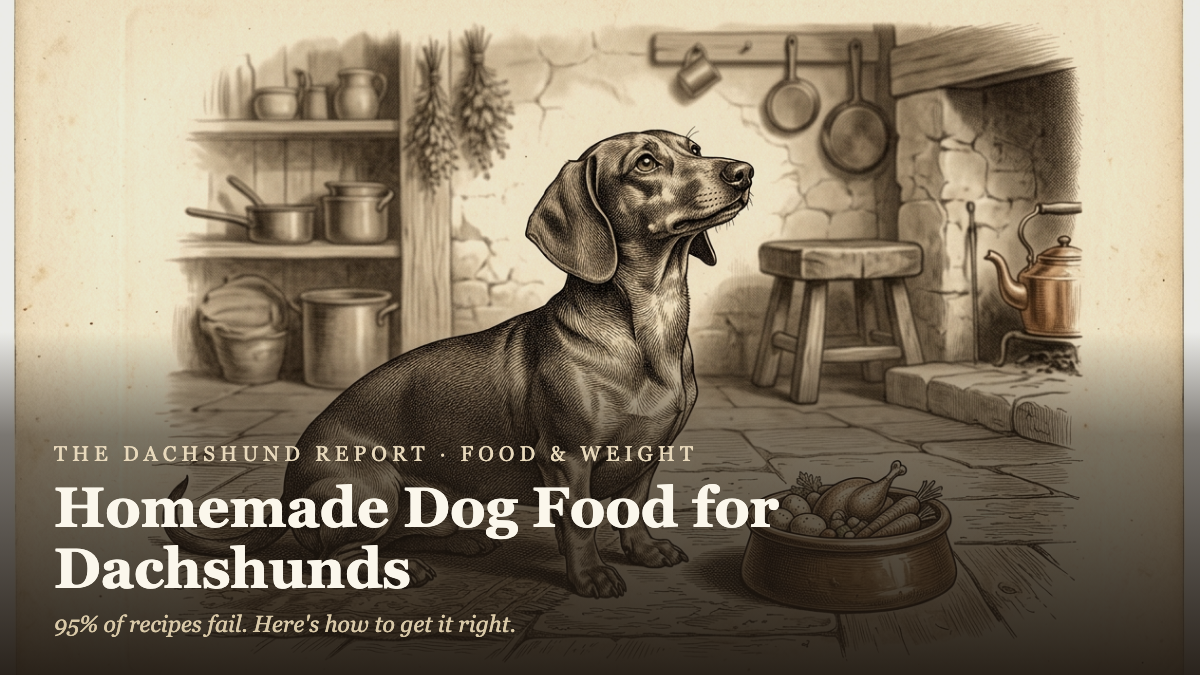
Most homemade dog food recipes you'll find online are nutritionally incomplete — a UC Davis study found that 95% failed to meet basic nutrient standards. For dachshunds, the stakes are higher: the wrong fat content can trigger pancreatitis, and the wrong calorie math can load extra weight onto a spine that's already working overtime. Here's how to cook for your doxie safely — with receipts.
I'm going to be honest with you.
About a year ago, I almost became one of those people who wrecks their dog's health while trying to improve it.
I was reading all these gorgeous homemade dog food posts on Instagram — golden broths, perfectly diced sweet potatoes, chicken shredded just so — and I thought, "That's it. I'm done with kibble. My dog deserves better."
And you know what? That instinct isn't wrong.
But here's the part nobody puts in the caption...
A study out of UC Davis evaluated 200 homemade dog food recipes — from books, websites, even veterinary textbooks. Only 9 met basic nutritional standards. That's a 95% failure rate.
And the kicker? The only recipes that passed were written by board-certified veterinary nutritionists. Not food bloggers. Not "holistic pet coaches." Actual specialists with years of training in animal nutrition.
A 2025 study from Texas A&M and the Dog Aging Project confirmed it with an even bigger sample — 1,726 homemade diets. Only 6% were potentially complete.
So if you're going to cook for your dachshund — and I'm not going to talk you out of it — you need to know what you're actually doing.
Because for our breed, getting it wrong hits different.
Why Does Homemade Food Hit Different for Dachshunds?
Two words: spine and pancreas.
Dachshunds carry the IVDD risk that nobody lets you forget — 15 to 24% will show clinical signs in their lifetime. And one of the biggest controllable risk factors is weight. Research from Packer et al. (2013) found that overweight dogs had significantly higher rates of disc extrusion.
Every extra ounce on a dachshund is a load on a suspension bridge that's already working at capacity.
And then there's the pancreatitis thing. Dachshunds are a predisposed breed. Too much fat in the diet — even once — can trigger an episode that lands you in the emergency vet at 2am. Not a hypothetical. An actual Tuesday night for thousands of doxie parents every year.
So when you're cooking at home, two numbers matter more than anything:
Calories (because every pound counts on that long back) and fat content (because the pancreas doesn't give second warnings).
How Many Calories Does a Dachshund Actually Need?
The veterinary formula is: RER = 70 × (body weight in kg)^0.75
Then multiply by 1.6 for a typical neutered adult. Here's what that looks like for our breed:
| Your Dachshund | Daily Calories (approx.) |
|---|---|
| 10 lb mini | ~350 kcal |
| 16 lb standard | ~500 kcal |
| 20 lb standard | ~585 kcal |
| 25 lb standard | ~680 kcal |
| 32 lb large standard | ~820 kcal |
Source: Merck Veterinary Manual RER formula. Adjust down for seniors, couch potatoes, or overweight doxies on a plan.
These numbers are smaller than most people expect.
When you're cooking at home without measuring, it's shockingly easy to double the calories. That gorgeous bowl of chicken and rice? Could be 800 calories. On a 16-pound dachshund, that's like you eating two Thanksgiving dinners and calling it lunch.
What's the Fat Ceiling for a Pancreatitis-Prone Breed?
According to the ACVN (American College of Veterinary Nutrition), the guideline for pancreatitis-prone dogs is less than 30 grams of fat per 1,000 calories.
For a 20-pound dachshund eating ~585 calories a day, that's roughly 17.5 grams of fat total. Max.
That's why I keep saying: skinless chicken breast, not chicken thighs. Lean ground turkey, not regular ground beef. And forget about bacon grease "for flavor" — I don't care how much your doxie's eyes are lying to you.
Those eyes were engineered in a German lab to manipulate you. Don't fall for it.
What Supplements Does Homemade Dog Food Need?
All of them. Basically.
I'm not being dramatic. Veterinary nutrition research — including work from Tufts and UC Davis — consistently identifies the same deficiencies in homemade diets:
- Calcium — boneless meat is dangerously low; the calcium-to-phosphorus ratio inverts without supplementation
- Zinc — the single most common deficiency; leads to skin and immune problems
- Vitamin D — dogs can't make it from sunlight like we do
- Choline — rarely adequate from meat alone
- EPA + DHA (omega-3s) — requires a marine source like fish oil
Here's the thing nobody tells you: these deficiencies don't show up for months or even years. As Tufts puts it, "inadequate levels of nutrients may not be evident for weeks or even years in adult animals, until the pet has a serious health problem that may not be easily reversed."
Your dog looks great. You post the bowl on Instagram. Everyone comments how lucky your doxie is.
And three years later, you're at the vet wondering why the bloodwork looks like that.
The non-negotiable supplement list:
- A complete canine vitamin/mineral supplement formulated to AAFCO standards (not a human multivitamin — different species, different needs)
- Calcium source — eggshell powder (½ teaspoon per pound of boneless meat) or bone meal
- Fish oil — dosed by EPA+DHA content (50–75 mg combined per kg of body weight), not by capsule size. A 1,000 mg fish oil capsule typically contains only ~300 mg of actual EPA+DHA. Read the label.
If that sounds like a lot... it is. Which brings me to the part I wish someone had told me earlier.
Is Homemade Dog Food Actually Worth It?
I'll say what the Instagram posts won't.
For most dachshund owners, the best commercial dog food — a good-quality, AAFCO-complete, breed-appropriate kibble or wet food — is safer, more nutritionally reliable, and less likely to slowly harm your dog than an unsupplemented homemade diet.
That's not me being lazy. That's Dr. Jennifer Larsen, DVM, PhD, board-certified veterinary nutritionist at UC Davis, saying: "It is extremely difficult for the average pet owner — or even veterinarians — to come up with balanced recipes to create appropriate meals that are safe for long-term use."
But — and this is a real but — there are situations where cooking makes sense:
- Your dachshund has confirmed food allergies and you need total ingredient control
- You're doing a vet-supervised elimination diet and commercial limited-ingredient options aren't cutting it
- Your vet or a board-certified nutritionist has formulated a specific recipe for your dog's medical needs
- You want to add toppers or partial fresh food to a complete commercial base (this is the move most dachshund owners should consider first)
If you're doing full homemade, the one tool I'd point you to is BalanceIT — created by Dr. Sean Delaney, a board-certified veterinary nutritionist who used to teach at UC Davis. It's free, it's used by over 20,000 veterinarians, and it will tell you exactly what's missing from your recipe.
Don't guess. Don't eyeball. Don't trust a recipe from someone whose credentials are "dog mom."
A Simple Low-Fat Framework for Dachshunds
If you do cook, here's a starting framework. This is not a prescription. Any homemade diet fed long-term should be verified by a veterinary nutritionist.
Lean Turkey & Rice (Pancreatitis-Safe)
- 1 lb 99% lean ground turkey, cooked
- 1 cup cooked brown rice
- 1 cup steamed broccoli, finely chopped
- 1 cup shredded carrots
- 1 tbsp fish oil (measured by EPA+DHA content, not capsule size)
- AAFCO-compliant canine vitamin/mineral supplement
- ½ tsp eggshell powder per pound of meat
Approximate fat: ~9% on a dry matter basis — well within the pancreatitis-safe ceiling.
What to never put in the bowl: grapes, onions, garlic, xylitol, chocolate, macadamia nuts, cooked bones, avocado. And for the love of your dachshund's pancreas: no bacon, no fatty skin, no fried anything.
Portion for a 20-pound dachshund: roughly 1 to 1¼ cups per day, split into two meals. Weigh on a kitchen scale if you can — the scale matters more than you think.
FAQ
Can I feed my dachshund homemade food every day?
You can — but only if the recipe is nutritionally complete, supplemented properly, and ideally verified by a board-certified veterinary nutritionist (DACVN). The UC Davis study found that 95% of recipes fail this bar. Feeding a deficient diet daily compounds the problem faster than occasional home cooking.
What's the best protein for a dachshund with a sensitive stomach?
Lean, single-source proteins tend to work best — skinless chicken breast, 99% lean ground turkey, or white fish like cod. Avoid high-fat proteins (duck, lamb shoulder, pork). If your dachshund has a confirmed protein allergy, a novel protein (rabbit, venison) under vet guidance is the standard approach.
Do I need to add supplements to homemade dog food?
Yes — always. Boneless meat is critically low in calcium, and home-cooked diets are consistently deficient in zinc, vitamin D, choline, and omega-3 fatty acids. A complete canine supplement plus a calcium source (eggshell powder or bone meal) and fish oil are the minimum. Tufts recommends against "winging it" with individual supplements — use a formulated canine product.
Is homemade food better than kibble for dachshunds?
Not automatically. A well-formulated commercial food that meets AAFCO standards is nutritionally complete and consistent. A poorly supplemented homemade diet is worse than decent kibble — even if it looks prettier in the bowl. The advantage of homemade is ingredient control, which matters most for dogs with allergies, intolerances, or specific medical conditions.
How do I know if my homemade recipe is balanced?
Use BalanceIT, a free formulation tool created by a board-certified veterinary nutritionist and used by 20,000+ veterinarians. It analyzes 40+ nutrients against AAFCO standards and tells you exactly what's missing — plus the supplement dose to fix it.
Free: The Dachshund Back Handbook
I put everything we know about keeping these long little backs strong into one free guide — the 8 early warning signs, the furniture setup, the weight math, how to pick up a doxie the right way, and the exact checklist I'd bring to a vet visit.
It's free, it's short, and it might be the most useful thing you ever read about your wiener dog.
Grab the free Back Handbook here
(Educational only — not veterinary advice. When in doubt, call your vet. Always call your vet.)



