
Why Do Dachshunds Dig So Much? (Spoiler: It's Not a Phase)

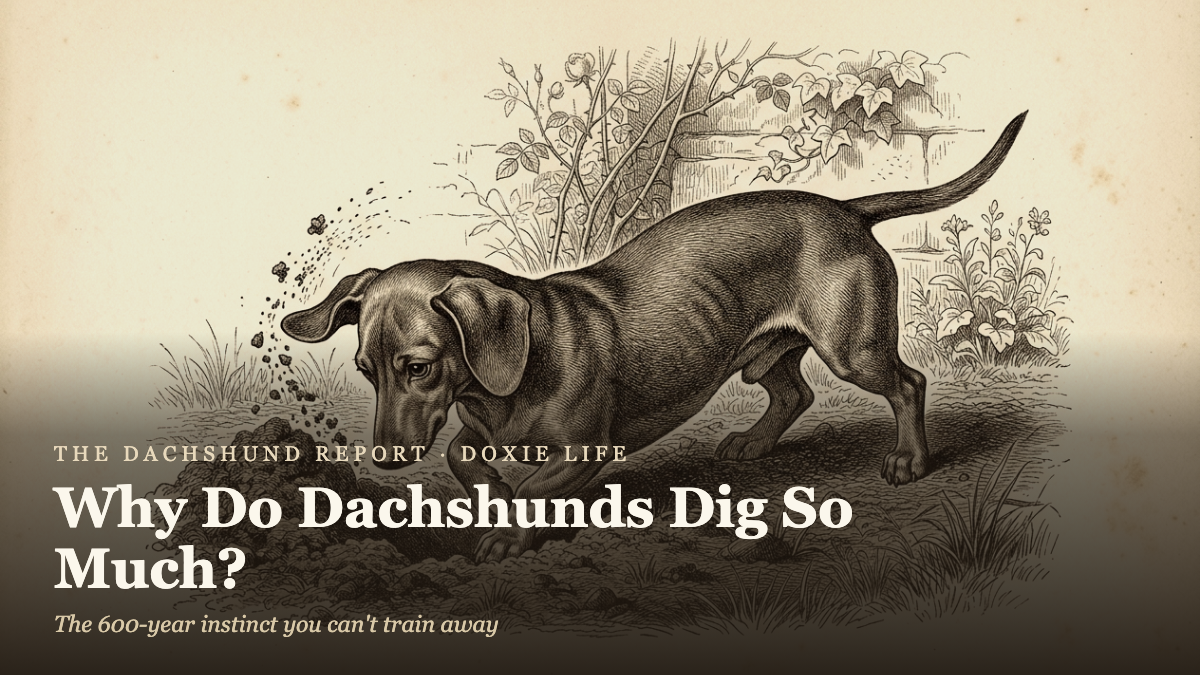
Dachshunds dig because they were literally engineered for it. "Dachshund" means "badger dog" in German, and for over 600 years these dogs were bred to pursue prey underground — digging into burrows, navigating tunnels, and fighting badgers in the dark. That instinct didn't disappear when they moved to your couch. Your doxie isn't being bad. They're being a dachshund.
You know the scene.
You step outside. There's a hole in the yard that wasn't there this morning. Dirt on the porch. Dirt on the dog. And your dachshund is sitting next to the evidence looking at you like, "What? I was busy."
Maybe it's not the yard. Maybe it's the couch cushions. The bed sheets. The carpet in the hallway at 2am for no apparent reason.
And you're standing there wondering... is this normal?
Yeah. It's normal.
In fact, if your dachshund digs, it means the 600 years of German engineering that built them is working exactly as designed.
Why Were Dachshunds Built to Dig?
Here's the thing most people forget about these little dogs: they're not decorative.
Dachshunds were bred in Germany to hunt badgers — animals that can weigh up to 40 pounds and fight like they mean it. The dachshund's job was to dig into the badger's burrow, navigate tight underground tunnels, corner the animal, and either flush it out or hold it until the hunter arrived.
That's not a lap dog job description.
The AKC notes that standard dachshunds hunted badgers while miniature dachshunds were sent after smaller prey like rabbits. Every physical feature — the long body, the barrel chest, the paddle-shaped front paws, the loose skin that doesn't tear in tight spaces — was purpose-built for underground work.
And here's where it gets interesting.
In 2009, researchers at the National Human Genome Research Institute discovered that dachshunds' short legs trace back to a single genetic event: a retrogene called FGF4 that inserted itself into their DNA. Those stubby legs weren't an accident. They were an evolutionary adaptation that made them better at one thing — getting into holes.
So when your dachshund excavates your flower bed?
They're performing the task their entire body was redesigned around.
Is Digging Actually Genetic? (What the Research Says)
You might think, "Sure, but MY dachshund has never seen a badger. How is digging still in there?"
Fair question. The science has an answer.
A 2019 study in Proceedings of the Royal Society B (MacLean et al.) analyzed 14 behavioral traits across breeds and found heritability estimates ranging from 0.50 to 0.73 — meaning your dog inherited a significant chunk of their behavioral tendencies from their breed line, not from watching YouTube videos of other dogs digging.
Now, a larger 2022 study published in Science (Morrill et al.) surveyed over 18,000 dogs and found that breed explains only about 9% of behavioral variation in individual dogs. So not every dachshund will be a compulsive digger — your mileage genuinely varies.
But here's the nuance: while breed is a weak predictor of an individual dog's personality, certain task-related behaviors — retrieving in retrievers, herding in herding dogs, going to ground in earth dogs — remain significantly more heritable than general personality traits.
Dr. Zachary Silver, who runs the Canine Intelligence Lab at Occidental College, puts it bluntly: "No matter how much we try with training, we are really not going to be able to overwrite what's hardwired into them from an evolutionary perspective."
Digging in a dachshund isn't a behavior problem. It's a breed feature.
The Five Reasons Your Dachshund Digs
Not all digging is created equal, though. Understanding WHY your doxie is digging helps you know what to do about it.
1. Instinct (the big one)
This is the badger-hunting DNA talking. Your dachshund smells something underground — a mole, a root, a bug, maybe just interesting dirt — and every fiber of their 600-year-old programming says DIG. They'll focus on specific spots, nose-first, tail up, completely deaf to your voice. That's not stubbornness. That's a prey drive so deep it predates your house, your yard, and probably your family tree.
2. Boredom
A dachshund with nothing to do is a dachshund who will find something to do. And "something" usually involves dirt. The Humane Society notes that dogs dig for entertainment when they "learn that roots and soil play back." If your doxie is left in the yard alone with no toys, no stimulation, and no company, the yard becomes the toy. This is especially common in puppies and adolescents.
3. Comfort
Hot day? Your dachshund is digging down to cooler soil. That's not misbehavior — it's thermoregulation. Dachshunds have a relatively high surface-area-to-body-mass ratio thanks to that long body, and they feel temperature shifts more than you'd think. A shallow hole in the shade is basically a dachshund air conditioner.
4. The Burrowing Instinct
This is the indoor version. Blankets, cushions, laundry piles — your dachshund "digs" into soft things because burrowing is wired into the same circuitry as digging. They're nesting. It's the same instinct that makes them disappear under your covers at night. It's comforting, and it's not going anywhere.
5. Anxiety
This is the one you need to watch for. If the digging is happening at exit points — doors, fences, window frames — especially when you're gone, that's not instinct. That's stress. Anxiety-driven digging is typically combined with other signs: pacing, whining, destructive chewing, accidents in the house. If this sounds familiar, read our guide on dachshund separation anxiety.
What NOT to Do (Seriously)
Here's where most dachshund owners go wrong:
They try to punish the digging out of their dog.
Yelling. Spraying water. Filling holes with pepper. Locking them inside.
Maddie Messina, a Certified Applied Animal Behaviorist, warns that "if you try to suppress an innate behavior, other problem behaviors are going to pop up." Suppress the digging and you might get barking, chewing, anxiety, or a dachshund who digs even more frantically when you're not looking.
You can't punish a dachshund for being a dachshund.
What you CAN do is channel it.
How to Channel 600 Years of Digging Instinct
Build a dig box
The single best investment for a digging dachshund: a designated dig zone. A shallow sandbox or raised bed filled with loose soil or sand. Bury treats and toys in it. Praise your doxie when they dig there. Redirect them when they dig elsewhere. Maddie Messina recommends "apartment-friendly dig boxes" that let dogs search for treats in a safe setting — this works even if you don't have a yard.
Try AKC Earthdog
This is not a joke. The AKC runs an actual sport called Earthdog — designed specifically for dachshunds and terriers. Dogs navigate underground tunnels to locate caged rats (the rats are safe and unharmed). The AKC describes it as testing your dog's ability to "hunt underground" — "simply doing what these dogs were bred to do."
Dr. Silver notes that after Earthdog trials, "the dogs show a lot of signs of fulfillment afterwards. They're happy to just go home and relax." Give a dachshund an approved outlet for their instinct, and the backyard excavation often slows down on its own.
Exercise and mental stimulation
A tired dachshund digs less. Adequate daily exercise — two moderate walks plus some play — burns off the energy that otherwise goes into your garden. Add puzzle feeders, snuffle mats, and nose work games. A dachshund's nose is one of the most powerful tools in the hound group. Use it.
Make unauthorized dig spots unappealing
Flat stones, chicken wire laid just beneath the surface, or citrus peels in garden beds can deter digging in specific spots without punishing the dog. Pair this with the designated dig zone for the best results.
When to Talk to Your Vet
Most dachshund digging is normal. But there are two situations that warrant a vet visit:
Sudden onset compulsive digging — if a dog who never dug before starts digging obsessively, that can signal pain, skin irritation, or a neurological issue. Dachshunds are prone to IVDD, and discomfort can manifest as restless, repetitive behaviors.
Digging at exits combined with distress signs — this is separation anxiety, and it can escalate. A veterinary behaviorist can help with a treatment plan that actually addresses the root cause rather than just the symptom.
FAQ
Is it normal for dachshunds to dig holes in the yard?
Yes. Digging is one of the most breed-typical behaviors in dachshunds. They were bred for over 600 years to dig into underground burrows to hunt badgers and other prey. Not every individual dachshund will be a prolific digger, but the instinct is present in the breed's genetic heritage.
Can you train a dachshund to stop digging?
You can redirect digging, but you probably can't eliminate it entirely. Research shows that task-related breed behaviors like digging are significantly heritable. Trying to suppress an innate behavior can lead to other behavioral problems. The most effective approach is providing a designated dig zone and channeling the instinct through enrichment activities like dig boxes, nose work, or AKC Earthdog trials.
Why does my dachshund dig at the couch and blankets?
Indoor "digging" is the burrowing instinct — the same neural wiring that drives outdoor digging. Dachshunds were built to navigate tight underground spaces, and burrowing into soft materials mimics that environment. It's a comfort behavior and is completely normal for the breed.
Why does my dachshund dig more when left alone?
If the digging is focused on exit points (doors, fences, gates) and happens primarily when you're away, it may be a sign of separation anxiety rather than instinct-driven digging. Separation anxiety is more common in dachshunds than in most breeds. Look for accompanying signs like whining, pacing, destructive chewing, or house soiling, and consult your vet if the pattern continues.
What is AKC Earthdog?
AKC Earthdog is a non-competitive sport designed specifically for dachshunds and small terriers. Dogs navigate underground tunnel systems to locate caged rats (the rats are always safe and unharmed). The sport tests the go-to-ground instincts these breeds were originally developed for. The program was launched in 1994 and is open to all eligible dachshund varieties.
Get Your Daily Dose of Dachshund Love
If you liked this, you'll love what lands in your inbox. Stories, breed science, and the kind of doxie content that makes you nod and say "that's MY dog."
(This article is for informational purposes only and is not veterinary advice. If your dachshund's digging is sudden, compulsive, or accompanied by signs of distress, consult your veterinarian.)



