Why Do Dachshunds Bark So Much? (It's Not What You Think)

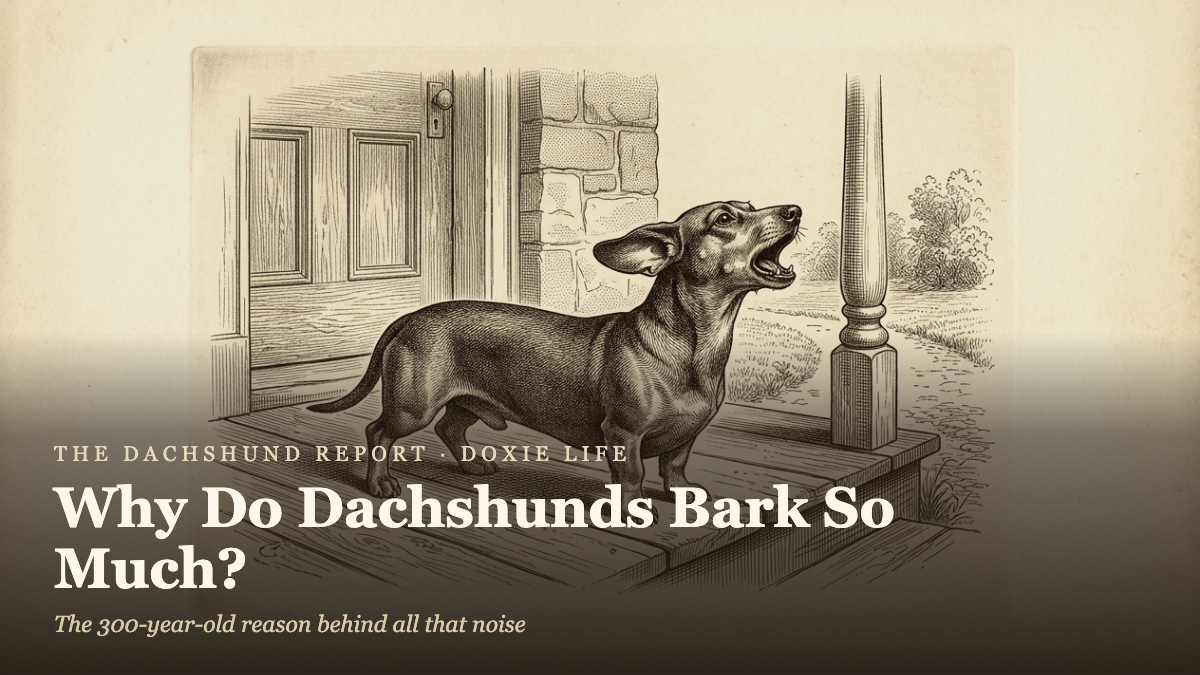
Dachshunds bark so much because they were literally bred for it. Their ancestors hunted badgers underground, and barking was the communication system that told hunters where the dog was — sometimes several feet below the surface. That instinct didn't go anywhere just because your doxie now lives on a couch.
You know that moment.
The mailman is three houses away. You can't hear him. The neighbors can't hear him. But your dachshund? Your dachshund has launched a full-scale alarm response that sounds like a German Shepherd got trapped inside a sausage costume.
And you're standing there thinking, "Why? WHY are you like this?"
I'll tell you why.
Because your dog is doing exactly what it was designed to do. And once you understand that, the barking starts to make a lot more sense.
Why Were Dachshunds Built to Bark?
Here's the part most people don't know.
When German hunters bred the dachshund starting in the late 17th century, the bark wasn't a side effect. It was the whole point.
The job was simple: crawl into a badger's burrow, corner the animal, and then bark loud enough for the hunter above ground to hear exactly where to dig.
Think about that for a second. Your dog's ancestors were barking through dirt. Underground. In a tunnel. And the bark had to be loud enough, and deep enough, to travel through the earth to a human standing on the surface.
The AKC describes the breed as having "a big-dog bark" — and that's not a cute description. It's a spec. That oversized ribcage, the one the AKC says was bred to be "long and well developed, providing ample room for the heart and lungs"? That's a bark amplifier.
Your dachshund is a 12-pound dog with the vocal equipment of something three times its size.
And according to DecibelPro, a dachshund's bark can hit 75 to 90 decibels — roughly the volume of a lawn mower. From an animal that fits in a tote bag.
That's not a design flaw. That's 300 years of German engineering.
What Does Each Bark Actually Mean?
Here's the thing that changed how I think about doxie barking: they're not just making noise. They're talking. And if you live with one long enough, you start to hear the difference.
The Alert Bark
This is the classic. The mailman bark. The someone-just-walked-past-the-window bark. The dog-across-the-street bark.
It's sharp, repetitive, and aimed at a specific target. Your dachshund has spotted something that wasn't there before, and they're doing their job — which, in their mind, is protecting a burrow. Except now the burrow is your living room.
The AKC calls dachshunds "smart and vigilant" and rates them as watchdogs for a reason. Purina puts it plainly: "Dachshunds make good watchdogs due to their surprisingly loud bark."
They're not being annoying. They're being thorough.
The Demand Bark
This one's shorter. More insistent. Usually accompanied by eye contact that could cut glass.
It means: I need something and you are failing me.
Could be food. Could be a bathroom break. Could be that they've decided they need to sit on your lap right now and you're not cooperating.
Dachshunds are independent thinkers who were bred to make decisions underground without human guidance. When they want something, they don't hint. They announce.
The Boredom Bark
This one's lower energy. More rhythmic. Almost like they're muttering to themselves.
A bored dachshund will bark because there's literally nothing else to do. These dogs were bred to work — running through woods, tracking scent, battling animals in tunnels. A day with no walk and no mental stimulation is like putting a marathon runner in a closet.
Witzig puts it simply: bored dachshunds bark to "burn off some extra steam." The fix is the same as the one we talk about in the exercise guide — two good walks a day, plus something for their brain (puzzle toys, sniff games, a frozen Kong).
The Anxiety Bark
This sounds different from the rest. Higher pitched. Sometimes paired with pacing, whining, or the full-body shake.
If your dachshund loses it when you leave the house, you're probably hearing separation anxiety — and barking is one of the most common symptoms. These are dogs that were bred to bond closely with one person and follow them everywhere. When that person disappears, the dog's brain goes into crisis mode.
This isn't a training problem. It's a breed feature running the wrong program.
The Excitement Bark
Tail going. Body wiggling. Bark that sounds almost like a yelp.
This is the "you picked up the leash" bark. The "someone I love just walked in" bark. The "I can smell a treat from 40 feet away" bark.
It's pure joy, and honestly? It's kind of hard to be mad about this one.
Can You Train a Dachshund to Bark Less?
Yes. But let's be honest about what "less" means with this breed.
You are not going to turn a dachshund into a quiet dog. That's not how 300 years of breeding works. What you can do is teach them to stop faster and not bark at every single thing that moves.
Here's what actually works:
Reward the quiet, not just the bark. Most people yell at the bark. The dog thinks you're barking with them. Instead, wait for a pause — even a one-second pause — and reward that. Over time, the pause gets longer.
Teach a "thank you" cue. When your dachshund alert-barks, acknowledge it. Say "thank you" or "I see it." Then redirect. This sounds silly, but you're telling the dog: I heard you. I got it. You can stand down. Many dachshund owners find that acknowledging the alert actually reduces the barking faster than trying to suppress it.
Don't skip the walk. A tired dachshund is a quieter dachshund. Not silent. But quieter. Two 20-minute walks a day minimum. Sniff-heavy routes are better than fast ones — mental work drains a dachshund faster than physical work.
Desensitize the triggers. If it's the doorbell, play doorbell sounds on your phone at low volume while treating calmly. Gradually increase. If it's the mail carrier, sit by the window with treats before the usual delivery time and reward calm behavior. This takes weeks, not days.
Never use punishment. Yelling, squirt bottles, bark collars — they suppress the behavior without addressing the cause. With a dachshund, punishment often means the anxiety goes somewhere worse. Witzig specifically warns that raising your voice is counterproductive — your dachshund interprets it as you barking along with them.
When Should Barking Worry You?
Most dachshund barking is normal. Annoying, maybe. But normal.
A few things worth noting, though:
If the barking is new and sudden — especially if it's happening at night or seems directionless — it could signal pain. Dachshunds are prone to back issues that can cause discomfort without visible symptoms. A dog that suddenly starts barking or whimpering for no clear reason deserves a vet visit.
If the barking is constant when you leave and paired with destruction, bathroom accidents, or escape attempts, that's likely separation anxiety, not stubbornness. Talk to your vet — there are behavioral approaches and, in some cases, medication that can help.
If the barking changes in pitch or quality — goes raspier, weaker, or sounds painful — that could be a throat or respiratory issue.
The rule is the same one we repeat in every health article on this site: when in doubt, call your vet.
FAQ
Why is my dachshund's bark so loud for such a small dog?
Because the breed was designed that way. Dachshunds hunted badgers underground, and their bark had to carry through tunnels and dirt to the hunter above. The AKC describes them as having "a big-dog bark", and their deep, roomy ribcage amplifies the sound. DecibelPro measures dachshund barks at 75–90 decibels — comparable to a vacuum cleaner or lawn mower.
Do all dachshunds bark a lot?
Most are vocal, but the intensity varies. Wirehaired dachshunds, which carry terrier genetics, tend to be the barkiest. Longhaired dachshunds are often the calmest. But every dachshund has the hardware — whether they use it constantly depends on their environment, training, and how much exercise they get.
Will my dachshund grow out of barking?
No. Barking is hardwired into the breed, not a puppy phase. What changes is your ability to manage it. Early training — starting with the basics of how dachshund brains work — gives you the best shot at teaching your doxie which barks are worth it and which aren't.
Is it bad to let my dachshund bark?
Not inherently. Alert barking is what the breed does — suppressing it entirely can increase anxiety. The goal is management: acknowledge the bark, redirect, reward quiet. A dachshund that's allowed to bark-and-stop is generally happier than one that's being constantly shushed.
How do I stop my dachshund from barking at the door?
Desensitization works best. Before the trigger arrives, position yourself near the door with treats. When the doorbell rings or the knock comes, say your cue word ("thank you" or "enough"), then treat when the dog pauses. Practice with recordings first. This takes patience — dachshunds were bred to alert, so you're working against centuries of instinct. But they're also food-motivated enough to negotiate.
Get Your Daily Dose of Dachshund
If this sounded like your dog, you'd probably like what we send. One email a day — doxie stories, breed facts, back-health tips, and the kind of stuff only a dachshund person would care about.
It's free, it's short, and it's written by someone who's spent years in this world.
(We'll never sell your info. Unsubscribe anytime. But you probably won't want to.)