
Dachshund Puppy Teething: The Breed That Gets Hit from Every Direction

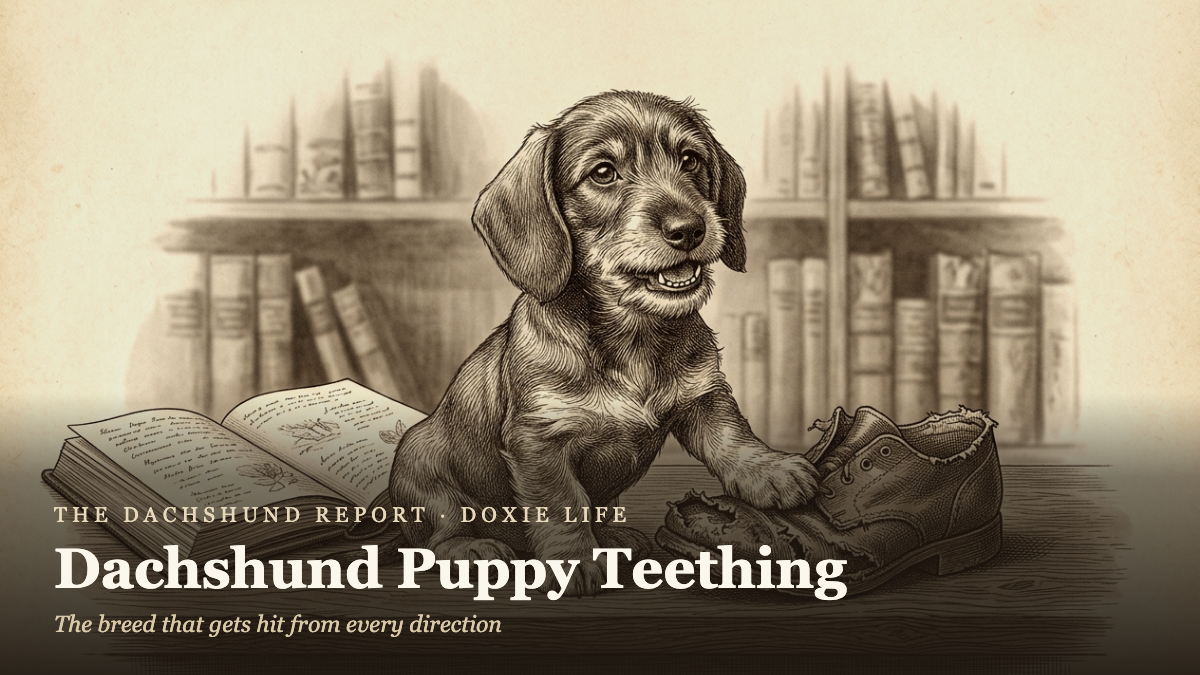
Dachshund puppies start losing their 28 baby teeth around 3.5 to 4 months old, and most have all 42 adult teeth by 6 to 7 months. But dachshunds sit at the intersection of three dental risk factors — small breed, long-nosed skull, and breed-specific genetic malocclusion — that make their teething phase the opening chapter of a lifelong dental story most owners never hear about until it's too late.
You know the phase.
Your dachshund puppy — the one who looked like an angel at the breeder — has turned into a twelve-pound piranha with ears.
Everything is a chew toy. Your shoes. Your couch. Your fingers. That one corner of the baseboard that you're pretty sure was fine yesterday.
And somewhere between Googling "is my puppy broken" and fishing a sock out of a tiny mouth full of needles, you land on the question every new doxie parent asks:
When does the teething stop?
Here's the short answer: around six months.
Here's the real answer: the teething stops, but the dental story is just getting started. And for dachshunds specifically, that story has a few chapters nobody tells you about.
When do dachshund puppies start and stop teething?
The timeline is the same across all breeds, with one small-breed caveat.
Birth: No teeth. Just gums and that new-puppy smell.
3 weeks: The first deciduous teeth start poking through — incisors first, then canines, then premolars. This is when the "piranha teeth" reputation begins, and it's earned.
6 weeks: All 28 baby teeth are normally in. They're tiny, they're sharp, and your puppy has zero idea how to use them gently.
3.5 to 4 months: The real teething begins. Baby incisors start falling out as permanent teeth push through. You might find tiny teeth on the floor. You might not — puppies swallow most of them, which is completely normal.
4 to 6 months: Canines and premolars swap out. This is peak discomfort. Peak chewing. Peak landshark.
5 to 7 months: The molars come in — these are new teeth, not replacements, since puppies don't have molars. By the end of this window, your puppy should have all 42 adult teeth.
The small-breed note: Large and giant breeds tend to erupt their adult teeth slightly earlier than small breeds like dachshunds. So if your doxie is still losing teeth at seven months while your neighbor's Lab finished at five, that's normal.
What's not normal is a baby tooth still hanging around after the adult tooth has come in next to it. And that's where the dachshund-specific part starts.
Why are dachshunds more prone to retained baby teeth?
Here's the rule your vet will tell you: no two teeth should be in the same place at the same time.
When a permanent tooth erupts correctly, it pushes on the root of the baby tooth, causing that root to dissolve and the baby tooth to fall out. Clean swap.
But sometimes the permanent tooth comes in at the wrong angle — or the baby tooth root doesn't dissolve properly — and you end up with two teeth side by side. Those are called persistent or retained deciduous teeth.
And small breeds get hit harder.
A 2024 study in Research in Veterinary Science — the largest of its kind, nearly 3 million dog records from Banfield Pet Hospitals — found that extra-small breeds had a 15% prevalence of retained deciduous teeth, compared to 7% overall. Small breeds like dachshunds sit right behind them in risk. In fact, the study used dachshunds as the statistical reference breed in their small-dog modeling, which tells you how common it is in the breed.
The most commonly retained teeth? The upper canines, followed by the lower canines, then the incisors.
You'll know it when you see it — two fangs where there should be one, the baby tooth slightly smaller and often angled differently than the permanent one coming in beside it.
This isn't cosmetic. It's the start of a cascade.
What happens if a retained baby tooth isn't removed?
Everything bad, slowly.
The baby tooth and its permanent neighbor create a pocket where food debris, plaque, and tartar accumulate much faster than normal. That leads to gingivitis, then periodontitis, then premature tooth loss — in a dog that might live 13 to 16 years.
But it gets worse.
When a lower canine is retained, it forces the permanent canine to grow on the inside of the baby tooth. The tip of that permanent canine angles toward the roof of the mouth. If you think that sounds painful — it is. Contact between the canine tip and the palate can cause traumatic ulcers that interfere with eating.
And then there's the dachshund-specific curveball.
The three dental risk factors that hit dachshunds simultaneously
No other breed sits at the intersection of all three of these. That's not drama — it's anatomy.
1. Small breed = crowded mouth.
Dachshund mouths are compact, but their teeth haven't downsized to match. The result is overcrowding — teeth packed tightly together, sometimes rotating or misaligning to fit. Small breeds like dachshunds are more likely to experience retained baby teeth, which compounds the crowding problem. More teeth in less space means more surfaces trapping food and bacteria.
Extra-small breeds are up to five times more likely to be diagnosed with periodontal disease than giant breeds, according to a Waltham/Banfield study of over 3 million dogs.
2. Long-nosed skull = thinner bone.
This is the one nobody mentions.
Dachshunds are dolichocephalic — they have long, narrow skulls. And when jaws are made longer and narrower, the amount and thickness of bone is proportionately reduced. Dr. Aaron Forsayeth, a veterinary dental specialist, explains it plainly: the same amount of periodontal bone loss will be more significant in a long-nosed breed because there's less bone to lose.
The bone around the upper canines and premolars can be especially thin — particularly on the palatal side. When that bone erodes, it can create an oronasal fistula — a hole between the mouth and the nasal cavity. Sneezing, nasal discharge, chronic infections.
A peer-reviewed study in the Journal of Veterinary Dentistry confirmed what vets had long suspected: dachshunds are 3.3 times more likely to develop oronasal fistulas than other small breeds of similar age and weight.
And the most commonly affected teeth? The maxillary canines. The exact same teeth most commonly retained during teething.
See how the story connects?
3. Breed-specific genetic malocclusion.
The Merck Veterinary Manual specifically names dachshunds (alongside Shetland Sheepdogs) as predisposed to lance canines — a genetic condition where the upper canine teeth point forward instead of sitting in their normal position.
Lance canines can result from persistent baby teeth deflecting the erupting adult teeth into an abnormal orientation. The cause is likely inherited, which means it runs in lines.
When you put all three together — crowded mouth, thin bone, and a breed-specific tendency for mispositioned teeth — the teething phase isn't just a discomfort window. It's the setup for everything that follows.
The case that proves the point
Dr. Forsayeth shared a case study that every dachshund owner should know about.
An eight-year-old miniature dachshund was referred for inflamed gums and bad breath. The owner was doing everything right — daily dental chews, previous professional cleanings. The dog was eating normally and showed no obvious signs of oral pain.
Under anesthesia, the examination found severe bone loss around the upper canines, premolars, and molars. Deep 12mm pockets on the palatal side of both upper canine teeth. Associated oronasal fistulas.
Eighteen teeth had to be extracted.
The dog was eating normally. No obvious signs of pain. And still — 18 teeth. Dr. Forsayeth's takeaway: "This case is a great reminder that external appearance, such as minimal tartar, doesn't always reflect what's happening beneath the gumline." Especially in long-nosed breeds like dachshunds, where the bone is thinner and the damage is harder to catch.
That's the invisible disease problem. By the time you see it, it's advanced.
What should I give my teething dachshund puppy to chew on?
The right chew during teething does three things: soothes sore gums, redirects the biting away from your hands, and starts building good chewing habits.
The thumbnail test: veterinary dental specialists recommend avoiding any toy that's harder than your fingernail. Press your thumbnail into it. If it doesn't give, it can fracture a tooth.
Safe during teething:
- Rubber chew toys like the KONG Puppy — durable, fillable, soft enough for puppy teeth
- Rope toys — the fibers can help clean teeth, and dachshunds love the tug (replace them when they fray)
- Frozen or chilled blueberries, green beans, and carrots — the cold soothes inflamed gums; the texture satisfies the chew urge
- Frozen kibble inside a KONG or puzzle toy — cold plus mental enrichment
- Soft nylon chew toys designed for puppies
Avoid during teething (and forever):
- Bones — cooked or raw, they're too hard and can fracture teeth or cause intestinal damage
- Antlers and cow hooves — too hard, likely to fracture teeth
- Ice cubes — hard enough to chip a tooth, especially baby teeth
- Tennis balls — the felt traps dirt and acts like sandpaper on tooth enamel over time
And the real-world advice from every dachshund parent who's survived the landshark phase: have multiple chews available at all times and swap them out when your puppy loses interest. A bored puppy will find something to chew on. You'd rather it be a KONG than your baseboards.
What are the signs my dachshund puppy is teething?
You'll know. But here's the checklist from VCA Hospitals:
- Drooling more than usual
- Reluctance to eat (tender mouth)
- Irritability
- An overwhelming urge to chew on everything in sight
- "Puppy breath" — that characteristic smell is normal during teething and goes away once the process finishes
Some puppies also get a little blood on their toys when a tooth falls out. That's normal. A lot of blood, or bleeding that doesn't stop, means call the vet.
The thing dachshund owners specifically need to watch for: the teething phase overlapping with the biting phase. Dachshund puppies bite because they're teething, because they're exploring, and because they're descended from dogs who fought underground predators for a living. All three happen at the same time, and the combination can feel relentless.
It ends. Typically by seven to eight months, the teething is done and the bite inhibition training you've been doing starts to pay off.
When should I worry about my dachshund's teeth?
Check your puppy's mouth weekly from about four months to seven or eight months of age. You're looking for one thing: double teeth.
Call your vet soon — not next month — if you see:
- Two teeth in the same spot (baby tooth still in, adult tooth coming in beside it)
- Adult teeth coming in visibly crooked or angled wrong
- A lower canine pointing toward the roof of the mouth (that's the one that causes palatal trauma)
- Red, swollen gums around a tooth that seems stuck
The sooner a retained tooth is extracted, the more likely the adult tooth will move into its correct position on its own. Wait too long, and you might be looking at orthodontic intervention from a veterinary dental specialist.
And here's the part that matters for the next decade of your dog's life:
80 to 90% of dogs over age 3 have some component of periodontal disease. It's worse in smaller breeds, and dachshunds are at the front of that line.
Start brushing your puppy's teeth now — during teething — even if it's just getting them used to the toothbrush. That daily habit is the single most effective thing you can do against the invisible dental crisis that took 18 teeth from Dr. Forsayeth's patient.
Your vet won't tell you this at the puppy visit. Not because they don't care, but because there's never enough time.
But you're reading this. So now you know.
FAQ
How many teeth do dachshund puppies have vs adults?
Dachshund puppies have 28 deciduous (baby) teeth. Adult dachshunds have 42 permanent teeth. The extra 14 come from molars, which puppies don't develop — they only appear as permanent teeth between 5 and 7 months old.
Is it normal for my dachshund to have double teeth?
Two teeth visible in the same spot means a baby tooth has been retained alongside the incoming adult tooth. While this is more common in small breeds like dachshunds, it's not something to leave alone. Schedule a vet appointment — early extraction usually prevents the adult tooth from growing in crooked and avoids crowding problems that lead to periodontal disease.
Do dachshunds have worse teeth than other breeds?
Yes — and it's not close. Dachshunds combine three risk factors: small breed (crowded mouth), long-nosed skull (thinner jaw bone that erodes faster), and breed-specific genetic malocclusion like lance canines. They're 3.3 times more likely to develop oronasal fistulas than comparable small breeds. Daily brushing and annual dental cleanings aren't optional with this breed — they're survival equipment.
What can I give my teething dachshund for pain relief?
Cold helps. Frozen blueberries, chilled carrots, and frozen kibble in a KONG soothe inflamed gums naturally. Rubber puppy chew toys (like KONG Puppy) give the right texture for gnawing. Never give human pain medication — even a single ibuprofen or acetaminophen dose can be toxic to a dog, especially one as small as a dachshund. If your puppy seems in significant pain or won't eat, call your vet.
When should I start brushing my dachshund puppy's teeth?
Now. Even during teething, getting your puppy used to the sensation of a soft brush or finger brush builds the habit that will protect their teeth for the next 13 to 16 years. Start with just touching the gums. Graduate to a puppy toothbrush and enzymatic dog toothpaste. Daily brushing is the single most effective defense against the periodontal disease that hits dachshunds harder than almost any other breed.
Free: The Dachshund Back Handbook
I put everything we know about keeping these long little backs strong into one free guide — the 8 early warning signs, the furniture setup, the weight math, how to pick up a doxie the right way, and the exact checklist I'd bring to a vet visit.
It's free, it's short, and it might be the most useful thing you ever read about your wiener dog.
Grab the free Back Handbook here
(Educational only — not veterinary advice. When in doubt, call your vet. Always call your vet.)



