
Are Dachshunds Good with Cats? The Honest Answer from Someone Who's Seen Both Sides

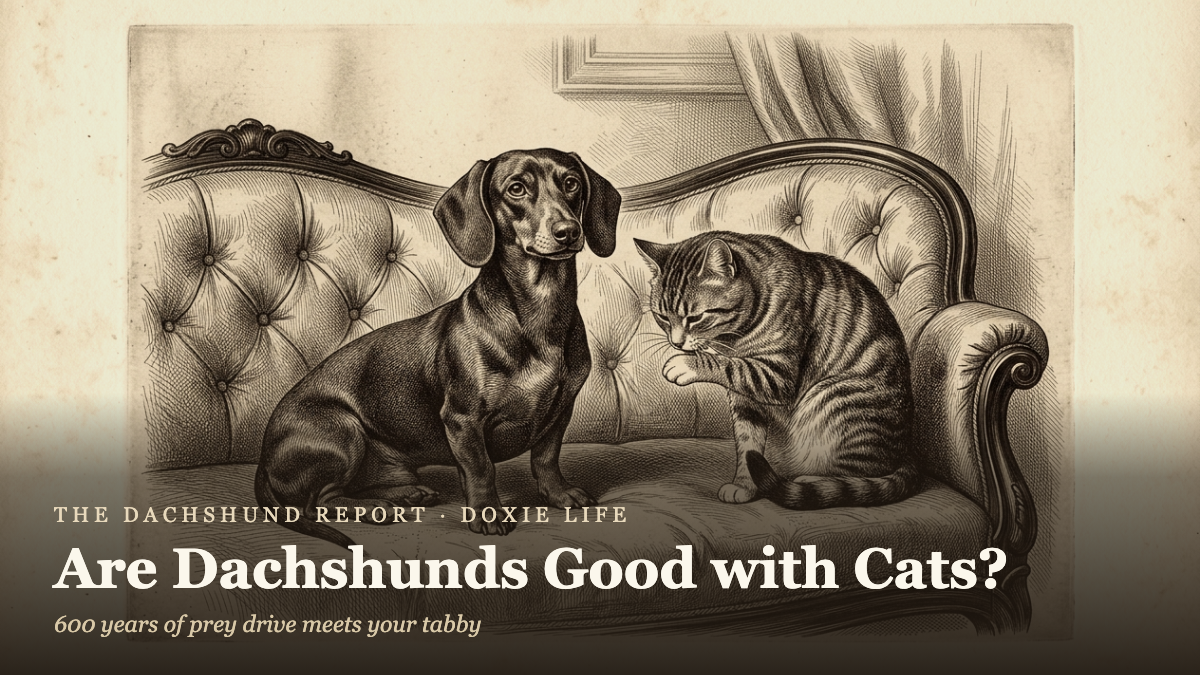
Yes, dachshunds can get along with cats — many live with them happily for years. But dachshunds were bred to hunt small burrowing animals for six centuries, and that prey drive doesn't vanish because you brought home a kitten. The answer depends on timing, introductions, and knowing which specific things about your dachshund's breed make this different from "can a Golden Retriever live with a cat."
Here's the thing about this question that nobody gives you straight.
Every article you'll find on the internet says "it depends on the individual dog."
Which is true. And also completely useless.
Because if you're Googling "are dachshunds good with cats" at 11pm, you're probably not looking for a philosophy lecture. You're looking at a cat. And a dachshund. And wondering if someone is about to lose a whisker.
So let me actually help you.
Why Dachshunds Are Different from Other Dogs Around Cats
Your dachshund is not a Labrador.
A Lab sees a cat and thinks "friend?" A dachshund sees a cat and thinks "target acquired."
I'm exaggerating. Slightly.
The name "Dachshund" literally translates to "badger dog" in German. These dogs were bred — for six hundred years — to follow burrowing animals underground into their dens. Standard dachshunds hunted badgers and foxes. Minis were bred for rabbits. They even hunted wild boar in packs.
So when the AKC says that for dachshunds, "anything whizzing by — such as cats, squirrels, and perhaps even cars — can trigger that instinct," they're not being dramatic. They're being accurate.
The Duffy, Hsu, and Serpell study (2008) at the University of Pennsylvania surveyed thousands of dog owners across 30+ breeds using the C-BARQ behavioral assessment. Dachshunds scored among the highest for aggression — higher than most breeds people actually worry about. The C-BARQ includes a specific "chasing" subscale measuring the tendency to chase cats, birds, and small animals.
This is what I mean when I say it's different. Your dachshund's prey drive isn't a personality flaw. It's a feature. It's what they were built for.
But — and this is the important part — the AKC also says that "if they're brought up with cats and other dogs they generally do just fine."
Both things are true. And which one wins depends on you.
Does It Matter Which Coat Type You Have?
Actually, yes.
Wire-haired dachshunds were created in the late 19th century by crossing smooth dachshunds with wire-haired terriers to produce a tougher coat for hunting in dense brush. That terrier ancestry didn't just change their fur — many owners and breeders report that wire-haired dachshunds tend to be more energetic and tenacious than their smooth and long-haired counterparts, consistent with their terrier lineage.
Long-haired dachshunds? Generally considered the calmest of the three. Smooth coats fall somewhere in the middle.
This isn't a hard rule. I've met calm wires and hyper longhairs. But if you've got a wire-haired dachshund and a nervous cat, just know that you're playing the game on a slightly harder difficulty setting.
The DachsLife 2015 study of 2,031 dachshunds confirmed that these coat varieties aren't just cosmetic — they carry meaningfully different genetics. Standard smooth-haired had IVDD rates of 24.4%. Standard wire-haired? Just 7.1%. Different bodies, different tendencies.
The Socialization Window Nobody Tells You About
Here's the single biggest factor, and it has nothing to do with the cat.
The AVMA says puppies are most open to learning about other animals between 3 and 14 weeks of age. The MSD Veterinary Manual puts it at 19 days to 12 weeks. Either way, there's a window — and it closes.
A dachshund puppy that meets a cat at 10 weeks old files "cat" under "normal household thing." A dachshund that first sees a cat at 2 years old files it under "small furry animal that moves fast" — which activates six centuries of breeding.
This is also why the AVSAB says behavioral problems are the number one cause of death in dogs under three years of age. Not disease. Not accidents. Behavior. They recommend socialization begin before full vaccination is even complete — that's how critical the window is.
If your dachshund met cats as a puppy? You're probably fine.
If your dachshund is an adult who's never seen a cat? It's not impossible. But you'll need a plan.
How to Actually Introduce a Dachshund to a Cat
The good news: this has been studied to death. The bad news: almost nobody follows the actual protocol.
Best Friends Animal Society outlines three approaches:
Method 1 — Slow desensitization. Baby gate between rooms. The animals see each other but can't reach each other. This goes on for days to weeks. Boring? Yes. Effective? Extremely.
Method 2 — Controlled face-to-face. Dog on a loose leash. Cat free to move. You're watching body language like a hawk. Stiffening, staring, fixating = back to Method 1.
Method 3 — "Look at That" training. You teach the dog that looking at the cat and then looking back at you earns a treat. This rewires the prey-drive impulse into a check-in impulse. It's the gold standard for reactive dogs.
American Humane adds a critical step: before any of this, separate the animals for several days and swap their bedding so they learn each other's scent first. And make sure the cat always has vertical space — shelves, cat trees, somewhere the dachshund absolutely cannot reach.
With a dachshund, this part is actually easier. Your cat can jump on a kitchen counter and your dachshund will just stand there, personally offended, staring up at them with the full force of six centuries of indignation. The height advantage is real.
One more thing. If you're bringing a dachshund INTO a cat's home, you'll generally have an easier time than bringing a cat into a dachshund's territory. Territorial dynamics matter, and dachshunds — if you haven't noticed — are not exactly known for sharing.
The Back Thing (Yes, It Matters Here Too)
You didn't think I'd skip this, did you?
Dachshunds face 10-12x higher risk of IVDD than other breeds. About 1 in 4 will show symptoms during their lifetime. And Cornell recommends minimizing jumping and sudden impacts.
So what does that have to do with cats?
Roughhousing. Chasing. Sudden direction changes during a game of "catch the cat" across the living room. The kind of full-speed, twisting, leaping play that two animals do when they actually like each other.
The DachsLife study found that regular moderate exercise protects dachshund backs. But there's a difference between a calm walk and a high-speed cat chase that ends with your dachshund launching off the couch.
If your dachshund and cat become friends — genuinely friends, the kind that play together — watch the play style. Gentle wrestling on the floor? Fine. Olympic-level parkour involving furniture? That's the couch jump conversation all over again.
The Warning Signs That It's Not Working
I won't sugarcoat this. Some dachshunds and cats will never be safe together.
The red flags, per Best Friends Animal Society and general veterinary behavioral guidance:
- Your dachshund stiffens and stares at the cat with locked focus
- Barking, lunging, or pulling toward the cat after weeks of controlled introductions
- The cat stops eating, hides constantly, or shows signs of chronic stress
- Any contact that draws blood on either side
If you're two weeks into slow introductions and your dachshund still goes rigid the second they see the cat, this isn't a training problem. This is a prey drive that's stronger than your management plan. And forcing it puts both animals at risk.
Dachshunds are among the breeds most likely to not back down from a confrontation. That stubbornness — the same trait that makes them delightful and infuriating in equal measure — is the reason you can't "wait it out" when things aren't working.
FAQ
Can dachshunds and cats be left alone together?
Only after months of successful, supervised interactions with zero incidents. Even then, many behaviorists recommend keeping them in separate rooms when you're not home. The risk isn't that they'll fight while you're watching — it's what happens when you're not there to interrupt a chase sequence.
Are miniature dachshunds better with cats than standard dachshunds?
Not necessarily. Minis were bred to hunt rabbits, which are closer in size and movement pattern to cats than badgers are. Their prey drive is just as real — they're just smaller while doing it. What matters more than size is individual temperament and socialization history.
My dachshund chases my cat. Is it playing or hunting?
Watch the body language. Play includes loose body movements, play bows, pauses, and role-switching (the cat chases back). Hunting looks like locked focus, stiff body, stalking posture, and acceleration without pause. If the cat is running and your dachshund is pursuing with zero breaks and a rigid body, that's not a game. Separate them.
What if I adopt an adult dachshund who's never seen a cat?
Start with Method 1 (baby gate, visual contact, no physical contact) and expect it to take longer — weeks to months instead of days. Many adult dachshunds can learn to coexist with cats, but the socialization window is closed, so you're building tolerance through repetition rather than capitalizing on developmental openness. Some never get there, and that's not a failure — it's biology.
Is it easier to bring a dachshund into a cat's home or a cat into a dachshund's home?
Bringing a dachshund into a cat's existing home is generally easier. The cat already has established escape routes, high perches, and a sense of security. A cat entering a dachshund's territory may trigger stronger resource-guarding and territorial behavior from the dachshund.
Look. I won't pretend this is simple.
Dachshunds are brilliant, stubborn, loyal, and hardwired to chase small fast things. Cats are small, fast things.
But I've seen dachshunds curl up with cats like they've known each other their whole lives. I've seen dachshunds who panic when their cat leaves the room. I've seen a dachshund groom a cat's ears — which the cat tolerated with the expression of someone being touched by a co-worker at a team-building event.
It works when you respect the breed, do the introduction right, and pay attention to what both animals are telling you.
And it doesn't work when you skip the steps and hope for the best.
Your dachshund is a 600-year-old hunting program in a 12-pound body. Your cat is a 10,000-year-old apex predator in a 9-pound body. With patience and a baby gate, most of them figure it out.
Join the daily dose of Dachshund love — stories, tips, and things only doxie people understand:
(This is behavioral guidance, not veterinary advice. If you're seeing aggression in either animal, consult a certified animal behaviorist — not the internet.)



