
Dachshund Dementia: The Signs Most Owners Miss (Until It's Late)

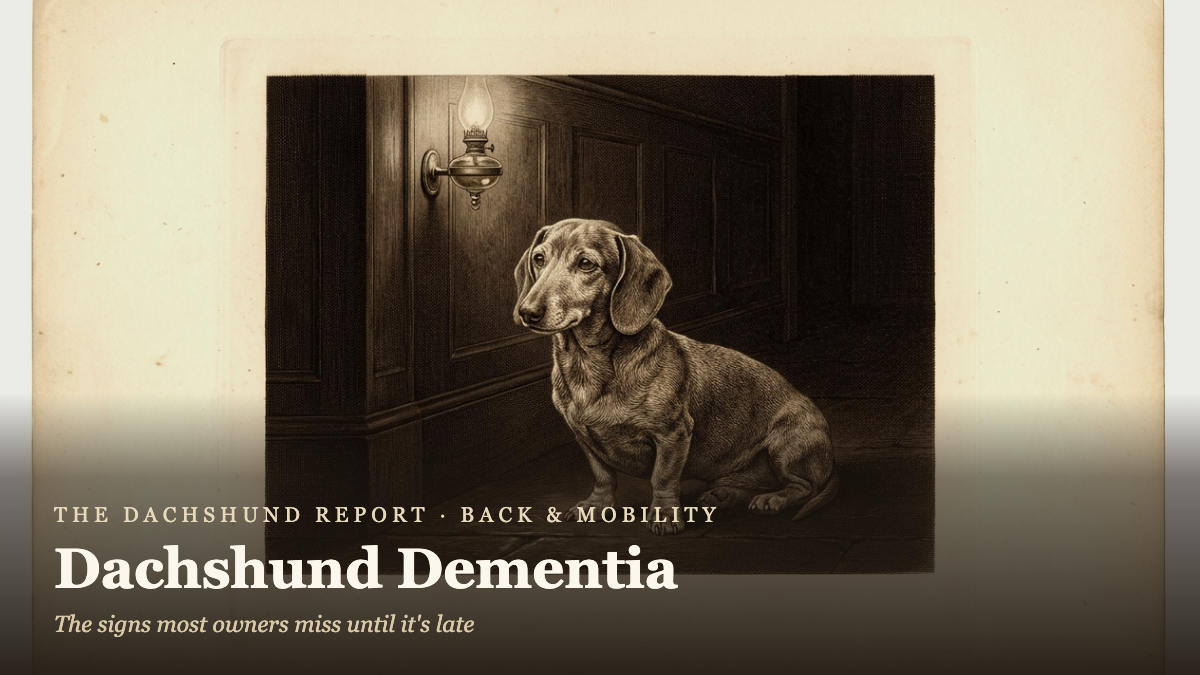
Canine cognitive dysfunction — dog dementia — affects up to 68% of dogs aged 15 and older, and dachshunds live long enough to be squarely in the risk window. The signs start subtle: staring at walls, forgetting where the food bowl is, pacing at 2am. There's no cure, but catching it early and starting the right combination of enrichment, diet, and veterinary support can slow the decline and protect months or years of quality life.
You know your dachshund.
You know the bark that means "someone's at the door" versus the bark that means "I can see a squirrel through the window and I have chosen violence."
You know the head tilt. The blanket burrow. The exact spot on the couch they've claimed since puppyhood.
So when something shifts — when they stand in the kitchen staring at the wall like it owes them money, or forget which door goes outside, or pace the hallway at midnight like they're looking for something they can't name...
You notice.
And then you Google it.
And then you find the word nobody wants to find: dementia.
Here's what you actually need to know.
What Is Canine Cognitive Dysfunction?
Canine cognitive dysfunction syndrome (CDS) is the veterinary term for what most of us call dog dementia. It's a neurodegenerative condition — meaning the brain physically deteriorates over time. Plaque builds up around the neurons, nerve cells die, and the brain slowly loses its ability to do things it's done for a decade.
If that sounds familiar, it should.
CDS has been compared directly to Alzheimer's disease in humans by Cornell University's College of Veterinary Medicine. The same kind of beta-amyloid plaque deposits. The same progressive pattern. The same heartbreak.
The difference is that your dog can't tell you they're confused.
They just... show you.
How Common Is Dementia in Dachshunds?
Here's the number that stopped me cold.
According to a study published in JAVMA, 28% of dogs aged 11 to 12 show signs of cognitive dysfunction. By 15 to 16, that number climbs to 68%.
Now think about your dachshund.
The average dachshund lives 12 to 16 years. That's not a coincidence — it's the whole problem. Dachshunds live long enough to land right in the danger zone. The same longevity that makes them one of the best companion breeds also makes them one of the most vulnerable to cognitive decline.
And here's the part that should make you angry: one JAVMA study found that while 14.2% of dogs over 8 showed signs of CDS, only 1.9% had actually been diagnosed by a veterinarian. That's a massive gap. Most owners — and, honestly, a lot of vets — chalk the early signs up to "just getting old."
It's not just getting old.
What Are the Signs of Dementia in Dachshunds?
Veterinary behaviorists use an acronym called DISHAA, created by Dr. Gary Landsberg, to categorize the signs. Here's what it actually looks like in a dachshund household:
D — Disorientation. Your doxie gets lost in your house. They stand at the wrong side of the door. They walk into corners and just... stay there. The dog who's navigated your living room for 12 years suddenly acts like they've never been in the room before.
I — Interaction changes. They stop greeting you at the door. Or the opposite — they become velcro-clingy in a way that feels different from normal dachshund attachment. They might not recognize a family member they've known their whole life. That one hurts.
S — Sleep-wake cycle. This is the one that breaks most owners. They pace all night. They sleep all day. The internal clock that used to run like German engineering just... stops keeping time.
H — House soiling. A dog who's been reliably potty trained for a decade starts having accidents. Not because they're being stubborn (though I know what you're thinking — they're a dachshund, so stubbornness is always on the table). Because they genuinely forgot.
A — Activity changes. Less interest in toys. Less interest in walks. Repetitive behaviors — circling, head-bobbing, staring. Or sometimes increased restlessness with no obvious purpose.
A — Anxiety. New fears. Sudden noise sensitivity. General unease that looks different from arthritis pain but is just as distressing to watch.
One or two of these in isolation? Could be anything. Three or more? Call your vet. Don't wait.
When Should You Call Your Vet About Dementia?
Now.
Seriously — if you're reading this because you noticed something, that's your cue.
The 2023 AAHA Senior Care Guidelines recommend screening for cognitive dysfunction starting at age 7 for large breeds and 10 for small breeds. Your dachshund's annual wellness visit after age 10 should include a cognitive screening conversation.
Here's why timing matters: according to Today's Veterinary Practice, treatment is most effective when started in the early stages — the stage that most owners dismiss as "normal aging." The early signs are the easy-to-miss ones: sleeping a little more, engaging a little less, taking a beat longer to respond to their name.
By the time your dachshund is standing in the corner staring at the baseboard, you've already lost ground.
Your vet can rule out other conditions that mimic CDS — hypothyroidism, pain, vision or hearing loss, urinary tract infections — and start a management plan early enough to actually make a difference.
Can You Slow Down Dementia in Dachshunds?
There's no cure. Let me say that plainly so nobody reads past it: there is no cure for canine cognitive dysfunction. The brain damage is real and irreversible.
But slowing the progression? That's real too. And it's not one thing — it's the combination that works.
1. Medication. Selegiline (sold as Anipryl) is the only drug FDA-approved for canine cognitive dysfunction in the United States. It works by increasing dopamine in the brain and reducing oxidative damage. Clinical trials showed improvement in sleep patterns, house-training, and activity levels within 4 weeks. It's not a miracle — but it's the closest thing we have to one. Your vet can also discuss melatonin for nighttime settling and other supportive medications. Talk to your vet about what's right for your dog.
2. Diet. Diets enriched with antioxidants, omega-3 fatty acids, and medium-chain triglycerides (MCTs) have shown measurable cognitive benefits in published research. MCTs provide an alternate energy source for the aging brain — up to 20% of the brain's fuel, according to the research. Hill's Prescription Diet b/d and Purina ProPlan NeuroCare are the two most commonly recommended by veterinarians in a recent survey of US vets.
3. Enrichment — and this is the big one. A landmark study by Milgram et al. found that dogs who received BOTH an antioxidant-rich diet AND behavioral enrichment performed better cognitively than any other group — better than diet alone, better than enrichment alone. The enrichment protocol was straightforward: training exercises, social interaction, toy rotation, and regular walks.
Your dachshund doesn't need a PhD program. They need you to keep challenging that brain. New puzzle toys. Short training sessions. Sniff walks where they lead. Rotating the toys instead of leaving the same ones out until they're invisible. The same instincts that made them underground hunters — the problem-solving, the persistence, the nose — are the exact tools that keep their brain firing.
And one more thing from the research that matters: a JAVMA study found that dogs enrolled in a 4-week senior dog class showed no significant progression of cognitive decline, while dogs who didn't participate got worse. A class. Four weeks. That's all it took to hold the line.
What Can You Do at Home Right Now?
You don't need a prescription to start helping tonight.
Keep the routine sacred. Same feeding times. Same walk route. Same bedtime ritual. Predictability is the scaffolding that holds a confused brain together.
Light the nighttime path. Night-lights along hallways and near water bowls. A confused dog pacing in the dark is a stressed dog.
Block the dead ends. If your doxie gets stuck in corners or behind furniture, baby gates solve it immediately.
Don't stop the walks. Even if they're shorter. Even if they're slower. Movement supports cognition, and a sniff walk is a full brain workout for a dachshund nose.
Write it down. Track the behaviors you're seeing — what, when, how often. Your vet will need this more than you think. The DISHAA checklist gives you a structured way to do it.
And please — be patient. They're not doing this on purpose. They're not being difficult or stubborn (for once). They're scared and confused in a body that used to know exactly what to do.
They still know you love them. That part doesn't go.
FAQ
At what age do dachshunds get dementia?
Signs of canine cognitive dysfunction typically begin appearing around age 10 to 12 in dachshunds, though subtle changes can start earlier. Research published in JAVMA found 28% of dogs aged 11-12 are affected, rising to 68% by ages 15-16. Since dachshunds commonly live 12 to 16 years, they're at higher risk simply because they live long enough to develop it.
Is dachshund dementia the same as Alzheimer's?
Not exactly, but very close. Cornell University notes that canine cognitive dysfunction involves the same type of beta-amyloid plaque buildup seen in human Alzheimer's disease. The progression is similar — starting with mild forgetfulness and advancing to disorientation, personality changes, and loss of learned behaviors. Your vet can assess your dog and recommend a management plan.
Can dementia in dachshunds be treated?
There is no cure, but the progression can be slowed. Selegiline (Anipryl) is the only FDA-approved medication for CDS in the US. Combined with an antioxidant-rich diet, regular mental enrichment, and environmental adjustments, early intervention can protect quality of life for months or years. The earlier treatment starts, the more effective it is. Talk to your vet.
How do I know if my old dachshund has dementia or is just getting old?
Normal aging slows a dog down, but doesn't fundamentally change who they are. Dementia does. If your dachshund is getting lost in familiar rooms, failing to recognize family members, pacing at night, or having house-training accidents after years of reliability, that's beyond normal aging. The DISHAA screening tool can help you track symptoms, and your vet can rule out other conditions that mimic CDS. When in doubt, call your vet.
Should I put my dachshund down because of dementia?
That's a conversation between you and your veterinarian, and nobody else gets to make that call for you. CDS alone is not an automatic reason for euthanasia — many dogs live comfortably with management for months or years after diagnosis. The question is always quality of life: Are they still eating? Still engaging, even a little? Still comfortable? Your vet can help you assess this honestly and compassionately, and there's no wrong answer as long as the dog comes first.
Free: The Dachshund Back Handbook
I put everything we know about keeping these long little backs strong — plus the senior health checklist every doxie parent should have — into one free guide. The 8 early warning signs, the furniture setup, the weight math, how to pick up a doxie the right way, and the exact checklist I'd bring to a vet visit.
It's free, it's short, and it might be the most useful thing you ever read about your wiener dog.
Grab the free Back Handbook here
(Educational only — not veterinary advice. When in doubt, call your vet. Always call your vet.)



