Feeding a Mini Dachshund Puppy: The Calorie Math Nobody Shows You

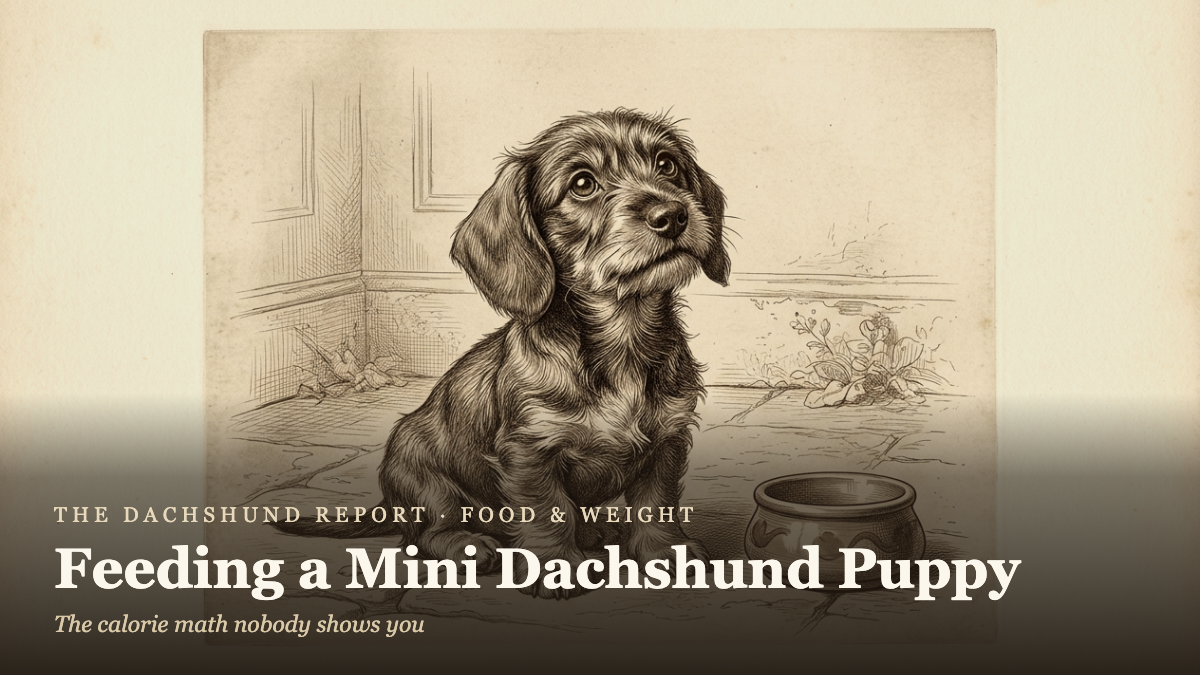
A miniature dachshund puppy under four months old needs roughly three times its resting energy requirement — about 265–390 calories per day depending on weight — split across four meals to prevent hypoglycemia. After four months, that drops to twice the resting energy, split across two to three meals. The breed's long back makes overfeeding a problem that compounds for life, so getting the math right now matters more than it does for most dogs.
You just brought home a miniature dachshund puppy.
Seven pounds of sausage-shaped confidence. Already owns the couch. Already rules the house.
And now you're standing in the pet food aisle, reading the back of a bag of puppy food that says "1/2 to 1 cup per day" — which is a pretty wide range when your dog weighs less than a housecat.
Here's the problem with those bag recommendations:
They're made for all puppies. Golden retrievers. German shepherds. Labs.
Your dog is a miniature dachshund. It will top out at 11 pounds. It has the metabolism of a hummingbird and the spine of a suspension bridge. What you feed it — and how much — in these first 12 months will shape its body for the next 12 years.
So let's actually do the math.
How Many Calories Does a Mini Dachshund Puppy Need?
Veterinary nutritionists use a formula from the Merck Veterinary Manual to calculate a puppy's daily energy needs:
Step 1: Calculate the Resting Energy Requirement (RER):
RER = 70 × (body weight in kg)^0.75
Step 2: Multiply by the puppy age factor:
- Under 4 months: RER × 3.0
- Over 4 months: RER × 2.0
Here's what that looks like for a miniature dachshund at each stage:
| Weight | Age | Daily Calories |
|---|---|---|
| 3 lbs (1.4 kg) | Under 4 months | ~265 kcal |
| 4 lbs (1.8 kg) | Under 4 months | ~330 kcal |
| 5 lbs (2.3 kg) | Under 4 months | ~390 kcal |
| 3 lbs (1.4 kg) | 4–12 months | ~175 kcal |
| 5 lbs (2.3 kg) | 4–12 months | ~260 kcal |
| 8 lbs (3.6 kg) | 4–12 months | ~370 kcal |
| 9–11 lbs (adult) | Adult | ~275–325 kcal |
Calorie calculations derived from Merck RER formula with puppy multipliers via PlainBowl.com breed charts. Ohio State University's Veterinary Medical Center notes that individual pets can vary by as much as 50% from calculated values — always adjust based on your puppy's body condition.
One thing you'll notice: a tiny puppy under four months actually needs MORE calories per pound than a bigger puppy over four months. That's because small-breed puppies have a higher metabolic rate per unit of body weight than large-breed puppies — they burn through energy faster.
Which brings us to something most puppy feeding guides skip entirely.
Why Hypoglycemia Is a Real Risk for Mini Dachshund Puppies
This is the part nobody talks about in the cute-puppy-photos version of this article.
Miniature dachshund puppies under three months old are in the weight range where hypoglycemia — low blood sugar — is a genuine emergency.
The Purina Institute explains it plainly: puppies under 12 weeks old "have not fully developed the ability to regulate blood glucose concentration." They can't store much glycogen in their tiny livers, and they burn through what they have fast.
Signs to watch for: sudden weakness, lethargy, muscle tremors, wobbly walking, and in severe cases, seizures.
This is why meal frequency matters so much in the early weeks:
| Age | Meals Per Day | Why |
|---|---|---|
| 6–12 weeks | 4 meals | Blood sugar can't be maintained on fewer meals at this size |
| 3–6 months | 3 meals | Liver glycogen storage is developing |
| 6–12 months | 2–3 meals | Most minis can handle twice-daily feeding |
| 12+ months | 2 meals | Adult schedule |
Schedule consensus from VCA Hospitals, Dachshund Club of America, and Purina Institute.
The Dachshund Club of America adds one more rule that dachshund parents in particular need to hear: "Dachshunds should always be fed on a schedule and never allowed to free feed. With their ravenous appetites they can easily become overweight."
If you've ever seen a dachshund puppy beg for food, you know why that rule exists. Those eyes were engineered in a German lab. They are lying.
Does a Mini Dachshund Puppy Need Small-Breed Food?
Yes, and here's what actually makes it different — because it's not just the kibble size.
The Purina Institute explains that small-breed puppy formulas are higher in calorie density per gram than standard puppy food. This matters because a miniature dachshund puppy's stomach is roughly the size of a walnut. It physically cannot eat enough standard-density food in a single sitting to meet its calorie needs.
The other differences: AAFCO growth profiles require puppy food to have a minimum 22.5% protein and 8.5% fat (versus 18% and 5.5% for adult food). Small-breed formulas push the fat and protein higher to pack more energy into less volume. And yes, the smaller kibble actually matters for a dachshund's narrow snout — it's not marketing.
When you're reading the bag, look for the statement "provides complete and balanced nutrition for growth" or "for all life stages." That AAFCO statement means the food meets puppy nutritional requirements. Even better: "animal feeding tests using AAFCO procedures substantiate..." — that means they actually fed it to real dogs and measured the results.
The brands vets recommend most often — and this is based on what Tufts University's veterinary nutritionists recommend, not affiliate programs:
- Royal Canin Dachshund Puppy — one of the few breed-specific puppy formulas; shaped kibble for the dachshund snout, calcium/phosphorus balance for joint support
- Hill's Science Diet Puppy Small Paws — DHA for brain development, smaller kibble
- Purina Pro Plan Small Breed Puppy — chicken-first, DHA, high digestibility
Tufts explains why they lean toward larger manufacturers: "Larger companies generally have more stringent quality control protocols, employ expert nutritionists and food scientists, and strive to increase our collective nutrition knowledge through research."
That's not glamorous. But when you're feeding a 3-pound puppy with a blood sugar problem, quality control isn't negotiable.
When Should I Switch My Mini Dachshund to Adult Food?
Miniature dachshunds hit full skeletal maturity earlier than big dogs. VCA Hospitals notes that small breeds typically reach it between 6 and 10 months — compared to 15–24 months for large and giant breeds.
The Dachshund Breed Council UK recommends switching between 9 and 12 months. Tufts says at least 12 months for all breeds.
My take: talk to your vet, but somewhere in the 9–12 month window is the sweet spot for most minis. And when you switch, do it gradually — mix increasing amounts of adult food with puppy food over 7–14 days to avoid digestive upset. Their stomachs are small enough that a sudden swap will make itself known on your carpet.
If you want to land on the right adult feeding amounts, I've already done that calorie math too.
Can Overfeeding a Dachshund Puppy Set Up Back Problems?
This is where the dachshund-specific research gets nuanced — and where most guides get it wrong.
You'll read everywhere that "overweight dachshunds get more back problems." And a 2013 Royal Veterinary College study of 700 dogs did find that overweight dogs were more likely to suffer disc extrusion.
But the larger DachsLife 2015 study — 2,031 dachshunds — couldn't replicate that finding. The Dachshund Breed Council UK is upfront about it: "We weren't able to replicate that finding in our 2015 survey."
So what's the honest answer?
The evidence that weight directly causes disc herniation is mixed. But the evidence that excess weight causes other serious problems is unambiguous:
- Overweight dogs have shorter lifespans across all 12 breeds studied
- Overweight dachshunds recover more slowly after IVDD surgery
- Heart disease, diabetes, and joint stress are all well-documented consequences of canine obesity
- Dogs in a JAVMA longevity study fed to ideal weight lived roughly two years longer
So even if the back-problems link is more complicated than "fat = IVDD," the weight you set in puppyhood shapes everything that comes after. An overweight adult dachshund started somewhere — and that somewhere was usually a bowl that was a little too full, a little too often, with the begging face winning a few too many treats.
The rib test works on puppies too: you should be able to feel the ribs easily without pressing, but not see them. Viewed from above, there should be a visible waist behind the ribs. Treats should stay under 10% of daily calories (UC Davis) — and for a puppy eating 260 calories a day, that's one small training treat, not a Milk-Bone buffet.
What About the 5-Minutes-Per-Month Exercise Rule?
You'll hear this one everywhere: "5 minutes of exercise per month of age." A 3-month puppy gets 15 minutes. A 6-month puppy gets 30.
It's a clean rule. Easy to remember.
It's also not backed by science.
The PDSA — UK's largest veterinary charity — explicitly says "there's no scientific evidence behind this rule." And a 2012 study of 500+ puppies found that what mattered more than duration was the type and surface of exercise: puppies walked on stairs before three months had higher hip dysplasia risk, while off-leash exercise on soft ground was actually protective.
For dachshund puppies specifically, the Dachshund Club of America says: "Use caution when exercising a puppy and gradually build up their activity level until it's a year old when its bones and muscles are more developed."
The real rule for dachshund puppies isn't a timer. It's common sense:
- Soft ground, not concrete. Grass over pavement.
- No stairs, no jumping on or off furniture. Ramps are your friend.
- Short, frequent walks are better than one long march.
- If the puppy stops and sits down, the walk is over. They're not being stubborn — they're done.
- Build up gradually. By adulthood, the DachsLife 2015 data shows that dogs who exercise more than an hour a day have significantly lower IVDD risk.
Your dachshund puppy doesn't need a fitness program. It needs to be allowed to grow into a strong adult — and not be wrapped in bubble wrap along the way.
FAQ
How much should a miniature dachshund puppy weigh at 8 weeks?
Most miniature dachshund puppies weigh between 2 and 5 pounds at 8 weeks. There's wide variation depending on the individual dog and its parents. By 12 months, a miniature dachshund should be 11 pounds or under per the AKC breed standard. Use the rib test rather than a number on the scale — every dachshund's frame is different.
Can I feed my mini dachshund puppy raw food?
The AVMA's official policy discourages raw diets for dogs because of the risk of bacterial contamination (Salmonella, E. coli) to both pets and the humans handling the food. The DachsLife 2015 survey found no statistically significant difference in IVDD rates between dogs fed complete diets, wet food, raw food, or any combination. For a puppy, the bigger risk is nutritional imbalance — homemade and raw diets are difficult to get right without a veterinary nutritionist.
Should I give my dachshund puppy supplements?
For most puppies on a complete and balanced puppy food — one that meets AAFCO growth profiles — additional supplements aren't necessary and can actually throw off calcium/phosphorus ratios during growth. The Dachshund Breed Council UK advises "a good quality, well-balanced diet that maintains ideal body condition" rather than supplements. If you want to learn more about what the evidence says once your dog is an adult, I've written a full guide to dachshund supplements.
When is a miniature dachshund fully grown?
Most miniature dachshunds reach their full adult weight by 10–12 months. Growth is fastest in the first six months, then slows significantly. Some may fill out slightly in the chest through 18 months, but the bones are done growing by about a year. This is earlier than large breeds, which is why small-breed puppies can transition to adult food sooner.
Free: The Dachshund Back Handbook
I put everything we know about keeping these long little backs strong into one free guide — the 8 early warning signs, the furniture setup, the weight math, how to pick up a doxie the right way, and the exact checklist I'd bring to a vet visit.
It's free, it's short, and it might be the most useful thing you ever read about your wiener dog.
Grab the free Back Handbook here
(Educational only — not veterinary advice. When in doubt, call your vet. Always call your vet.)